
Navigation & Maneuvering
Study Guide
What to Know About Navigation & Maneuvering on the Water
From Rules of the Road to anchoring and docking, it’s all covered here. See and hear examples of the navigation lights and sounds you’ll encounter when out on the water and learn more about some of the issues unique to inland boating like locks and dams. You’ll also find a comprehensive overview of Aids to Navigation including the size, shape, colors and meaning of different buoys you’re likely to see while boating.
Rules of the Road
Right of Way Rules
Whenever you meet another boat, it’s like approaching an unmarked intersection in your car. Knowing a few, simple right of way rules will help you avoid a collision. Just as motorists must know what to do when approaching a four way stop, every crossing situation at sea is like approaching an unmarked intersection.
Because there are so many different types of boats and styles of boating, it is important to know what to expect when you come upon another vessel.
“Vessels” are anything that floats on the water that is used, or is capable of being used as a means of transportation on water. A log, a bathtub and many other things could be considered a vessel under the Navigation Rules. The Navigation Rules distinguish one vessel from another by both its design, and by its actions. This section covers maneuvering rules only.
There are other navigation rules that you are required to know. Sound Rules are covered under the Sound Signaling Equipment section. Light Rules are covered under the Navigation Light Equipment section.
The Rules of the Road are published by the U. S. Government Printing Office, and are available in any boating supply stores. Every boat owner should have a copy, but they are mandatory to be kept on vessels over 12 meters (39.4 feet) in length.
The Rules generally used in this course are Inland Rules, unless otherwise noted. There are small but important differences in the Rules depending on where you are operating your boat. It is your responsibility to know the Navigation Rules for your boating area.
- International Rules – Apply to all vessels upon the high seas and in all waters connected to them that are navigable by seagoing vessels.
- Inland Rules – Apply to all vessels upon the inland waters of the United States, and to vessels of the United States on the Canadian waters of the Great Lakes to the extent that there is no conflict with Canadian law. Certain inland waterways may have specific provisions that apply to certain vessels.
- Great Lakes – Includes the Great Lakes and their connecting and tributary waters including the Calumet River as far as the Thomas J. O’Brien Lock and Controlling Works (between mile 326 and 327), the Chicago River as far as the east side of the Ashland Avenue Bridge (between mile 321 and 322), and the Saint Lawrence River as far east as the lower exit of Saint Lambert Lock.
- Western Rivers – Includes the Mississippi River, its tributaries, South Pass, and Southwest Pass, to the navigational demarcation lines dividing the high seas from harbors, rivers, and other inland waters of the United States, and the Port Allen-Morgan City Alternate Route, and that part of the Atchafalaya River above its junction with the Port Allen-Morgan City Alternate Route including the Old River and the Red River.
Vessel Types
- Power Driven Vessel – Any vessel propelled by machinery. This includes any boat that has an engine. Sailboats are considered powerboats when they are being propelled by a motor – even if the sails are up.
- Sailing Vessel – Any vessel under sail alone. Remember, if being propelled by a motor, a sailboat is considered to be a powerboat.
- Vessels Engaged in Fishing – Means any vessel fishing with nets, lines, trawls or other fishing apparatus which restrict maneuverability, but does not include a vessel fishing with trolling lines or other fishing gear which doesn’t restrict maneuverability. This means a shrimper out of Galveston is “engaged in fishing” Someone out trolling for stripers in their Grady-White is NOT considered to be engaged in fishing under the Rules.
- Seaplanes – Are any aircraft designed to operate on the water.
- Vessels Constrained by Draft – Means that a vessel can’t deviate from a course/channel because they might run aground. A freighter in a narrow channel is an example of this. Note: This is for International waters only, not Inland.
- Vessels Restricted in Their Ability to Maneuver – Means a vessel that can’t maneuver as required by the rules because of the size or operation of the vessel. A fishing vessel pulling in nets and a buoy tender placing a buoy are both examples of a vessel restricted in their ability to maneuver.
- Vessels not under Command – Any vessel that for some exceptional circumstance is unable to maneuver as required by the Rules, and is therefore unable to keep out of the way of another vessel. If Joe boater slips and knocks himself out, and can no longer steer–that’s a vessel not under command. If the steering cable goes out, and you can’t turn the boat, that’s a vessel not under command. If the captain is not paying attention and hits another boat, that’s negligence.
- Underway – Means that you are not anchored, moored, at the dock, or aground. If you are even drifting along, you are underway.
- Restricted Visibility – Means any condition such as fog, mist, falling snow, rain, or other similar causes that make it difficult to see other vessels. Losing your glasses is NOT restricted visibility.
Rule, Rule, Rule your Boat
It may seem as if you can do anything you want while you are on the water (You might also think that it looks as if everyone else is going crazy on the water). Boating on a crowded waterway can be scary! The good news is that there are rules to govern the action of each vessel. The bad news is that many vessel operators do not know the rules!
Not complying with the Rules – even if you don’t know them, can get you in trouble on the water. Even if you think you are following the Rules, if there is something that you can do to avoid a collision – you must do it, even if you deviate from a different Navigation Rule.
It is your responsibility as the ship’s captain to be aware of your surroundings at all times, and to operate your vessel in a safe manner. Caution may not be fun, but having an accident sure stinks.
The Rules state that every vessel shall use all available means appropriate to the prevailing conditions to determine if a risk of collision exists. If there is any doubt, such risk shall be deemed to exist.
Rules Explained
The Rules are designed to tell you what to do when you operate your vessel near other vessels. The purpose of the Rules of the Road is to help you avoid an accident–not to establish responsibility or liability if you get into an accident. – Remember, if you get into an accident, you can be held liable, even if you followed the Rules to the letter!
Your primary obligation is to operate in a safe manner. Under the Rules, there is no “right-of-way” like there is on a street. For most situations, Boats are called one of the following.
- Give-Way Vessel – If you are the Give-Way vessel, you must act as if the “stand-on” vessel has the right to keep going the way it is going. It is your responsibility to signal your intentions to the stand-on vessel, and it is your responsibility to maneuver your boat around the other in a safe manner. Also known as a “Burdened” vessel, as it has the burden of.
- Stand-On Vessel – If you are the Stand-On vessel, it is your responsibility to acknowledge the intended actions of the give-way vessel. You must also maintain your current course and speed until the give-way vessel passes, or you enter a dangerous situation.
Operator Responsibilities
In addition to the Rules, you have other responsibilities as the captain as well. You are responsible for the safety of everyone aboard your vessel at all times–and you have a responsibility to those with whom you are sharing the water.
- You must always operate at a safe controlled speed for the situation in which you are boating, and any legally mandated speed requirements that there may be, such as a slow/no wake zone.
- Take care to avoid careless, reckless or negligent boat operations–such as operating too closely to other vessels, boating under the influence, or operating at an unsafe speed for the given conditions.
- Steer clear of naval vessels, and other restricted facilities such as bridges, power plants and dams. New Homeland security measures require it, as does your safety! For more information, see the National Security pages.
Finally, as a boater, you have a responsibility to all other boaters–and all others who enjoy the water–to be courteous and respectful of others. This means that you should always watch your boat noise (a legal requirement) avoid congested waters as much as possible, avoid disturbing wildlife and sea grasses, and look out for the safety and well being of other boaters by giving a hand to those in need.
The Pecking Order
There is a “pecking order” that can be used as a simplified memory aid to determine right of way for vessels of different types. Get very familiar with this list, as it is important to understand it thoroughly. The lower most vessel on the list is the give way vessel, and must stay out of the way of vessels that are higher on the list.
- Overtaken vessel (top priority)
- Vessels not under command
- Vessels restricted in their ability to maneuver
- Vessels constrained by draft
- Fishing vessels engaged in fishing, with gear deployed
- Sailing vessels
- Power driven vessels
Collision Avoidance
- Rules apply to vessels in all conditions of visibility. Rules are the same at night or in fog, for instance, as they are during a bright sunny day.
- Every vessel must maintain a proper look-out by sight and hearing at all times. Operator inattention and not having an adequate look out are a leading cause of accidents each year.
- Every vessel must proceed at a safe speed at all times. Several factors should be considered when determining safe speed, including but not limited to the state of visibility, traffic density, your vessel’s maneuverability, with special reference to stopping distance and turning ability. At night, consider the presence of background lights such as those from shore, or from the back-scatter of your vessel’s own lights. Consider also the state of wind, sea, and current, and the proximity of navigational hazards.
- The Rules specifically require that any action taken to avoid collision, if the circumstances allow, will be positive, made in ample time, and in keeping with good seamanship. Any changes in course or speed should be large enough to be readily apparent to the other vessel. This means that you should avoid last second changes in course, and you should avoid a small series of changes. Change direction early, and make a large turn.
Maneuvering
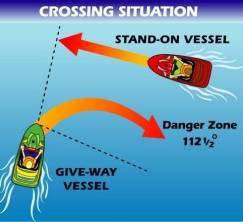
The main situations of collision risk are overtaking, meeting head-on, and crossing. When one of two vessels is to keep out of the way (give-way vessel), the other, the stand-on vessel, must maintain course and speed. The stand-on vessel must take avoiding action when it becomes apparent that the vessel required to give way is not taking appropriate action.
The Crossing Rule
Both International and Inland Rules state that when two power-driven vessels are crossing so as to involve risk of collision, the vessel which has the other on her starboard side (the give-way vessel) must keep out of the way.
As the give-way vessel it is your duty to avoid a collision. Typically, this means you must alter speed or direction to cross behind the other vessel (the stand-on vessel).
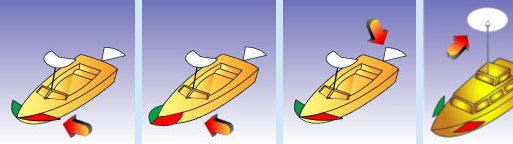
At night, if you see a red light crossing right-to-left in front of you, you need to change your course. If you see a green light crossing from left-to-right, you are the stand-on vessel, and should maintain course and speed.
The Meeting Situation
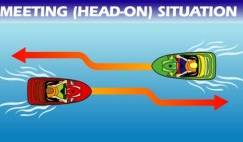
At times there may be some doubt whether the situation is a crossing or a head-on meeting. In case of doubt, you should assume that it is a meeting situation, in which neither vessel has a clear-cut “right-of-way,” and each must act to avoid the other. Each vessel in a meeting situation must alter course to starboard so that each will pass on the port side of the other. At night, you will recognize a head-on meeting situation if you see both red and green side lights at the same time.
The Overtaking Situation
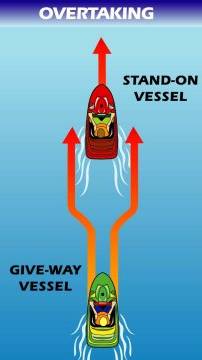
Any vessel overtaking any other vessel must keep out the way of the vessel being overtaken. The former is the give-way vessel and the latter is the stand-on vessel.
This rule applies even if the overtaking vessel is propelled by wind, oars, or rubber band paddlewheel.
A vessel is deemed to be overtaking when coming up with another vessel from a direction more than 22.5 degrees abaft (behind) her beam. This is the angle prescribed by the stern light.
At night, the overtaking vessel will see only the white stern light of the vessel being overtaken. If you see either side light, it is a crossing situation.
Operating in a Narrow Channel
First and foremost, you have to avoid larger vessels that can only travel in a channel. Even if your vessel is operating under the rules otherwise, you must give way to a boat that could potentially run aground or get into a collision if they left the channel.
Try and operate on the edge of the channel. Be extra cautious if you come to a bend in the waterway, and can’t see traffic coming towards you.
You may sound a prolonged blast as a warning to traffic headed your way.
On the Great Lakes and Western River system, vessels going downstream are stand-on, vessels going up stream must give-way.
Potential Collision Situation
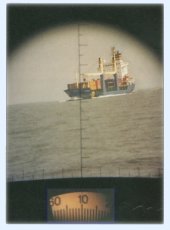
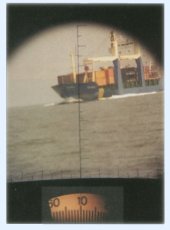
When the distance between two vessels decreases and the relative angle of the other vessel off the bow remains the same, then you will soon be trying to occupy the same spot in the water – a collision situation. Change course or reduce speed, even if you are the stand-on vessel.
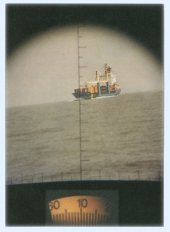
Conduct of Vessels During Periods of Restricted Visibility
Operating a boat in areas or at times of restricted visibility requires extra concentration by the skipper and the lookout. You must operate your vessel at a speed at which you can identify and react to a situation and still have enough time to avoid a collision. This is especially important when vessels are no in sight of one another.
- Operate at a safe speed for the prevailing circumstances
- Have engines ready for immediate maneuvering – including reverse
- Don’t rely on radar or other electronic imaging alone – use your buiilt in senses at all times
- Take avoiding actions early and provide ample time for the other vessels to maneuver
- Avoid sharp turns if being overtaken
- Always – you are in doubt, reduce your speed
- Every vessel shall at all times proceed at a safe speed
Other Rules
Whether under inland or international rules, power vessels must keep clear of sailing vessels in open waters. A sailboat with motor running is defined as a motor boat. The “pecking order” between sailing vessels is more complex. When two sailing are approaching one another so as to involve risk of collision, one of then shall keep out of the way of each other as follows.
- When each has the wind on a different side, the vessel which has the wind on the port side shall keep out of the way of the other.
- When both have the wind on the same side, the vessel which is to windward shall keep out of the way of the vessel which is to leeward.
- If a vessel with the wind on the port side sees a vessel to windward and cannot determine with certainty whether the other vessel has the wind on the port or the starboard side, she shall keep out of the way of the other.
- For the purposes of these rules the windward side shall be deemed to be the side opposite to that on which the mainsail is carried. On square-rigged vessels, it shall be deemed to be the side opposite to that on which the largest fore-and-aft sail is carried.
Practice
Now that you are familiar with “The Rules,” go out and use them in passing, meeting, and crossing situations you find on the water. You will get many puzzled looks from inexperienced boaters with no training or testing.
Remember, if a collision does occur, your proper use of the correct signals and appropriate actions will win you points! But you know enough now to avoid a collision.
The navigation rules of the road contained in this course summarize basic navigation rules for which a boat operator is responsible. Additional and more in-depth rules apply regarding various types of waterways and operation in relation to commercial vessels and other watercraft. It is the responsibility of a boat operator to know and follow all the navigation rules.
For a complete listing of the navigation rules, refer to the document “Navigation Rules of the Road” published by the U.S. Coast Guard (COMDTINST 16672.2 Series) and available through the U.S. Government printing office or on the web here.
For state specific navigation requirements, refer to the state laws where you intend to boat.
Navigation Lights
You are required to display the appropriate lights at night or during times of reduced visibility.
Navigation lights are used to prevent collisions at night or in times of reduced visibility, and are an essential tool in keeping you and your vessel safe. Nav lights allow you to see other nearby vessels, and allow other vessels to see you.
Nav lights also provide information about the size, activity, and direction of travel. By understanding the characteristics of Nav lights, you can determine an appropriate course of action as you approach another vessel.
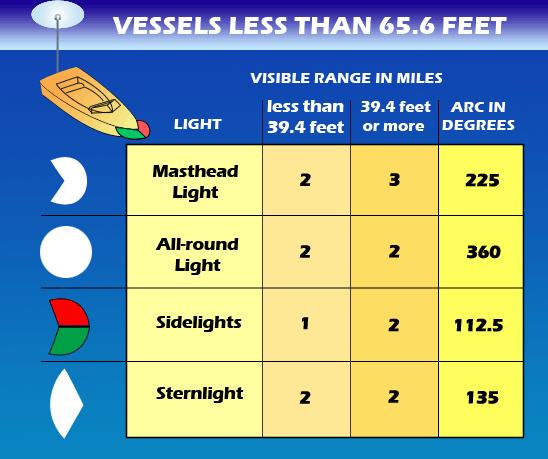
On any vessel, navigation lights have a specific color, (white, red, green, yellow, blue), arc of illumination, range of visibility, and location, as required by law and regulations. For the purposes of this course, we will concentrate on pleasure boats under 65 feet in length. Knowledge of navigation lights is important to a small-boat skipper for separate, but important, reasons.
- You are legally responsible for displaying lights of the proper color, intensity, location and visibility on your boat.
- You are required to display the appropriate lights at night or during times of reduced visibility.
- Knowing the type and heading of another boat.
Legal Requirements
Vessels are required to show the proper navigation lights from sunset to sunrise in all weather conditions, good and bad. During these times, no other lights that could be mistaken for lights specified in the Rules of the Road can be displayed, nor any lights that impair the visibility or distinctive character of navigation lights, or interfere with the keeping of a proper lookout. The Rules also state that navigation lights must be shown in conditions of reduced visibility, and may be shown at other times considered necessary.
It’s Your Responsibility
It is the responsibility of the owner/operator of a vessel that she show the proper navigation lights for her size and the waters in which she is operating. It is not the responsibility of the manufacturer, importer, or selling dealer. Many boats are delivered with lights that do not meet legal requirements with respect to technical characteristics or placement on the vessel. Remember also, that the angles of visibility must be met when the boat is underway-if your boat rides at a significant bow-up angle, take that into consideration when installing and/or checking your lights.
Navigation Lights for Powerboats
Power driven vessels underway shall exhibit a masthead light forward, sidelights and a stern light. Vessels less than 12 meters in length may exhibit an all around white light and side lights. Power driven boats on the Great Lakes may carry an all around white light in stead of a second masthead light and stern light combination.
Sidelights – Colored lights – red on port and green on starboard – showing an unbroken arc of the horizon of 112.5 degrees, from dead ahead to 22.5 degrees abaft the beam on each side.
Combination lights – Sidelights may be combined in a single fixture carried at the centerline of the vessel.
Stern light – A white light showing over an unbroken arc of the horizon of 135 degrees, centered on dead astern.
Navigation Lights for Sailing
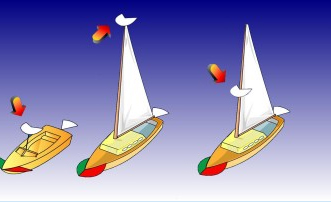
A sailing vessel of less than 7 meters in length shall, if practicable, exhibit regular navigation lights, but if not practical, she shall have ready at hand an electric torch or lantern showing a white light which shall be exhibited in sufficient time to prevent collision.
Diving Lights
Another light display that you may see in resort areas, or waters that have wrecks or reefs, is the night diving configuration. This has three vertical masthead lights, that have a red-white-red sequence. You must maintain a good distance from these vessels, and you should also be aware that there may be divers near you.
Interpreting what you see

It’s great that you’re learning the basics of lights – what is required and when they’re required. But, this in only the beginning. You must also learn how to interpret the navigation lights that you see when you are underway at night- and for your safety-learn it well.
For instance, if you see a vessel approaching that shows a light pattern such as the ones to the right, you immediately know that you are in a crossing situation, and that you must yield to the other vessel – that’s why it is red.

Seeing a green light over a white light indicates a fishing vessel actively trawling. You not only need to avoid the vessel, but you also need to remember that it could potentially have a very large net deployed that you will also need to avoid.
And there are numerous other lights and combinations of lights that you must be able to instantly recognize – the lights for a sailboat that is privileged over a motorboat, the special lights of various fishing vessels, a dredge or a vessel not under command. Study the requirements for navigation from the viewpoint of a “looker” as well as a boat owner.
Navigation Sounds
Just as lights play a significant role in understanding what other boats are doing, so do sounds. Understanding what you hear is another step towards being a “complete mariner.” Virtually every boat is required to have some sound producing device. There is a great deal of latitude in what type of sound making device you choose, but loud is good!
Legal Requirements
Equipment for Sound Signals is based on the length of your boat as follows.
- Boats less than 39.4 feet in length – must carry an efficient sound producing device. In general, this may be a bell, whistle, or air horn. Though guns–even pots and pans–can make a suitable sound signal useful in getting attention in an emergency, you should always carry the appropriate equipment.
- Boats at least 39.4 feet to less than 65.6 feet in length – Must carry a whistle and a bell. The whistle must be audible for 1/2 nautical mile. The mouth of the bell must be at least 7.87 inches in diameter.
When and How to Sound Off
Sound signals are to be used only when vessels are in sight of each other and are meeting or crossing at a distance within half a mile of each other. These signals must never be used in fog or other conditions of reduced visibility, where the vessels are not visible to each other by eye. Only the fog signals listed under the Inland Rules, Rule 35 may be sounded at such time.
Signals
Sound signals are called “blasts”. There are two different blasts used for warning and steering signals.
- Short Blast – Lasts about one second.
- Prolonged Blast – Lasts from four to six seconds.
Maneuvering Signals
There are different blasts combinations for various movements on the water that may use both short and prolonged blasts. When power-driven vessels are in sight of one another and meeting or crossing at a distance within half a mile of each other, each vessel underway, when maneuvering as authorized or required by the Inland rules must use the following sound signals.
- One Short Blast – This means “I intend to leave you on MY port side”. When you pass near another boat, you will manuever by leaving them on your left side as you pass. If you are behind another boat, going the same direction and about to overtake it, one short blast means: “I intend to pass you on YOUR starboard side, MY port side”.
- One Prolonged Blast – This means you are leaving a dock or departing your slip. It signals to others a change in status and that you are getting underway. A prolonged blast is also sounded when a vessel is approaching a bend in a river where vessels coming from another direction cannot be seen. It is sometimes referred to as the “blind bend signal”.
- Two Short Blasts – This means “I intend to leave you on MY starboard side”. When you pass near another boat, you will manuever by leaving them on your right side as you pass. If you are behind another boat, going the same direction and about to overtake it, two short blasts means: “I intend to pass you on YOUR port side, MY starboard side.”
- Three Short Blasts – This means you are operating in astern propulsion, for example backing away from a dock
- One Prolonged Blast + Three Short Blasts – This is technically two different signals in succession. One prolonged blast indicates you are getting under way, and three short blasts indicate you are backing up. This is what is sounded when you are departing a dock in reverse.
- Five Short Blasts – This is the DANGER signal. Remember, that when you approach another vessel and hear either one or two short blasts, and you both understand their signal and can safely let them do it, then you are required to respond with the same signal in response. However, if you don’t understand their intentions, or feel that their proposed maneuver is dangerous to either vessel, then you are required to sound the DANGER signal.
Note: Inland Rules regarding sound signals are occasionally different from International Rules. Inland Rules signal intended action and International Rules signal what you are actually doing. The following information reflects Inland Rules. If you travel overseas, you must learn the International Rules.
Proper Sound Signals
Passing Port to Port
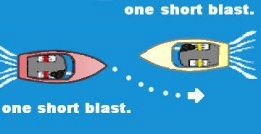
When you meet an oncoming vessel, and wish to pass port to port, you are required to sound one short blast with your horn. If the other boat is in agreement, they should respond with a similar blast.
Passing Starboard to Starboard
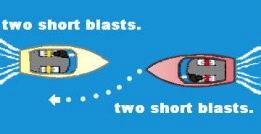
If you approach another vessel head on, and wish to pass it on its starboard side, you are required to sound two short blasts with your horn. If the other vessel is in agreement, they should sound the same signal in response.
Overtaking on Portside
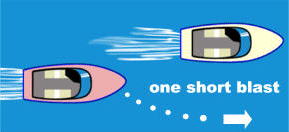
When you are planning on passing another vessel from behind, there are several things you must do. Any vessel that is overtaking another must keep out of the way of the vessel being overtaken. This means that you can’t expect them to move, slow down, or change their course. If you plan on passing them on THEIR starboard side, you must sound one short blast. If they understand your signal and agree, they will sound one short blast in response. The vessel being overtaken has a responsibility to maintain course and speed in order to minimize the potential for collision.
Overtaking on Starboard
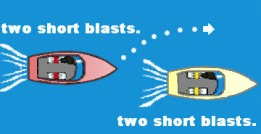
When you are planning on passing another vessel from behind, there are several things you must do. Any vessel that is overtaking another must keep out of the way of the vessel being overtaken. This means that you can’t expect them to move, slow down, or change their course. If you plan on passing them on THEIR PORT side, you must sound two short blasts. If they understand your signal and agree, they will sound two short blasts in response. The vessel being overtaken has a responsibility to maintain course and speed in order to minimize the potential for collision.
Note: These are not the only rules concerning sound signals in restricted visibility; there are additional rules concerning sound signals that may be found in the Rules of the Road or in Chapman’s Piloting.
Aids to Navigation
Navigation Aid Basics
Unlike the roads and highways that we drive on, the waterways we go boating on do not have road signs that tell us our location, the route or distance to a destination, or of hazards along the way. Instead, the waterways have AIDS TO NAVIGATION (or ATONs), which are all of those man-made objects used by mariners to determine position or a safe course.
These aids also assist mariners in making a safe landfall, mark isolated dangers, enable pilots to follow channels, and provide a continuous chain of charted marks for precise piloting in coastal waters. The U.S. Aids to Navigation System is intended for use with nautical charts, which provide valuable information regarding water depths, hazards, and other features that you will not find in an atlas or road map.
The term “aids to navigation” includes buoys, day beacons, lights, lightships, radio beacons, fog signals, marks and other devices used to provide “street” signs on the water. Aids To Navigation include all the visible, audible and electronic symbols that are established by government and private authorities for piloting purposes.
The Coast Guard is the agency responsible for maintaining aids to navigation on U.S. waters that are under federal jurisdiction or that serve the needs of the U.S. armed forces. On bodies of water wholly within the boundaries of a single state, and not navigable to the sea, the Coast Guard grants the state responsibility for establishing and maintaining aids to navigation. The U.S. Corps of Engineers is responsible for many of the canals, dams, locks, and other man-made waterways in the country. The Corps also is responsible for the regulation of mooring buoys in all navigable U.S. Waters.
The individual Coast Guard districts also may grant permission to private groups and citizens to place “Private” Aids to Navigation. These aids allow individuals or organizations the ability to mark privately maintained channels, zones or waterways. These aids must be pre-approved, and must be maintained by the individual or organization.
Types of Aids to Navigation
The term “aids to navigation” encompasses a wide range of floating and fixed objects (fixed meaning attached to the bottom or shore), and consist primarily of:
- Buoys – floating objects that are anchored to the bottom. Their distinctive shapes and colors indicate their purpose and how to navigate around them.
- Beacons – structures that are permanently fixed to the sea-bed or land. They range from structures such as light houses, to single-pile poles. Most beacons have lateral or non-lateral aids attached to them. Lighted beacons are called “LIGHTS”, unlighted beacons are “DAYBEACONS”.
Both Buoys and Beacons may have lights attached, and may have a sound making device such as a gong, bell or horn. Both Buoys and Beacons may be called “marks”.
Caution: Do not count on floating aids to always maintain their precise charted positions, or unerringly display their characteristics. The Coast Guard works constantly to keep aids on station and functioning properly, but obstacles to perfect performance are so great that complete reliability is impossible. Only use floating aids for use as a navigation fix when you cannot see a fixed point of reference.
Aids to Navigation Systems
Depending on where you boat in America, you may see several differences in how navigational marks are colored, numbered, or lighted. Regardless of the location, buoys and beacons are placed in very specific locations, to mark either a particular side of a waterway, or some other navigational feature. The primary system in use is referred to the “U.S. Aids to Navigation System”. The U. S. Coast Guard maintains this system in conformance to the International Association of Lighthouse Authorities (IALA), which is an international committee which seeks to ensure safe navigation, primarily through the use of common navigation aids and signals.
The “LATERAL” system is the familiar RED RIGHT RETURNING system, meaning that on all navigable waters returning from sea, the red even-numbered marks are on the starboard (right) side of the channel and the green odd-numbered marks are on the port (left) side of the channel. Numbers on the marks ascend when traveling from sea to harbor–if you don’t have a compass and become disoriented on the water, you will always know you are heading upstream if the buoy numbers get larger as you travel.
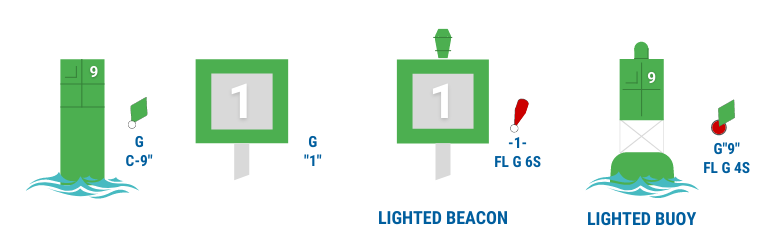
Port Side Odd Numbered Aids
Port side numbered aids are green in color, odd numbered and may be lighted. Port side marks are located on the left side of the waterway as you travel upstream, and the buoy numbers will increase as you head upstream. (Chart depictions are shown next to the marks) Port-Side Buoys have a cylindrical above-water appearance, like a can or drum floating on its axis. Commonly referred to as “CAN” buoys. Beacons – Port side beacons have square marks attached to them, with two shades of color and a reflective border.
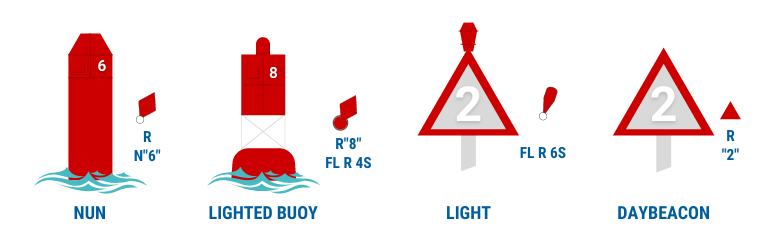
Starboard Side Even Numbered Aids
Starboard aids are red in color, evenly numbered and will be on your right side as you travel upstream. Buoy numbers increase as you head upstream, and may have a red light. Starboard-side buoys have an above-water appearance like that of a cylinder topped with a cone, pointed end up. The cone may come to a point or be slightly rounded. Commonly referred to as “NUN” buoys. Starboard-side Beacons have triangular marks attached to them, with two shades of color and a reflective border.
Intracoastal Waterway
For the sea buoys that delineate channels off the coast of the United States, and for the Intracoastal Waterway (ICW), red is on the right (shore side) when proceeding clockwise around the U. S. from the East Coast to the Gulf Coast, or proceeding north along the West Coast.
ICW marks are further identified by a small yellow reflector at the bottom of the mark. The same port and starboard marks shown above will look like the following.
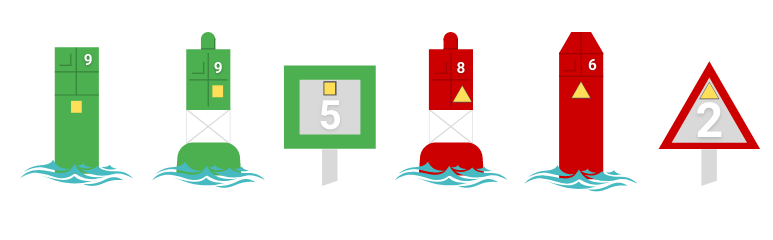
Numbers on the marks ascend when traveling in this direction. Where the IALA-B and ICW marks meet, one must be very careful to observe the change in meaning by referral to local charts.
Other Aids – Marks
Dayboards
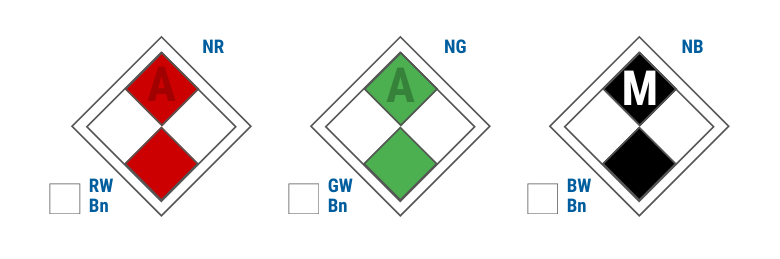
These diamond shaped marks are used to help the vessel operator determine location on a nautical map. When you see a dayboard, and find the corresponding mark on the chart, you know your precise location. They may be lettered, and may be lighted with a white light. Their color reflects that of nearby lateral marks.
Safe Water Marks
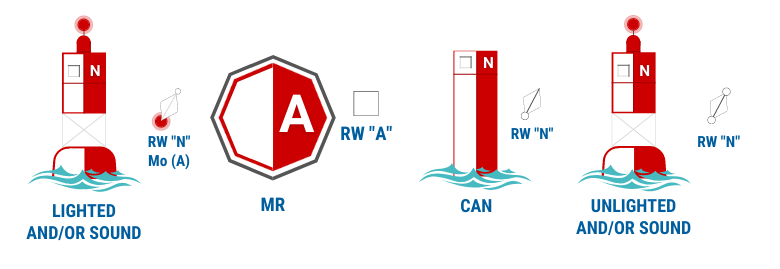
These marks are used to mark fairways, mid-channels, and offshore approach points. They have unobstructed water on all sides. These marks may be lettered, and may be lighted with a white light. They may also have a red top mark.
Isolated Danger Marks
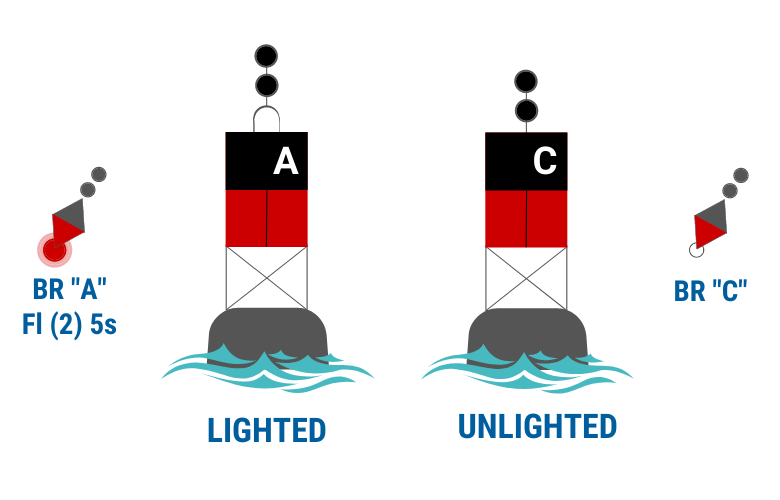
These indicate a danger which may be passed on all sides. They are erected on, or moored on or near danger. They should not be approached closely without special caution. They may be lighted, and they may be lettered.
Special Marks
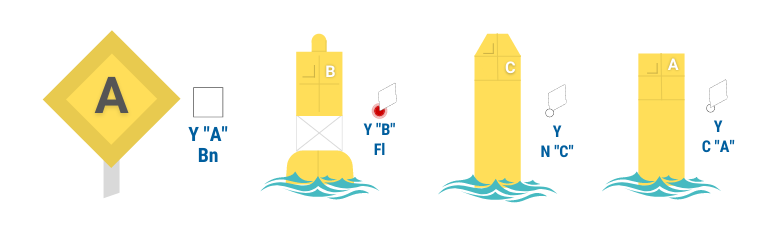
Special marks have no lateral significance (meaning they don’t tell you which side of the channel or river you may be on). These marks are used to mark a special feature or area. These include area limits for anchorages, fishing grounds, or dredging/spoil areas. These buoys may be lighted, and if they are it will be a fixed or flashing yellow light. Shape is optional, but usually follows the shape of the navigation buoys that it is positioned near.
Other Aids – Miscellaneous
Mooring Bouys
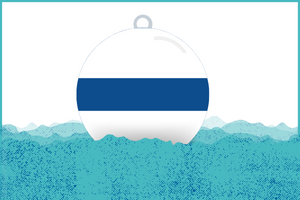
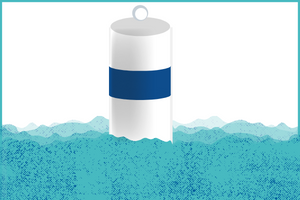
Mooring buoys come in two different shapes; spherical and cylindrical. Both have white bodies with a solid blue horizontal band on the center of the buoy. Mooring buoys may have a white reflector, or a white light attached to them. Mooring buoys are the ONLY buoys to which you may legally tie your boat. Buoys are generally placed in marked anchorage areas, and you must take caution if you are traveling near buoy areas. Check your state boating guide for particular operating restrictions in anchorage areas.
Ranges
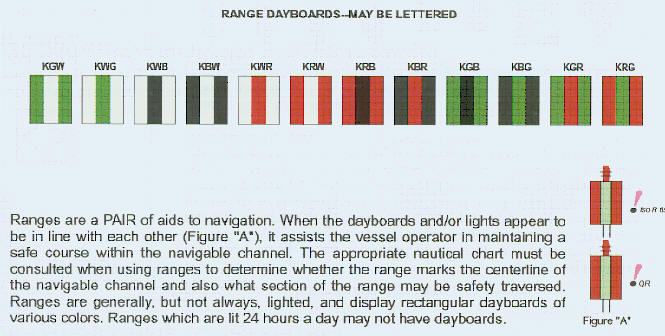
These are pairs of unlighted or lighted fixed aids that when observed in line show the pilot to be on the centerline of a channel.
Regulatory Marks
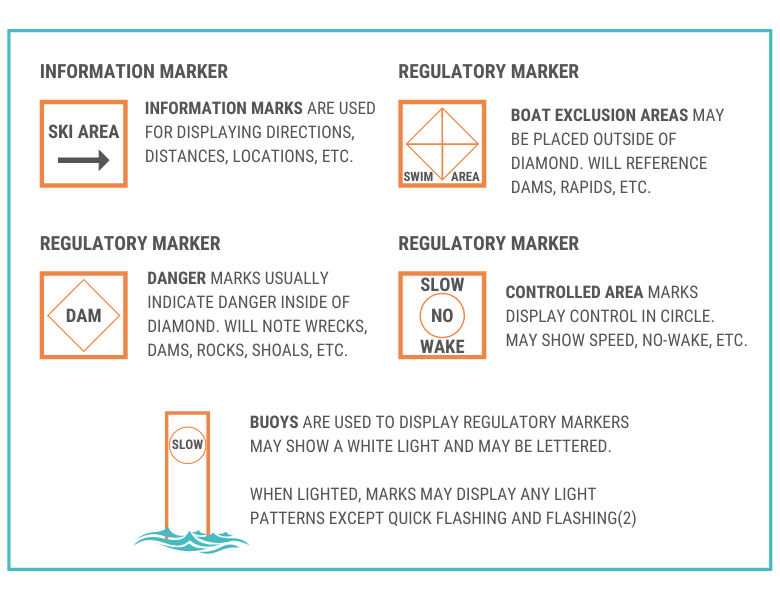
Regulatory Marks re designed to assist boaters by informing them of special restrictions or dangers that they are approaching. Regulatory marks are white “can” buoys that have an orange shape on them. The mark will give either a warning or instructions on how to proceed. The shape determines what type of mark it is.
- An open diamond shape signifies danger.
- A diamond with a cross in it signifies an exclusion area that you may not enter.
- A circle indicates an upcoming operating restriction, such as a speed limit.
- A square or rectangular shape is used for conveying instructions.
Uniform State Waterway Marking System
This system was originally intended for use by states on lakes and inland waterways that weren’t covered by nautical charts. The buoys used in the Uniform State Waterway Marking System (USWMS) used colors, shapes and marking patterns that differed greatly from the U.S. Aids to Navigation System (ATONS).
In 1998, the U.S. Coast Guard decided to phase out the USWMS to avoid potential confusion of boaters and instead, favored using the more widely recognized ATONS. By 2003, the USWMS was completely phased out. Below are a few of the differences from the federal system you should know about.
Here’s a summary of the important changes regarding the phase out of USWMS:
- The old USWMS black port side channel markers are now GREEN can buoys.
- The old USWMS red starboard side channel markers are now red NUN buoys.
- The old USWMS red and white vertically striped buoys have been replaced by one of the following: a red or green channel marker directing safe passage, an orange and white regulatory marker, or a red and black isolated danger marker.
- The old USWMS white buoys topped with black or red bands, have been replaced by one of the following: a red or green channel marker directing safe passage, an orange and white regulatory marker, or a red and black isolated danger marker.
Lateral Aids
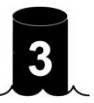
The state system differs in several ways, in case you happen to encounter them. These aids also assist mariners in making a safe landfall, mark isolated dangers, enable pilots to follow channels, and provide a continuous chain of charted marks for precise piloting in coastal waters. The U.S. Aids to Navigation System is intended for use with nautical charts, which provide valuable information regarding water depths, hazards, and other features that you will not find in an atlas or road map.

- Buoys are placed in pairs, and you pass between them.
- State buoys do use the color red for starboard side marks, but they are cans, and not nuns, while port buoys are black and can-shaped.
- Numbers on buoys go up as you head upstream, or towards the head of navigation.
- Portside buoys use the color black instead of green.
- Portside buoys are numbered with odd numbers.
- Portside buoys may show a green reflector or light.
- Starboard side buoys are red.
- Starboard side buoys are numbered with even numbers.
- Starboard side buoys may show a red reflector or light.
Other State Aids
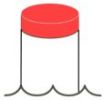
Red-topped White Buoys
- Signify that you may pass south or west of buoy
- May be numbered
- May show a white reflector or light

Black-striped white Buoys – Inland Waters Obstruction Mark
- Signify that you should not pass between mark and nearest shore
- May be lettered
- May show white reflector or light
- Replaces the old red and white vertically striped buoy
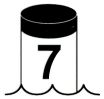
Black-topped White Buoys
- Signify that you may pass east or north of buoy
- May be nubered
- May show white reflector or light
Anchoring & Mooring
With so much investment literally riding on your anchor, your boat’s anchoring system is no place to cut corners. Your choice of anchor depends on the size and type of your boat, and the weather and anchoring conditions you generally encounter.
Boats with heavy displacements or superstructures that present a great deal of wind resistance need heavier gear. The same is true of cruising yachts that brave a wide variety of conditions and may sometimes have to anchor in open waters.
Although not required by Federal Law, it is recommended you carry one anchor of sufficient size and strength to hold your boat for an extended period, like overnight–or in an emergency situation, such as if you run out of gas. When you are thinking or buying an anchor – BIGGER IS BETTER.
Also, there is safety in numbers. No anchor will work for you in every situation, so if you have space carry two anchors–preferably of different types.Many people choose to carry a small anchor, or “lunch hook”, and a larger working or storm anchor. The lunch hook is for use in calm weather and when the crew is monitoring the anchor. Working and storm anchors are useful at times when the crew is asleep or ashore, and during heavy weather, when winds are 30 miles an hour and over.
The general name for all of the equipment you need to anchor your boat is “ground tackle”. This includes an anchor, chain, line and connecting elements. The anchor line, including chain, is called the rode.
Playing Hooky
Just as boats come in a wide variety of shapes and sizes, so do anchors. Choosing an anchor is easy, choosing the right one for your boat can be very difficult. Your first task in choosing an anchor is to have an understanding of three things:
- Your Boat – Your boats’ size, weight and design characteristics affect what kind of anchor you will need to use. For instance, a 30 foot 10,000 pound houseboat needs a larger anchor than a 30 foot 6000 pound speedboat.
- Where You’re Going – Where you plan to anchor often dictates what type of anchor you should use. Is the bottom rock, or is it soft mud? If you are not familiar with the area, ask around or look at a local chart.
- Local Conditions – Anchoring in a calm protected cove can be quite different than anchoring offshore or on a large open bay. And don’t forget the weather–high winds, tides and waves can all make anchoring difficult, if not impossible.
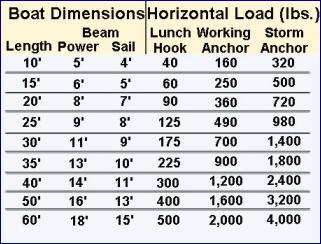
Anchors are rated by “holding power”–which is the ability of an anchor to hold a given weight. Keep in mind that a 10,000 pound boat may only require an anchor with a holding power of a few hundred pounds on a calm day, but may need 1,000 pounds of holding power or more on a stormy day.
Anchor Types
There are several types of anchors and you should choose a style based on the bottom characteristics in the areas you will anchor most often. Then, choose a size based on the size and weight of your boat.
Lightweight or “Danforth” Anchors
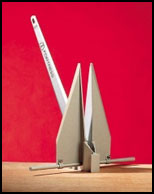
Lightweight type anchor with two long pivoting “flukes”; designed to reduce clogging with mud and grass; range from 2.5 pounds to nearly 200 pounds, and are generally made of cast galvanized metal, though some models are machined from a light-weight aluminum composite. When dropped, flukes dig the anchor into the bottom and the anchor buries itself and part of the anchor line.
Commonly used on small recreational boats, as they are relatively light weight for the amount of holding power they provide, especially in comparison to other anchors. Best in hard sand or mud, where flukes can easily dig into the bottom.
Not recommended for very soft or loose mud, which can ball up around the flukes; or on rocky bottoms where the flukes cannot penetrate. Also not recommended for grassy bottoms, which the flukes tend to slip off.
Kedge or Navy Anchors
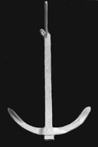
A more traditional style anchor with arks, flukes and stock. Good in heavy grass, weeds, rocky bottoms or hard sand where one arm can penetrate a crevice. Not good in mud or loose sand, where flukes can’t dig in.
Functions differently than previous anchors as it is not a burying anchor; one arm digs into bottom and one lies exposed. Generally only used by very large ships, as it relies on weight for most of the holding power; not really suitable for recreational use other than for a lunch hook.
Grapnels Anchors
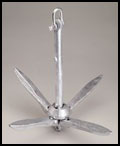
Very inexpensive, but not much holding power. Some models are made of bent re-bar, others are made of galvanized metal and have folding flukes. Good for recovering items on the bottom, or for wreck reef anchoring. Commonly used on very small boats such as canoes or jon boats.
Plow or “CQR/DELTA” Anchors
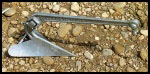
The plow styles’ good holding power over a wide variety of bottom types makes it a top choice of cruising boaters. Has either a fixed (Delta style) or a pivoting (CQR) shank.
When dropped in the water, a plow lands on its side, then when pulled, buries itself. Its shape allows it to reset fairly easily should the wind or tide shift the boat position.
Great in sand and on rocky bottoms, weeds and grass. Does not do well in soft bottoms. Generally made of galvanized metal, though they are available in stainless steel.
Claw or “BRUCE” Anchors
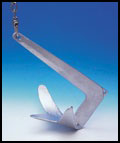
Unique shape of the claw allows a 360 degree turn without breaking out. Has similar performance to plow anchors,at a lower weight.
Sets just like a plow, but curved flukes make it easier for a claw to right itself no matter how it lands on the bottom, or how much the boat gets swung around.
Mushroom Anchors
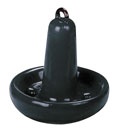
Mushroom anchors get their name from, as you might imagine, their rounded, mushroom shape. Mushroom anchors are used extensively for moorings, and can weigh several thousand pounds for this use.
The shape works best in soft bottoms, where it can create a suction that can be difficult to break. Decent for very small boats to use as a lunch hook, but not practical for larger boats. Both Buoys and Beacons may have lights attached, and may have a sound making device such as a gong, bell or horn. Both Buoys and Beacons may be called “marks”.
Line and Gear
Depending upon the size and type of your boat, and where you anchor–your choices for an anchor line are either an all-rope anchor rode, a combination of rope and chain, or all chain.
Nylon Line in Three-Strand Twist
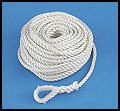
Three-strand line can absorb shock and the constant tugging associated with anchoring much better than braided line or chain alone. Chain may also be used, especially in anchorages that are primarily rock or coral, which may cut a nylon line. A length of chain should be used between the anchor and a longer length of line. The chain will add weight to set your anchor without making it too heavy to lift manually, while serving to exert a horizontal pull on the anchor to set it.
Nylon Three-Strand line is the leading choice for use as an anchoring line. Lines generally come in a “soft” or “medium” lie. Soft lines are generally softer to the touch, and loosely woven. These aren’t as good as medium or hard lines for anchoring, as they are more prone to unraveling and chafing. Tightly wrapped lines are the best choice for anchoring.
Lines that have been treated with a wax-like coating are available. These lines help the line resist water/salt absorption. To help keep your lines in good shape, clean them from time to time by soaking them in soapy water. Never use bleach, as it can break down the line.
Chain
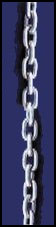
Chain may be used instead of nylon line for anchoring. Chain has several benefits, including added weight, chafe and wear resistance, and high strength. It also lowers the angle of pull on the anchor, which helps it to set more firn\mly into the bottom.
Chain is generally found made of galvanized steel, though you can find stainless steel and vinyl coated chain, which is designed to be non-marring to your deck.
Chain comes in three general varieties: “Proof Coil” is the most common, and is adequate for most marine uses. “BBB” (“Triple B” or “3B”) chain has thicker, shorter links than proof chain. BBB is slightly stronger than proof chain, and is generally used for windlasses. Finally, “Hi-Test” chain is made of hardened steel, and is stronger and lighter than proof coil. Hi-test chain is favored by those wishing to avoid carrying too much weight.
Nylon Line in Three-Strand Twist
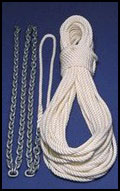
Combination anchor-rodes consist of both chain and nylon line. You may buy a combination rode, or you may make one yourself. Generally, it is recommended to have either one foot of chain for each foot of boat length, or to have one pound of chain for each pound of anchor length. Which ever method you choose, having more chain than necessary is never a bad idea.
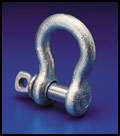
As the saying goes, a chain is only as strong as its’ weakest link…Make sure that your anchor and line are attached to each other with adequate gear. Some lines come with plastic thimbles or eyes–but metal, either marine-grade stainless steel or hot-dipped galvanized steel, is best. Swivels and shackles should be inspected regularly for wear, and to ensure that the connections are tight and functional.
Scope
Scope: Length of the anchor line/ height of the deck cleat to the sea bed.
Before leaving the dock, you will need to determine how much anchor line, or “rode”, you will need. It is recommended that you use a scope of 7:1, meaning that for every foot of water depth, you should use 7 feet of rode.
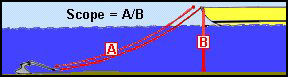
For example, to anchor in 10 feet of water, you would pay out 70 feet of line. Measure the scope as the ratio of the length of the anchor rode to the height of the bow above the bottom. If you’re using a lightweight anchor on a small boat in good weather conditions, a shorter scope of 5:1 is sufficient and safe. A prudent boater always has extra line and chain on hand, just in case.
Minimum Working Rode Sizes
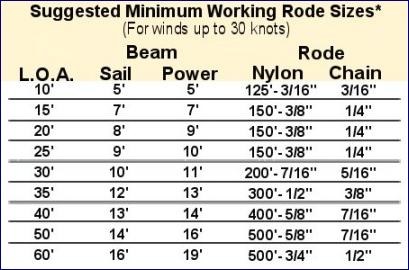
Suggested holding sizes assume fair holding ground, scope of at least 5:1 to 10:1, and moderate shelter from high seas.
Boats that operate generally in shallow waters, as on the East Coast of the United States, may get by with shorter rode lengths. As the wind picks up, deploying additional line will help maintain position, as will tossing out an extra anchor.
Setting Anchor
Anchoring can be accomplished quickly and easily by following a few simple steps.
- Check your chart for bottom characteristics and to determine that you are anchoring in a safe and allowable place. If there are rocks, shoals, reefs or other boats to consider, give them all as wide a berth as possible. Remember that other boats will often have different requirements for anchor rode length–larger or taller boats frequently need a great deal of rode. Also, keep in mind a possible swing of 360 degrees about the anchor with wind shifts or current changes.
- If your crew is not already wearing PFDs, have them put one on before going forward to set or retrieve an anchor or mooring.
- Secure the bitter end of the anchor line to a bow cleat. Make sure the line is ready to run free once tossed overboard.
- Head into the wind or current. Reduce speed and reverse the engine. When the boat starts to make a slight sternway through the water, lower – do not throw – the anchor.
- After you’ve let about a third of your line out, tug the anchor line to see how firmly it’s set, and then continue to release the rode.
- Once you let out an appropriate amount of scope, make sure the line is properly tied off on the bow cleat.
- Even if anchoring only in designated anchoring areas, it is always prudent to have the appropriate signal such as an all-around white light on to notify other boats that you are anchored at night. During the day you must display a ball shape which is sized according to the size of your boat.
Staying Put
It’s a good idea to take two immediate bearings. Select two items, one off each beam, that form a natural range and watch for any changes in their relationship. You can check these later to determine if you’re boat is swinging as expected or if you’re dragging anchor.
Picking Up a Mooring
One of the best ways to avoid the hassles of anchoring is to chose a cove or harbor with moorings available for your use. Mooring balls are identified by their white spherical or can shape, and having a blue horizontal band. It may have a number designation, a VHF contact # or name on it. You will typically have to pay a small fee to the harbor master to use a public mooring, but you can count on it being far cheaper than paying for dockage for the night.
Public moorings are professionally maintained and will use a large anchor or helix screw fixture to maintain position. The harbor master will let you know if the weight or length of your boat is too big for that particular mooring. Although moorings are typically more secure than anchors, moorings can and do periodically give way. For this reason, and for the obvious courtesy reasons, you should never pick up and use a mooring that does not belong to you.
Lines that have been treated with a wax-like coating are available. These lines help the line resist water/salt absorption. To help keep your lines in good shape, clean them from time to time by soaking them in soapy water. Never use bleach, as it can break down the line.
WATCH OUT
Common Anchoring Mistakes
- Letting the anchor go with out securing the line to the boat.
- Letting the anchor go with your foot wrapped in the anchor line.
- Poor communication between the captain and person on the foredeck.
Picking Up a Mooring
- Approach a mooring from downwind. This will give you better maneuverability as you go to secure your boat to the ball.
- Go slow, so as not to disturb those already moored.
- After putting on PFDs, send a crew member to the bow with a boat hook to grab the eye or the base of the mooring ball.
- Once the mooring ball is at the bow–slow, stop or gently reverse engines to halt forward motion. Use your crew to relay distance information if it is difficult for the skipper to see where the mooring ball is in relation to the boat.
- Loop the mooring line over one or both of your bow cleats. Pay attention to the possibility of chafing. You may want to use your own line to attach to the mooring ball if the one provided is dirty.
- Some moorings may have an antenna like device called ‘whip.’ This is simply an extension of the ball so you don’t have to reach as far to haul in the mooring line.
- Once secure, let the boat drift back and be sure that you are clear of those who have moored or anchored around you. There is no need to ‘back down’ on a mooring ball.
- Leaving a mooring is easy–just motor or pull up gently to the ball and release the mooring line from your boat. You can then either drift back or maneuver forward to clear yourself of the ball and the associated ground tackle.
Finally, never ever anchor a small boat by the stern! Your engine, and the bulk of the boat’s weight rest here. Stern anchoring is likely to result in swamping and flooding.
Docking
Your ability to dock well is the key to your reputation.
For many people docking their boat is one of the most trying experiences to be had on the water. Attempting to tie up to a busy fuel dock on a windy weekend day can test anyone’s piloting skills.
Let’s face it, you may be the greatest captain on the planet, but your ability to dock well is the key to your reputation.
The things you need to notice when you are about to dock is where you intend to tie up, where other boats are, what the wind is doing, and to a lesser extent what the current is doing.
- Look and see how much room you have to maneuver your vessel around the area you intend to dock.
- Docking next to a long open pier is usually going to be easier than backing into a narrow slip in a confined marina.
- Are other boats leaving or entering the area you need to turn? How other boats are tied up or moving can greatly alter your intended steering and docking.
- Knowing which way the wind is blowing can greatly aid your docking. When coming alongside a pier with the wind in your face, head in at a steep angle to the pier and turn sharply at the last moment to avoid being blown out by the wind. If the wind is at your stern, come into the dock at a narrow angle and let the wind do the work of pushing your boat up against the dock.
- Current can also effect your docking in a similar fashion to wind, and in some areas can preclude you from docking at all in low water. Consult your tide tables, especially when traveling in new waters.
At all times, maintain no more than steerage speeds and try and have some crew ready with lines to tie off immediately. Using your lines to assist in docking can save a great deal of time and energy. Lines can be used as simple fulcrums to help bring either end of your boat to the dock. Let the lines do the work.
Like the people who run them, all boats differ in their docking characteristics to one extent or another.
And, the distinctions are particularly significant among three separate types: single-screw, keel-equipped powerboats and sailboats; single-screw planing hulls of moderate draft powered by a single outboard or stern drive; and keel-less powerboats driven by twin engines, whether inboards, outboards, or stern drives.
Covering all three types (and the variations within each) would be impossible in one section, so we’re going to restrict ourselves to single engines this time around.
If you are routinely experiencing frustration and anxiety when entering slips or tying up to docks, the very first step is to give yourself a break: handling a boat – any boat – in tight quarters is difficult, particularly if you’ve got an audience and especially if you have to deal with wind and/or current.
Sure, launch operators and charter boat skippers who make 500-1,000 landings a year are good at it, but why should you be? Your total is probably more like 50 dockings annually, and expecting yourself to be perfect is unrealistic.
So, as you’re going into a docking situation, it’s better to relax and admit to yourself that you’re probably going to make a mistake. That step in itself should help you calm down and, more importantly, slow down. Only good can come of your being more deliberate and more forgiving of yourself and your crew.
Next to patience and self-control, your biggest ally in docking maneuvers is nylon line. If, early on in the process, you (or a crew member) can connect your boat to the targeted dock or piling, and if you then know what to do with the throttle and steering wheel, you’ve got it made.
Spring Lines
Here are some examples, all involving “spring” lines, a much-misunderstood term that simply means lines against which the boat can “work,” thus ending up in the right position.
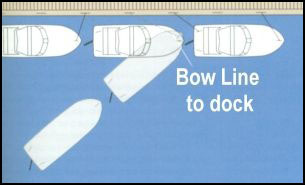
You are heading for a fuel dock consisting of a bulkhead of pilings and rip-rap. The problem is, you have to hit a gap between a 32′ power cruiser and a 20′ sailboat that are already tied up. And, to complicate matters, there’s a 15-knot wind blowing directly off the shore.
The dock attendant is on hand and looking nervous because you aren’t going to have more than 8′ of clearance fore and aft. Don’t worry! Ask one of your crew to throw him a line that is already cleated and coiled at the port rail forward, (preparation is 75% of the battle). As the dock attendant grabs the tag end of your line, ask him to attach it to a piling or cleat aft of the space into which you must fit.
Now, with the line secured at the dock and your wheel turned hard away from the dock (to starboard in this example), just put your boat in forward gear, at idle speed.
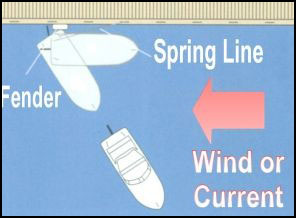
Miracle upon miracles, your boat will start moving sideways, into the allotted space! If you’re working against current or wind and your progress is too slow, just advance the throttle slightly. You can also make small adjustments in your approach angle and speed by turning the wheel slowly one way or the other.
And, if it looks as if you’re going to be too far forward of “the slot,” momentarily shift into neutral, take up the slack that will immediately develop in the spring line, recleat the line again, and put the engine into reverse once more. If you’re too close at the stern, carry out the same maneuver, but slack off the spring line.
Now, suppose there has been a 90 to 180 degree wind shift while you fueled up and went for groceries at the store down the block from the marina. When you get back to the boat, there’s a 15-knot wind blowing directly down the dock.
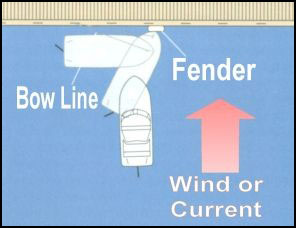
You can’t go ahead or astern very far because of the boat behind you and the one ahead of you. How are you going to get out of this fix? Again, spring lines are the answer.
If circumstances favor your pulling out and moving ahead, run a long spring line from a cleat on your port rail astern to a piling or cleat on the fuel dock well forward of your position.
Let go your bow and stern lines. Now, with your wheel hard to port, put the engine in reverse and back the boat down. Like magic, your bow will swing out to starboard, clearing the boat ahead (you may need additional throttle if you’re battling wind and current). You – perhaps aided by the dock attendant and/or a crew member-can now release the spring line and proceed out into the harbor.
When, on the other hand, circumstances favor your backing out of your spot, the spring line should be run from your bow to a piling or cleat well aft of your position.
In this case, let go the dock lines, turn the wheel hard to port (the side against the dock), put the idling engine into forward gear, and watch as your stern swings miraculously out of harm’s way.
When it clears the boat behind you, momentarily shift into neutral, release the spring line (or ask that the dock attendant free it), shift into reverse, and back away smartly. Again, the peanut gallery will be very impressed.
Five Rules for Avoiding Injury
- Before each docking maneuver, make sure everyone understands what he or she will be doing. The corollary to Rule 1 is that you should be aware of where your crew is and what each is doing.
A woman in California was securing a springline to a cleat when the skipper suddenly backed down hard with his two 200 HP engines and she got her fingers crushed. Another man was standing on the dock holding onto a trawler’s bow pulpit when the skipper gunned the engine and yanked him into the water. In both instances (and many others) the skipper and crew were acting independently. - Don’t encourage your crew to make Olympian leaps onto the dock. This is one of the most common types of accidents.
A California man, to cite one example, broke both his heals when he landed on the dock after jumping from the bow of a large sailboat. Whenever possible, hand docklines to someone on the dock. If that isn’t possible, wait until the boat is safely alongside the pier before instructing someone to step ashore. Your crew shouldn’t have to make daring leaps across open water to make up for your sloppy boat handling. - Keep fingers and limbs inboard! As a boats gets close to a dock, passengers tend to gravitate toward the rail and drape fingers, legs and arms over the side of the boat. If the boat suddenly swings into a dock or piling, the consequences can be painful.
A woman in lost a finger when a passing boat’s wake slammed her boat into a piling, and pinched her hand between the piling and the boat. - Make sure everyone is seated or has something to hold onto.
The owner of a 20′ runabout asked his inexperienced nephew to jump onto the dock with a bowline. The young man eagerly climbed out of his seat and stood precariously on the bow as the boat was approaching the dock. A few seconds later the boat glanced off of a piling, only slightly, but without a handhold the nephew lost his balance and fractured his elbow. - Don’t use bodies to stop the boat.
A Florida man suffered a separated shoulder when he tried to keep a 38′ Sportfisherman from backing into a piling. Slow down and use fenders.
National Security
Current world events are touching our lives as never before. As a boater, you may be placed in a situation that may put you in legal jeopardy, if not at risk of injury or worse. Knowing how to act in certain areas or situations can not only make your trip more enjoyable, it can help protect our country.
Naval Vessel Protection Zones
One thing you must contend with if you boat in certain areas of the country are Naval Vessel Protection Zones. These zones are designed to prevent attacks against our navy by placing restrictions on how closely you may come to a naval vessel.
- You may not approach within 100 yards of any U.S. naval vessel. Sometimes this is an impossible thing to accomplish. If you need to pass within 100 yards of a U.S. naval vessel in order to ensure a safe passage in accordance with the Navigation Rules, you must contact the U.S. naval vessel or the Coast Guard escort vessel on Channel 16 of your VHF radio.
- You must operate at minimum speed within 500 yards of any U.S. naval vessel. You must proceed as directed by the vessels’ commanding officer, or the official patrol.
Violations of the Naval Vessel Protection Zone are a felony offense, punishable by up to 6 years in prison and/or up to $250,000 in fines.
And don’t forget, both the Navy and the Coast Guard are authorized to use deadly force to protect themselves.
Your Role in Keeping our Waterways Safe and Secure
Keep your distance from all military, cruise line, or commercial shipping. In addition to the Naval Security Zone requirements, you may also not operate your vessel near certain commercial vessels. It’s best just to avoid all commercial vessels if possible.
Observe and avoid all security zones and commercial port operations. Areas that have a large marine facilities including military, commercial/cruise, or petroleum facilities should be avoided. There are also restrictions near most dams, power plants and other facilities located near water.
Don’t stop or anchor beneath bridges or in shipping channels. If you do, you can expect to be asked to move and/or be boarded by law enforcement officials.
Keep a sharp eye out for things that are out of the ordinary. You are asked to report all activities that seem suspicious to the local authorities, the Coast Guard, or the port authority. Do not approach or challenge those acting in a suspicious manner.
Wear your life jacket. Wearing your life jacket, and operating in accordance with the Rules of the Road and other boating regulations will ease the burden on the Coast Guard and other law enforcement personnel.
For more information on security zones and how you can help, visit the U.S. Coast Guard website.