
Sewage
Preserving Clean Water
What you need to know about sewage before your next outing
On-board sewage management is not a fun thing to think about, but it is a necessary part of your boat’s systems.
Explore the topics via the tabs below to learn more about sewage on the water.
Sewage
The Main Concern: Bacteria & Nutrients
Bacteria can make boating and swimming unsafe and can close waterways and shellfish beds. Excess nutrients can cause algal blooms. Fortunately there are a range of options for on-board sewage management including toilets, holding tanks and even onboard treatment devices. It is important to consider the size of your boat, the type of boating you do, the availability of pumpout stations and if you boat in any No Discharge Zones when selecting the option that is best for you.
There are several options for on-board sewage including:
- Composting head
- Portapotty
- Installed toilet with marine sanitation device
If your boat has an installed toilet by law you must have a Marine Sanitation Device.
The Law
Sewage regulations are some of the most misunderstood boating laws. To be clear, it is ILLEGAL to discharge UNTREATED sewage on inland waters and within 3 miles of shore. To legally dispose of sewage boaters must either have an on-board treatment device (Type I or Type II MSD) or a holding tank (Type III MSD) to hold the waste and have it pumped out ashore. A No Discharge Zone (NDZ) further prohibits the discharge of treated boat sewage.
- Within NDZ boundaries, vessel operators are required to retain their sewage discharges on-board for disposal at sea (beyond three miles from shore) or onshore at a pumpout facility.
- Vessel sewage discharge is regulated under the Clean Water Act. States can have all or portions of their waters designated as a No Discharge Zone for vessel sewage to:
- Protect aquatic habitats where adequate and reasonably available pumpout or dump station facilities are available for the safe and sanitary removal and treatment of sewage
- Protect special aquatic habitats or species
- Safeguard human health by protecting drinking water intake zones
It is vital to know the locations of any No Discharge Zones in the areas where you are boating. They will be clearly marked on NOAA charts. You can also visit the EPA’s list of No Discharge Zones.
General Tips
- When tied up to a dock, use onshore facilities. Encourage guests to take advantage of the onshore restrooms before you set out for a day trip.
- Regularly maintain your MSD and the attached plumbing and install the best hose you can afford to reduce odors.
- Don’t be afraid to talk about the issue. Talk to your friends and fellow boaters about how to pump out.
- Obey the law – keep untreated sewage out of all coastal and inland waters.
- Find out if you are boating in a No Discharge Zone do not discharge any sewage, treated or not, in a No Discharge Zone.
Marine Sanitation Devices (MSDs)
Types of MSDs:
Type 1
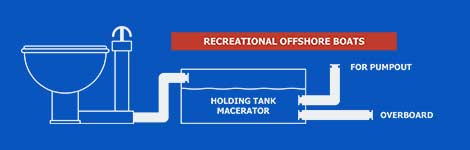
Type I is a an on-board treatment device using a physical/chemical based system that relies on maceration and chlorination. After treatment the treated waste can be discharged.
Type II
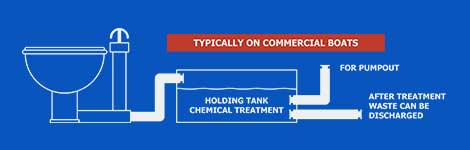
Type II is also an on-board treatment device that uses biological or aerobic digestion based system. After treatment the waste can be discharged. Type II systems are more often seen on large commercial vessels than recreational boats.
Type III
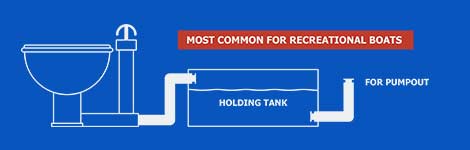
Type III is a holding tank or similar device that prevents the overboard discharge of treated or untreated sewage.
For Type III holding tanks:
- Use enzyme deodorizers for holding tanks and portable toilets.
- Pump out before you haul your boat for the winter.
- Know where your closest pumpout stations are located, and height or draft restrictions, seasonal closures and hours of operation.
- Consider using a pumpout boat service if one is offered in your area to make pumping out more convenient.
Pumping Out
If your boat has a holding tank, learning to use a pumpout station is a necessary part of your boat’s operation. This is an area where a small mistake can lead to a big mess, so take your time and be careful.
Using a Pumpout Station
How To Pump Your Boat’s Holding Tank
Since different machines vary slightly, be sure to read and follow posted directions! In general, here’s how it works:
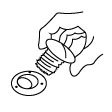
Step 1
Remove cap from boat’s deck waste fitting
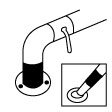
Step 2
Insert pumpout hose nozzle into deck fitting
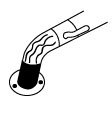
Step 3
Turn pump on
If there is a hose valve, open it to start the suction.
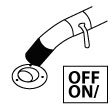
Step 4
Close hose valve
When no waste is seen in sight glass, close hose valve and remove nozzle from deck fitting.
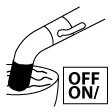
Step 5
Rinse out the hose
Put nozzle (with open valve) in bucket of water for 15 seconds to rinse hose. If desired, rinse boat’s holding tank with water and pump dry.
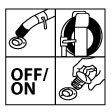
Step 6
Put away hose & turn off pump
Close valve. Put away hose. Turn off pump if requested. Replace deck fitting cap.