
Boarding Ladder Tests
U.S. Coast Guard statistics show that the vast majority of boating fatalities occur on boats under 20 feet. In a number of cases, the victims drowned because they couldn’t re-board their boats.
Foundation Findings #44 — March 2008
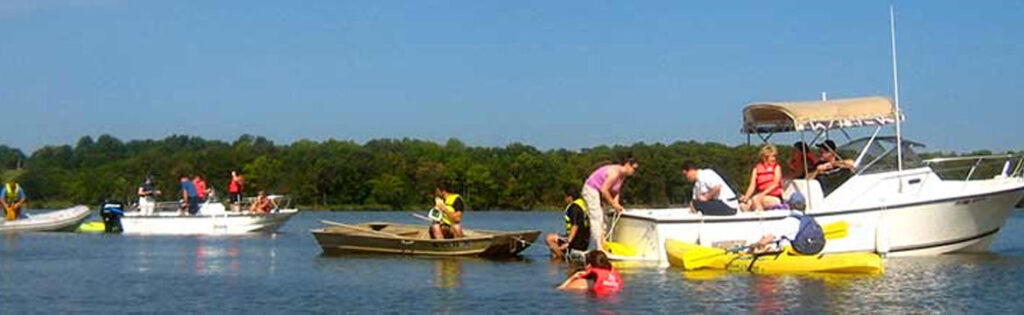
The BoatU.S. Foundation wanted to learn what ladders work best for self-rescue situations in small boats. On a beautiful late-summer day, Foundation staff spent nearly 10 hours testing boarding ladders with the help of 10 volunteers from BoatU.S. staff. Little did they know that they would be asked to perform over 200 re-boarding attempts over the course of one day. Needless to say, there were a lot of aching muscles the following morning.
Ladder Options
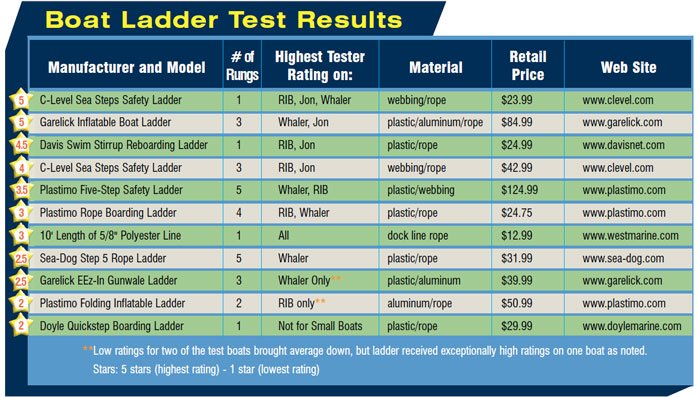
From single-step straps to five-step rope ladders, the range of styles available for small boats makes it easier than ever to find the right ladder to fit your boat. Our test boats represented three different boat designs to give our testers an opportunity to compare the performance of the ladders on each. A ladder that worked great on one boat often failed entirely on another. This highlights how important it is to choose your ladder carefully and test it to make sure you can use it on your boat before you find yourself in dire need of re-boarding assistance. Proving that the fanciest equipment isn’t always the best, testers also tried rigging a re-boarding device themselves using a 10 ft length of 5/8″ polyester line.
Though it was sometimes tricky to get the length right and tie a knot that would hold, many testers preferred using the line with one tester commenting:
“I would have chosen this over any of the products.” Another tester underscored the importance of adjust-ability saying, “It wasn’t anything fancy but I would trust that over buying something. If you take the time, you can customize it so it is right for you. Many of the store bought ladders you can’t adjust.”
Testing Protocol and Rating Criteria
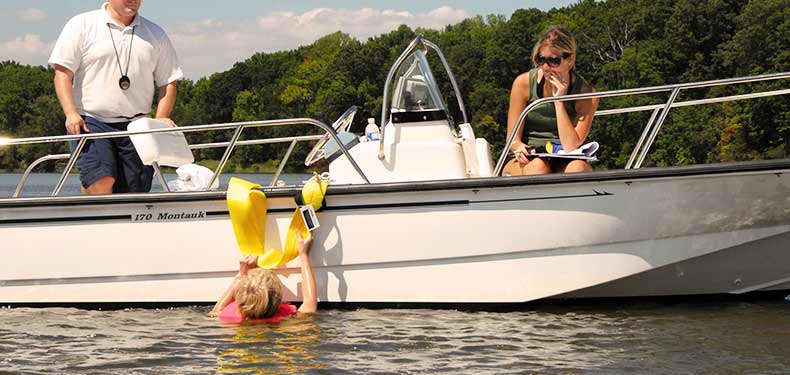
All of the testing took place on a warm summer day in late August. Ten volunteer testers along with nine observers and support staff gathered at a YMCA Camp on the Rhode River in Edgewater, Md. The morning round of testing included the jon boat and the rigid inflatable boat (RIB), both tied up to larger support boats from which the observers could communicate with testers without interfering in the re-boarding tests. As support boats during the morning testing, we used a Shamrock and the Boston Whaler, which was used as a test boat later that day. One male and one female tester on each boat tested each ladder at least once. Many of the ladders required additional adjustments and ended up being tested multiple times. Some ladders were completely unusable and were not tested at all on one boat but were a perfect fit for another. For each test the ladders were rated on seven different criteria: set-up, retrieval, timing, ergonomics, capacity, fit for the boat type, and a comparison between the successes of men and women testers.
The observer asked each tester to rate the ladder on a scale from 1 to 5 (5 being the best score) for each of the following questions:
- Was the use of the product obvious?
- Was the product easy to retrieve and deploy?
- Were the handholds and footholds conveniently placed?
- Will it support a wet, fully clothed adult with no problem?
- Overall was this a good product for this boat type?
Observers also gave ratings for each question based on their own observations. Each test was timed from when the tester reached into the boat to when they pulled their legs into the boat. Testers and observers then compared the experiences of the male and female testers.
Jon Boat Findings
The biggest difficulties testers faced with the jon boat were its instability and low free board. Because the boat’s profile is so low to the water, we had spotters watching to make sure it never flipped over on the testers as they boarded. The preferred technique on the jon boat was to step up on the ladder and quickly throw one’s torso or leg into the boat before pulling the gunwale too far down into the water. Then testers could roll the rest of their body inside.
The stern and bow of the jon boat were the easiest places to board because they each were within reach of a seat or something the testers could grab onto. Boarding at the stern, however, was only possible because the test jon boat had no outboard motor in place.
The favorite ladders were short one- or two-step models that didn’t swing far under the boat. The Davis Swim Stirrup got high marks for its simplicity and ease of use. A simple plastic step at the end of a long, adjustable rope, this ladder was ranked #1 for use on on the jon boat.
The Garelick Inflatable Boat Ladder ranked second on the jon boat. This ladder has two plastic and aluminum steps that are curved slightly to accommodate its intended use on the rounded tubes of an inflatable boat. The steps are attached to an adjustable rope, which was critical to making it suitable for the test boats. The third highest-ranking ladder was the C-Level Sea Steps Safety Ladder. This simple webbed-strap has a single loop at the bottom of a long piece of 4-inch wide webbed material. Not only was it easy to use, but it folds up neatly for convenient storage.
Testers found the longer ladders difficult because their feet pushed the ladder underneath the boat. This made the other side of the boat sway up, towards the tester, throwing them off balance. Many of the longer ladders tended to float on the surface making it difficult to get started. This was especially annoying on the jon boat.
Most of the complaints from testers on the jon boat were about ladders being too long, those ladders without any means to shorten the length were sometimes unusable on the jon boat and required much more upper body strength than others.
Rigid Inflatable Boat (RIB) Findings
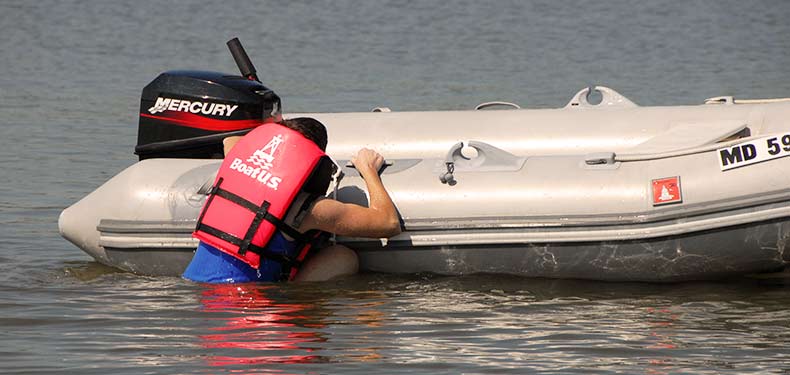
Several of the ladders tested were specifically designed for inflatable boats. But our testers found that most of them were not very effective. One of these, the Garelick Inflatable Boat Ladder, was a perfect fit on both the jon boat and the Whaler. But testers on the RIB found it very difficult to use because the lowest rung of this two-step ladder barely skimmed the water’s surface.
Female testers found that it was very difficult to reach into the boat to deploy the ladders because of the wide girth of the tubes. They, instead, preferred to reach into the boat from the stern then throw the ladder over the side. The male testers, in contrast, often appeared as though they didn’t need a ladder at all when pushing up to reach into the RIB and grab the test ladder.
The handhold straps on the tubes of the inflatable proved invaluable to testers as they boarded. Though the top rated ladders for the RIB didn’t have conveniently place handholds (if any at all) the handles on the boat worked perfectly as substitutes.
Another frequent complaint was that testers’ arms and legs were scraped by the sharper edges of the ladders that were exposed across the wide edge of the tube when climbing aboard. Shorter ladders were favored again since they tended to leave fewer exposed edges.
The number 1 ladder from the jon boat, the David Swim Stirrup, also ranked highest on the RIB. It was the perfect length (about 20 inches below the waterline) for all the testers. The C-Level Sea Steps was a close second. Though its bottom step was 24 inches below the waterline, just a hair too long, it was still described by one tester as, “Perfect for a boat like this!” Third place was a tie between the 3-step version of the C-Level Sea Steps and the Plastimo Folding Inflatable Ladder.
The Plastimo, designed specifically for use on inflatables, has a unique S-curve shape. The top of the S curves over the tube, hugging the gunwale and then curves back out at the bottom to give better leverage while boarding. This distinctive design often required testers to turn it over during testing since it only fits one way, a small point of frustration, but overall, it was well-liked for the RIB.
Again, testers found that many longer ladders floated out from under them causing much frustration. Tangled ladders also seemed to be more of a problem on the RIB compared to the other boats. Some ladders became twisted inside the boat or during deployment and testers had to adjust them multiple times before beginning to board.
Boston Whaler Findings
The Whaler was a completely different experience when compared to the other boats. With higher freeboard and less angle on the side of the hull, ladders that had been impossible on the other boats proved quite convenient on the Whaler. Despite the higher freeboard, testers still complained about swinging but it was the side-swing that proved most problematic.
Again, the C-Level Sea Steps Safety Ladder (1-step), was rated in the top three coming in third place on the Whaler. It was the only ladder that worked well on all the test boats. The top rated ladder for the Whaler was intended for use on inflatables, but the Garelick Inflatable Boat Ladder was preferred on the Whaler for its stability and ease of use. One tester said, “I loved this one!” The single complaint was that it was difficult to deploy. Pulling it through the railing on the boat was cumbersome but once it was deployed, it required very little upper body strength when compared with other ladders.
Another Garelick ladder, the EEz-In Gunwale Ladder, ranked in second place on the Whaler. Though it was also difficult to pull through the railing testers were surprised by its stability. The higher freeboard and slab side of the Whaler provided a perfect surface to push against while climbing this 3-step, hook-style ladder.
Though it didn’t rank in the top-three, the Plastimo Five Step Safety Ladder definitely deserves an honorable mention. It was the only 5-step ladder to rank in the top four on any of the test boats. Testers loved its innovative design but found it difficult to use on the other two boats because of its length. On the Whaler, though, its narrower steps and uncomlicated deployment earned it higher ratings. Designed as a simple bag with two loops for installation, this ladder deploys from its installed location by flipping it over the side of the boat and pulling on the handle to release the ladder. The Velcro flap pulls open and the five-rung plastic and webbing steps fall out of its pouch and into the water.
On a side note, the Boston Whaler used for this testing did have a swim platform and boarding ladder already installed. But, many boat owners with a similar style of boat won’t have a standard boarding ladder installed. For the purposes of this test, we did not use the swim platform and only evaluated the boarding ladders as they would be used on a similar boat without a permanently affixed swim platform.

Some Tips on Choosing the Right Ladder for Your Boat
One of the questions that arose with all the ladders was how and where to attach them. The jon boat was the toughest with no logical point of attachment inside the boat. Staff members had to rig a line that circled the interior deck of the boat and then each ladder could be clipped to the line with a heavy-duty carabiner. The RIB had a few D-rings on the floorboards and the Whaler had cleats on the top of the gunwale.
Plan Ahead – Before you choose a ladder, think about where and how you will be attaching it to the boat. This factor plays a big part in determining the right ladder for your boat. Other factors to consider include:
- Once installed, how much space do you have for storing the ladder so it is still reachable from the water?
- How much free board does your boat have and will you be able to use it as a surface to push against when climbing a ladder?
- Are there any obstacles that may impede deployment of the ladder – railings or stanchions that the ladder will have to be maneuvered around when deploying from the water?
The fanciest, most expensive ladder is not always the best choice for you or your boat. In our tests, we often found that simpler was better.
Practice, Practice, Practice – Once you’ve purchased a boarding ladder, you’ll need to practice using it. Re-boarding success is all about technique. Take your boat out on a warm day and practice boarding with your ladder so you know what to expect should the unexpected occur. This will also help you determine how and where you can store it.
It must be within reach of the water, which can vary depending on the person at the boat. If you can’t reach it from the water, you won’t be able to use it, and you may not be able to get back in the boat at all.
Foundation Findings #24 — March 1996
You are out alone delighting in a beautiful day on the water.
Suddenly, the engine quits. Belatedly, you realize you’ve entered a field of crab pots and one of the float-lines may have fouled your drive system. There’s only one way to find out if the cable is wrapped around your drive shaft or propeller. First you remove the key from the ignition, making sure your engine is completely shut off. Then you go over the side and under the water to check. After struggling to untangle the mess – because, as Murphy’s Law says, if something can go wrong it will go wrong, and at the worst possible moment – getting back on board could be much easier if your boat is equipped with a good boarding ladder or other device.
More importantly, a ladder can make retrieving a crew member who has fallen overboard easier. And a boarding ladder, with or without a platform, adds to the enjoyment of a pleasant swim in your favorite gunk-hole, by allowing easier access to the water.
| Boarding Ladders | ||||||||
| Price & Features | Emergency Rope w/plastic steps | Portable 3-step, sailboat | Portable 3-step, powerboat | Portable 4-step, sailboat | Portable 4-step, powerboat | Mini-swim platform, 2-step | Removable & folding, transom mount | Removable, transom mount boarding bar |
| Discounted Price (avg) | $22.95 | $26.95 | $33.50 | $135.00 | $129.00 | $67.50 | ||
| Lowest Step’s Depth Below Waterline | 20” | 6” | 10” | 14” | 20” | 18” | 16” | 10” |
| Seconds to board (four-member-team average) | 22.3 (test finished by only 3 subjects) | 10.35 | 9.18 | 9.39 | 8.59 | 6.665 | 4.76 | 12.045 (skewed by one subject’s time of 23.96 seconds) |
| Ease of entering water | poor | fair | fair | good | good | good | excellent | fair |
| Ease of exiting water in to boat | poor | fair | fair | good | good | good | excellent | fair |
| Step Comfort | poor | fair | fair | fair | fair | good | good | good |
In Water Ladder Tests
Last fall, the Foundation for Boating Safety conducted an in-water test to evaluate the efficiency and comfort of various boarding devices available through most boating equipment stores and catalogs. We wanted to find out what features of the various various types of ladders and platforms contribute to the ease or difficulty of putting them to their intended use. We discovered that some definitely gave better support and were easier to to use than others. We conducted the boarding tests on a quite creek where wind, weather, and water conditions were near optimum, so factors other than ease of ladder use would be minimized.
For the tests, we chose four subjects with different physical characteristics and whose weight ranged form about 140 pounds to approximately 225 pounds. Participants included one woman in her late 20’s, who exercises sometimes, but not on a regular basis, and three men: an athletic 24-year old who works out three times a week; a fairly active 50-year old who does not exercise regularly; and one man in his late-fifties, who exercises only in spurts.
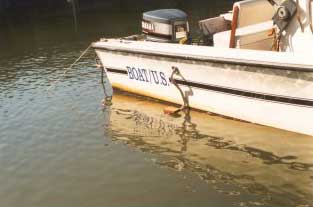
We wanted to evaluate a representative sampling of units which are likely to be used on recreational boats – both power and sail. The staff selected ladders and a platform that were readily available in the recreational boating marketplace. All the ladders tested were compact enough to store easily aboard most types of vessels. None float.
The mini-swim platform we used was fixed. During the tests we were careful to follow basic safety procedures, including wearing personal floatation devices by those testing the boarding devices. We also shut off boat engines completely, not just letting them idle, whenever anyone was in the water near the boat, to avoid the danger of cuts from the propeller.
Current American Boat and Yacht Council (ABYC) guidelines call for all manufacturer-installed boat boarding devices to be capable of withstanding a vertical downward static load of 400 pounds without permanent deformation in excess of 1/4 inch. They also specify that, if a ladder or other step-like device is used as the means for boarding, the first step shall be at least 10 inches below the waterline. ABYC is currently reviewing boat safety features including boarding ladder specifications, such as proper depth of immersion for the lowest rung and the most effective placement of hand holds for reboarding, under a U.S. Coast Guard grant scheduled to be completed this spring.
Boarding Ladder Ratings
The Foundation Team evaluated the various ladders based on how well they worked on the three boats on which we tested them; a 23-foot sloop with 16 inches of freeboard at the transom; a 31-foot auxiliary sloop with 36 inches of freeboard where the ladders were placed; and a 22-foot center console with 17 inches of freeboard. The devices may perform better or worse when used on boats with different freeboard and hull configurations. Units we tested, along with manufacturer’s suggested weight-bearing capacities, are as follows:
Emergency Boarding Ladder
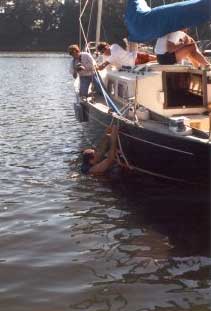
Designed to be secured to cleats, stanchions and halyards for emergency use, this ladder features five orange-colored plastic rungs connected by nylon rope, fed through plastic tubing to separate the steps that unfold up to a six-foot depth or fold for storage to six inches. Non-skid steps are curved, like thick, venetian-blind slats. First step depth during our test was 20 inches below the waterline, but may vary depending on your boat’s freeboard. Different models offer 300- and 450-pound weight capacity. This device is not well suited for emergency use, unless techniques for mounting the lowest, underwater step of the devices are learned and practiced. Even on a calm creek with ideal weather and water conditions it was extremely difficult to use. Because it is not at all rigid, when trying to get a foothold on the lowest, underwater rung it tends to swing up under the boat, often jamming the user’s toes between the ladder and the boat’s bottom.
Additionally, all participants said their hands and feet slipped on the rungs. One subject said the steps tended to slant to one side, causing slippage, and that the lower slat edges were quite sharp. Another caught his finger under the rope while grasping the boat, as he tried to get enough leverage to pull himself over the side. A third subject struggled to board this ladder and finally had to abandon the effort after more than two minutes because it offered no support. She lacked the upper body strength to wrestle her way to a standing position on the bottom rung and her arms were too short to reach above the boat’s smooth side to grasp the gunwale, as the men had. In the context of these tests, conducted on these vessels, the Foundation team rated this ladder’s performance poor.
Hood-Style Portable Ladders
Designed to be stored until needed, three-and four-step models are constructed of 1-inch diameter aluminum tubing with non-slip, plastic-grid steps. They offer 11-inch and 7-inch, vinyl-covered, cushion-tipped rail hooks for wide or narrow gunwales and movable, soft-tipped, aluminum standoffs which won’t scratch boat hulls. Standoffs, short legs designed to hold the ladder away from the boat’s stern or side, and hooks fold for compact storage. These ladders, we were surprised to learn, are weight-rated at only about 175 pounds-185, tops, according to the manufacturer. Weight-bearing capacity is neither mentioned on the shipping carton for these best-selling units nor in the accompanying literature.
We tested three-step and four-step ladders with 11-inch rail hooks on both a sailboat transom and the wider gunwale of a power boat. The hooks slipped on the narrower transom as they settled into place, startling the testers and making the ladders more difficult to mount.
Additionally, the vinyl covering on one unit’s hooks tore as it slipped because the 11-inch hooks were too large for the sailboat’s narrow transom. This incident points up the need to check to see if a smaller, seven-inch hook model would fit better on your boat. The folding standoffs were unsteady and collapsed on several occasions during the tests, even when the tester was under the 185-pound manufacturer’s maximum weight recommendation. Testers weighing 200 pounds or more found the standoffs to be extremely unstable, which caused them to collapse, resulting in jammed toes.
All evaluators agreed these ladders were significantly easier to use when hung over the motorboat gunwale than when hung from the sailboat’s transom because, due to the powerboat’s lower freeboard, they were more stable and their bottom steps were deeper in the water. They also found that the fourth step made entering and leaving the water much easier. All agreed the plastic step grids were hard, almost painful, on the feet and evaluated the ladders fair under the test conditions and on the boats mentioned above.
Mini-Swim Platform
This unit includes a permanently fixed, teak platform and 1-inch stainless steel steps with teak treads. Weight capacity figures are not available because weight bearing tests have never been run, the manufacturer says.
The team set out to test two mini-swim platforms; one with two steps, the other with only one. Because the step of the one-step platform was so close to the surface that it was about as easy to board the boat without it, we all agreed it was unsatisfactory and dropped it from the test. All gave positive marks to the two-step platform, and one participant chalked up her best boarding time on this unit. The 18-inch depth of the platform’s bottom step contributed greatly to the ease of boarding. This unit was awarded a good to excellent rating by the team.
Transom Ladder, Removable Mount
Also rated good to excellent, this ladder features 1-inch diameter stainless steel tubing and has two fixed steps and two that fold up for easy stowage and to avoid dragging in the water when underway. Flattened, contoured treads feature a non-skid finish, and two slide-in keyhole mounting brackets provide a secure fit and easy removal. Also available in a permanent-mount version, these ladders support up to 308.6 pounds with some flex, full recovery and nil deformation, according to the manufacturer.
This ladder received more excellent ratings than any other. One staffer called it excellent with good comfort and said it was definitely the easiest to use. Another found it superb when climbing aboard the boat and very easy to use when entering the water. All agree it was the best of all the ladders tested, and three of the four subjects had their fastest boarding times using this unit.
Removable Boarding Bar
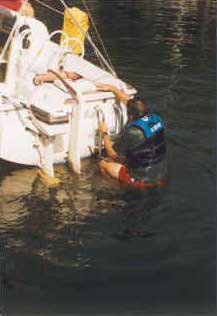
Also bracket mounted, this unusually shaped ladder is constructed from 1-inch stainless steel tubing with two teak steps. This unit worked fairly well when attached to the side of the boat we used for the tests. It is said to be capable of supporting 300 pounds.
One subject found the bottom step to be higher and less stable than anticipated, forcing him to steady the first step with both knees to carefully gain his balance before placing weight on the ladder. The two other men had mixed reactions: one, like the first subject, found the first step to be somewhat unstable and hard to mount; the other liked this device as well as any of those tested The female Team member, who had problems with the slat and rope ladder, liked this unit quite well. It was given a fair to good rating under the test conditions mentioned above.
Conclusions
The most valuable lesson we learned from our tests is that, whatever boarding device is used, it is important to familiarize yourself with how the unit works and to practice before an emergency occurs. Properly attach the device to your boat, then try it out! These results mirror the need to practice reboarding techniques that was discovered several years ago when the Foundation did crew overboard tests (Reports, January 1993). For all our test subjects, rigid ladders proved superior to the more flexible, rope ladder when reboarding a boat. That rigidity permits the user to board more easily because it provides better leverage and stability, allowing for better handhold and foothold coordination. This conclusion would seem to be borne out by early results of the tests being conducted by ABYC. Those tests appear to show that handhold location is as important a consideration as any other when attempting to reboard a boat, according to an ABYC spokesman.
These ladders may be purchased through West Marine and other marine equipment retailers.