
Life Jackets
Safety First
What you need to know about life jackets before your next outing
A life jacket is the single most important piece of equipment on your boat. More than two-thirds of all boating fatalities are drowning incidents and 87% of drowning victims were not wearing a life jacket.
Explore the content on this page and the tabs below to understand life jacket requirements and usage while boating.
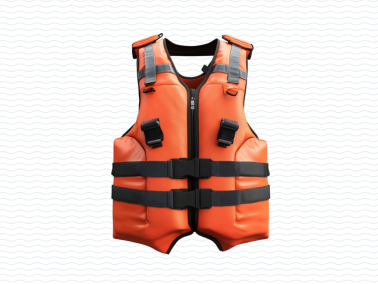
Life Jacket Requirements
There must be a properly fitting life jacket for each and every person aboard a recreational vessel. Life jackets must be Coast Guard-approved, in serviceable condition and the appropriate size for the intended user. Obviously, they are most effective when worn.
Children
On a vessel underway, children under 13 must wear an appropriate Coast Guard-approved PFD, unless they are below decks or in an enclosed cabin. Within the geographic boundaries of any State that has established a child PFD wear requirement, that State’s requirement will be adopted.
Each state may have additional wear requirements, such as for water skiing, personal watercraft operation, white water boating activities and during certain cool-weather months. Additionally, a boat 16’ in length or greater, except canoes and kayaks must have a throwable flotation device.
Child Life Jacket Loaners
Keep your child safe when out on the water by borrowing a life jacket from one of our nationwide partner locations.
types of personal floatation devices
Buy a life jacket you will wear…it could save your life
Each type of life jacket is designed for different boating activities and water conditions and each has its own maximum buoyancy, performance level, and limitations. You should choose your life jacket based on your boating activities and conditions.
Life jackets must be U.S. Coast Guard-approved in order to meet carriage requirements.
Inherently Buoyant
Type I
Intended Use
When cruising, racing and fishing offshore , or when boating alone, or in stormy conditions.
Minimum Buoyancy
22 lbs. for adults (11 lbs. for child size)
Additional Information
- Best for open, rough or remote water where rescue may be slow to arrive. Will turn MOST unconscious wearers face-up in water.
- Offers the best protection, but is somewhat bulky and uncomfortable. Does the best job of retaining body heat, as it has additional foam and fabric, and keeps your head higher above water.
- Currently, there aren’t any Coast Guard approved Type I inflatable PFD’s available to the general public.
Inherently Buoyant
Type II
Intended Use
Inland day cruising, fishing and sailing. Good for boating in light craft.
Minimum Buoyancy
15.5 lbs. for adult size.
Additional Information
- Good for protected, inland water near shore, where chances of immediate rescue is good.
- Not suitable for extended survival in rough water.
- Will turn SOME unconscious wearers face-up in water.
- Poor performer in rough water, often requires you to tread water in order to keep your head above water.
- More comfortable but less buoyant than Type I. Provides far less flotation than a Type I.
Inflatable
Type II
Intended Use
For serious inland and near shore cruising.
Minimum Buoyancy
34 lbs. for adult size.
Additional Information
- Not guaranteed to turn unconscious wearer face-up.
- Advantages: very comfortable, more buoyant than Type II Inherently Buoyant jackets.
- Disadvantages: High price; may be manual or automatic.
- There are many Type V (special use) inflatable jackets (covered later in this section) that provide Type II performance characteristics.
- Inflatable PFDs are not meant for children under the age of 16.
Inherently Buoyant
Type III
Intended Use
Supervised activities, such as sailing regattas, dinghy races, water skiing, fishing, canoeing, kayaking and during personal watercraft operation.
Minimum Buoyancy
15.5 lbs. for adult size.
Additional Information
- Good for protected, inland water near shore, where chance of immediate rescue is good.
- Not suitable for extended survival in rough water. Not designed to turn unconscious people face up in water.
- More comfortable to wear than a Type I or a Type II, but provides far less floatation than a Type I.
Inflatable
Type III
Intended Use
For boating inshore and near shore and for supervised activities such as sailing regattas, dinghy races, canoeing.
Minimum Buoyancy
22.5 lbs. for adult size.
Additional Information
- Not guaranteed to turn unconscious wearer face-up.
- Advantages: more comfortable than a Type III Inherently Buoyant jacket.
- Disadvantages: one manual inflation mechanism only.
- Inflatable PFDs are not meant for children under the age of 16.
Throwable Device
Type IV
Intended Use
A Type IV is designed to be thrown to an overboard victim or to supplement the buoyancy of a person overboard. It is not to be worn. Minimum buoyancy: 16.5 lbs. for ring buoy or 18 lbs. for boat cushion.
Additional Information
- A Type IV throwable device can be a square style, or a ring buoy or horseshoe buoy mounted on deck.
- A Type IV is not for unconscious persons, non-swimmers or children. Although these devices are often referred to as seat cushions, you should never use it as such. This degrades the foam and reduces the amount of floatation that is provided.
NOTE – Type IV devices must be IMMEDIATELY AVAILABLE for use. You must have one at arm’s length to throw over the side in an emergency. Having one in a locker under the driver’s seat isn’t considered “immediately available.”
Special Use
Type V
Intended Use
Restricted to the special use for which each is designed, for example: sailboard harness, deck suit, paddling vest, commercial white water vest or float coats.
Minimum Buoyancy
15.5 to 22 lbs. for adult size.
Additional Information
- Must be worn when underway to meet minimum US Coast Guard requirements. Simply having a Type V PFD on board will not meet the USCG carriage requirements.
Automatic Inflation
Type V
Intended Use
Restricted to the one use for which it is designed, ex. belt pack, deck suit, float coat.
Minimum Buoyancy
22.5 to 34 lbs. depending on style.
Additional Information
- Must be worn to meet federal requirements.
- Not guaranteed to turn an unconscious wearer face-up. Some manufacturers claim Type II performance. Some models feature a combination of CO2 inflation and built-in foam and provide 15.5 to 22 lbs. of buoyancy.
Hybrid Inflation
Type V
Intended Use
Models recommended for boating activities where rescue is nearby and must be worn when underway.
Minimum Buoyancy
Have 7.5 lbs. of built-in foam buoyancy and can be inflated to 22 lbs.
Additional Information
- More comfortable to wear than Type I or Type II, but are inadequate for unconscious overboard victims.
Inflation Mechanism
When activated, a CO2 cartridge is pierced, releasing gas to inflate the device. Water-activated models inflate automatically when submerged in water.
Manual units are activated by yanking a pull-tab. Both types of inflatables feature blow-tubes to provide a back-up method of inflation. It is important to follow the manufacturer’s instructions for checking and maintaining your inflation mechanism.
Support Us
Did you find this information useful? Donate Today!
There is only one way boaters can give back and help themselves at the same time — by making a donation to the BoatU.S. Foundation for Boating Safety and Clean Water. The non-profit 501(c)(3) Foundation needs your support for critical boating safety and clean water programs.
Life Jacket Care
How to Care for Your Life Jackets
The amount of buoyancy (and life-saving value) your life jacket provides will decrease over time. Treat your life jacket as if your life depends on it! Here’s how to take good care of it.
Life Jacket Maintenance: Do’s and Dont’s
Do:
- Check your life jackets at the beginning of each boating season.
- Check that all hardware and straps are in good shape, are firmly attached, and are in working order.
- Check for leaks, mildew, lumpy or hardened buoyancy material, & oil saturation in the fabric.
- Make sure that there are no rips or tears in the fabric.
- Make sure that the label stating USCG approval is attached, and that it is readable.
- Discard and replace life jackets that show signs of deterioration – tears, mildew stains, punctures, etc.
Don’t:
- Don’t use a life vest or throwable flotation cushion as a kneeling pad or boat fender.
- Don’t use harsh detergents or gasoline to clean it.
- Don’t remove any labels, straps or buckles.
Storage:
- Store in an area with good ventilation.
- If wet, allow it to dry thoroughly in open air before storing.
- Drying it in a dryer, in front of a radiator, or other source of direct heat will destroy its buoyancy.
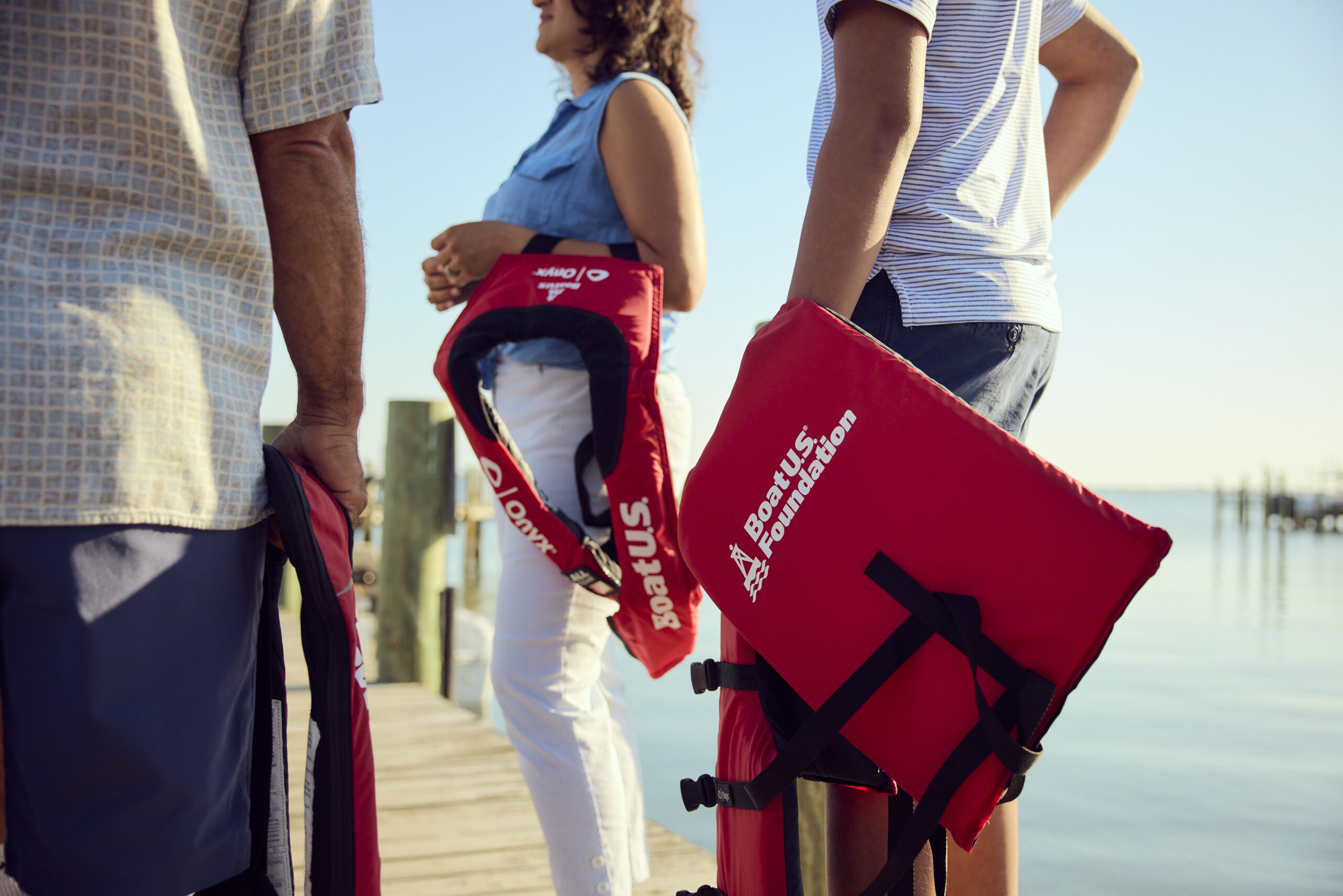
Inflatable Life Jacket Maintenance
Inflatable life jackets require more frequent maintenance than inherently buoyant life jackets.
- Check the status of the inflator every time to be certain cartridge is properly installed and the equipment is in working order.
- Check for leaks every two months; inflate life jacket orally and leave it overnight to check for leaks. If it leaks then it should be replaced.
- Immediately replace any spent CO2 cartridges with new ones. Frequent users of inflatables should check them often, especially if used around sharp equipment like fishing gear.
- Make sure all straps and zippers are in working order – keep your equipment in serviceable condition.
- Inflatables are NOT recommended for individuals who cannot swim (unless worn inflated) and are not for use where water impact is expected, like water skiing or riding a jet ski.
- Inflatable PFDs are not meant for children under the age of 16.
Life Jacket Labels
New Life Jacket Labels and Icons – What do they Mean?
If you haven’t already seen them, soon you will notice certain life jackets have a new style of label on the inside. Eventually, all new life jackets which are Coast Guard approved and available for purchase in the United States will have these new labels. It is part of an effort to make selecting the right life jacket for you and your intended on-water activity, easier. This new labeling process is also referred to as life jacket label harmonization, which is an effort to make them more universally understood and accepted, especially in Canada and Europe. The goal was to simplify the labels, with less writing and more icons.
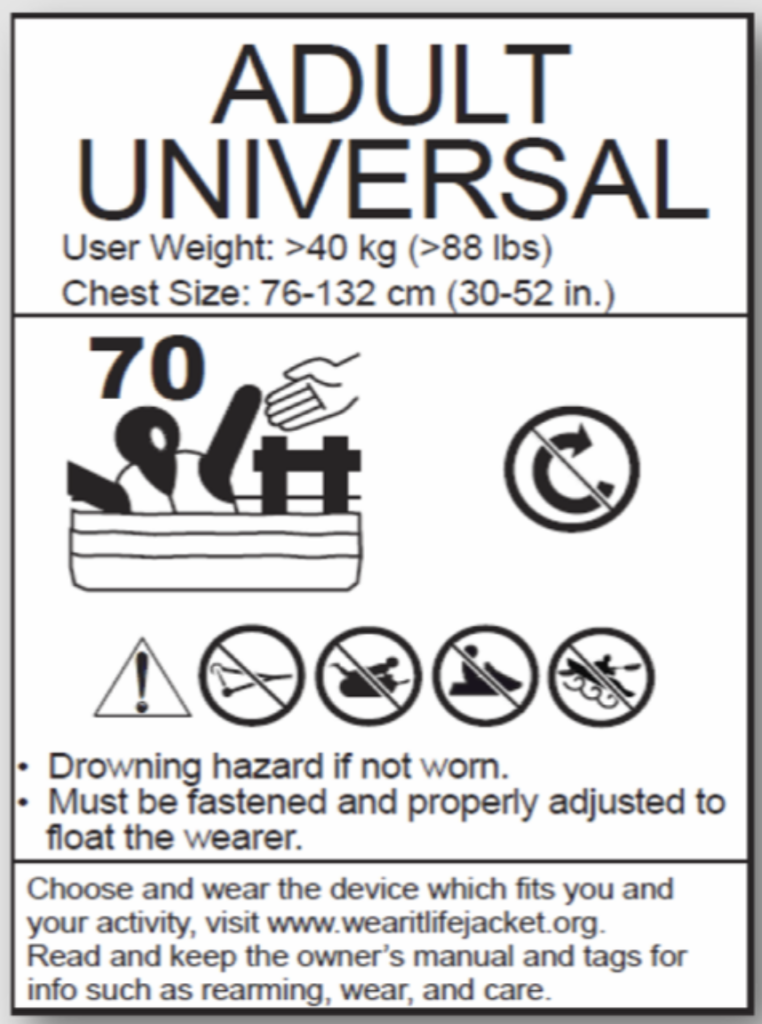
Top 10 Features and Goals of the New Life Jacket Labels
- Performance summary graphic
- Activity appropriateness icons
- Legal requirements specified
- Reduce language barriers
- More universal acceptance
- Harmony with other countries
- Approval status clearly noted
- Third party testing verification
- Manufacturer contact information
- Care and cleaning instructions
In general, the intent of the new labels is to help users select and care for the appropriate life jacket for the activity in which they are participating. The labels have fewer words more easily understood icons.
What About the Old Labels and Life Jackets?
In 2014, the U.S. Coast Guard removed the “Type” codes from the Code of Federal Regulations. As you may recall, life jackets and personal flotation devices had been referred to as Type I, II, III, IV and V, each of which corresponded to a certain performance or designated use. Going forward, these devices will be referred to as either “throwable” or “wearable” and have a performance category indicated by an icon.
New life jackets that are brought to the market will feature these new labels. However, it will take many years for the older style labels to be completely phased out and you are likely to see both styles in stores, on boats and in use for many years to come. Any life jacket will the old style label that is still serviceable and in overall good shape, as long as it’s Coast Guard approved, will continue to meet regulatory requirements.
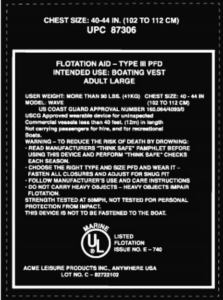
Take the Time Understand the New Label
Selecting a proper life jacket and wearing it is the best thing a boater can do to ensure a safe and enjoyable day on the water. A hang tag with important information will accompany each new life jacket. If shopping in a store, be sure you leaf through this hang tag or ask a store associate if you have any questions. If shopping online, read the full product description and reviews to ensure you’re purchasing the right life jacket for you.
New life jackets feature information in four main categories, usually in separate boxes. At the top of the label, usually toward the neck, is sizing information. The sizing usually specifies a user weight range and chest size range. Proper fit is one of the most important considerations when selecting a life jacket. Additional considerations are found elsewhere on the life jacket label. The placement and location of the information may vary, however, they must be on the life jacket.
What the Labels Tell You
- Performance, Buoyancy and Turning Information
- Warnings, Intended Activity and Limitations of Use
- Manufacturer, Certification and Approval Information
- Care and Maintenance Instructions
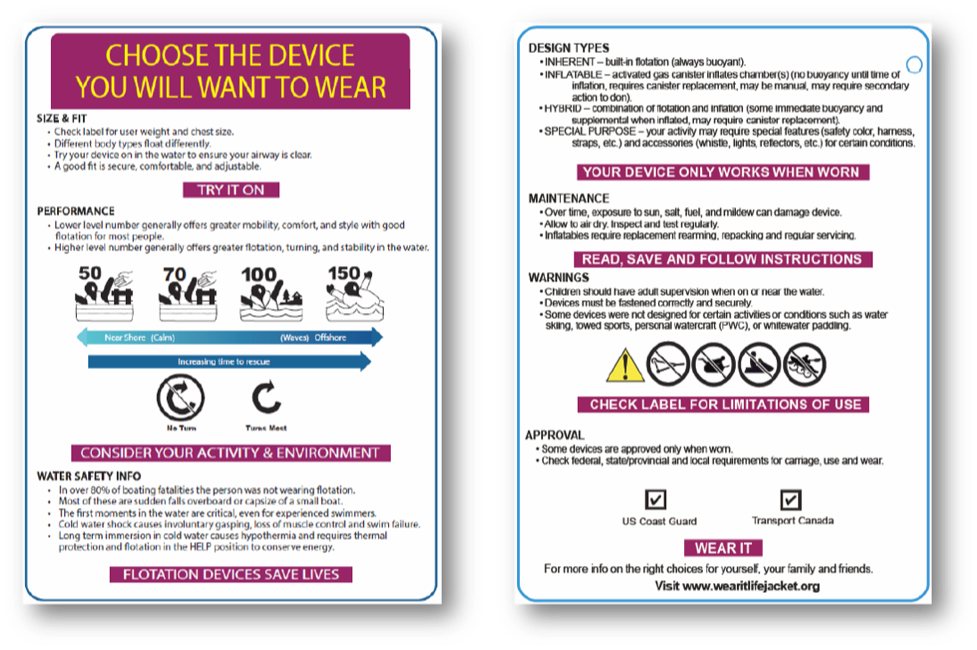
Understanding the New Label and Icons

Performance, Buoyancy and Turning Information – The first thing you’ll notice is a bold-faced number. It could be 50, 70, 100, 150, or 275. This a measurement of gravitational force, which in the case of a life jacket is essentially buoyancy. Simply put, the higher the number, the greater the floatation. For the time being, most all of the life jackets on the market today in the United States are Level 70 life jackets.
Let’s go over an example
Level 70 Label Decoding – The bold 70 means it’s a Level 70 life jacket which provides performance similar to the Type III life jackets previously available. Life jackets that are rated lower than 70 are not U.S. Coast Guard approved. This is a metric measurement in Newtons (70N is roughly 15 lbs. of floatation). Newtons are used so that it’s consistent with European and Canadian standards.
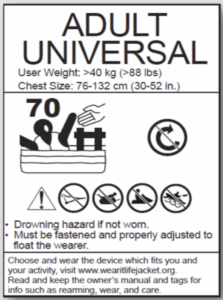
Also, on a Level 70 life jacket label, you’ll see a dock and an extended hand with some slightly wavy lines indicating fairly calm water. This means this life jacket is suitable for near shore use in relatively protected water where rescue is likely to be near at hand. You’ll note that the higher the number on these icons, the farther away the dock and background is, and the bigger the waves are in the icon.
The curved arrow indicates the turning ability of the life jacket. Turning ability is whether or not a life jacket is capable or designed to turn an unconscious person face up, unassisted. A Level 70 life jacket will not turn a person right side up, that’s what the curved arrow with a slash through it indicates. If there is no slash, it will turn most wearers face up. The higher the level number the more turning ability.

The next thing you’ll notice are warnings and exclusions. In this example, this life jacket is suitable for general boating. However, there are icons with activities and a slash through it. These symbols indicate this life jacket is not suitable for towed sports such as skiing and tubing, nor is it for personal watercraft operation or whitewater paddle sports.

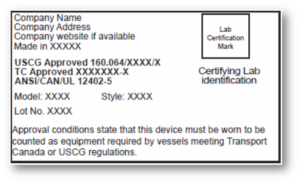
Manufacturer and Certification Information
In the United States and on navigable waterways, a Coast Guard approved life jacket, properly fitted for the intended wearer must be aboard for each occupant. Therefore, knowing your life jacket is approved by the Coast Guard to meet carriage requirements is important. You’ll find this information, as well as testing approval numbers and manufacturer information in this section of the label.
Care and Maintenance Instructions
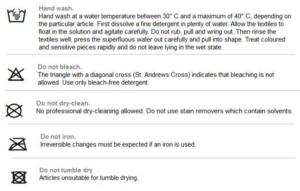
A life jacket should be viewed as an investment. You should care for it like you would anything else aboard that depends on proper function, with the exception this one could save your life! Your label and manual that came with your life jacket will have general cleaning and care instructions. These icons inform you to hand wash only, and to not use bleach, dry-cleaners, irons, or dryers in your care routine.
Life Jackets – Some Things to Know
- There must be at least one life jacket for each person aboard
- Life jackets must be properly sized for each person aboard
- Children under a certain age are required to wear their life jacket (typically under 13 – see state requirements)
- Participants engaged in certain water sports are required to wear a life jacket (typically skiing and personal watercraft operation – see state requirements)
- Life jackets must be approved by the U.S. Coast Guard in order to meet requirements
- These life jackets must be readily accessible and not in an out-of-reach location or in original packaging
- Any boat 16’ and longer (except canoes and kayaks) must carry a throwable PFD
- Throwable devices must be immediately available for use such as in the cockpit or near the helm
- An inflatable life jacket must be properly armed with an unused gas cylinder
- Inflatable life jackets are authorized for use on recreational boats by a person at least 16 years of age
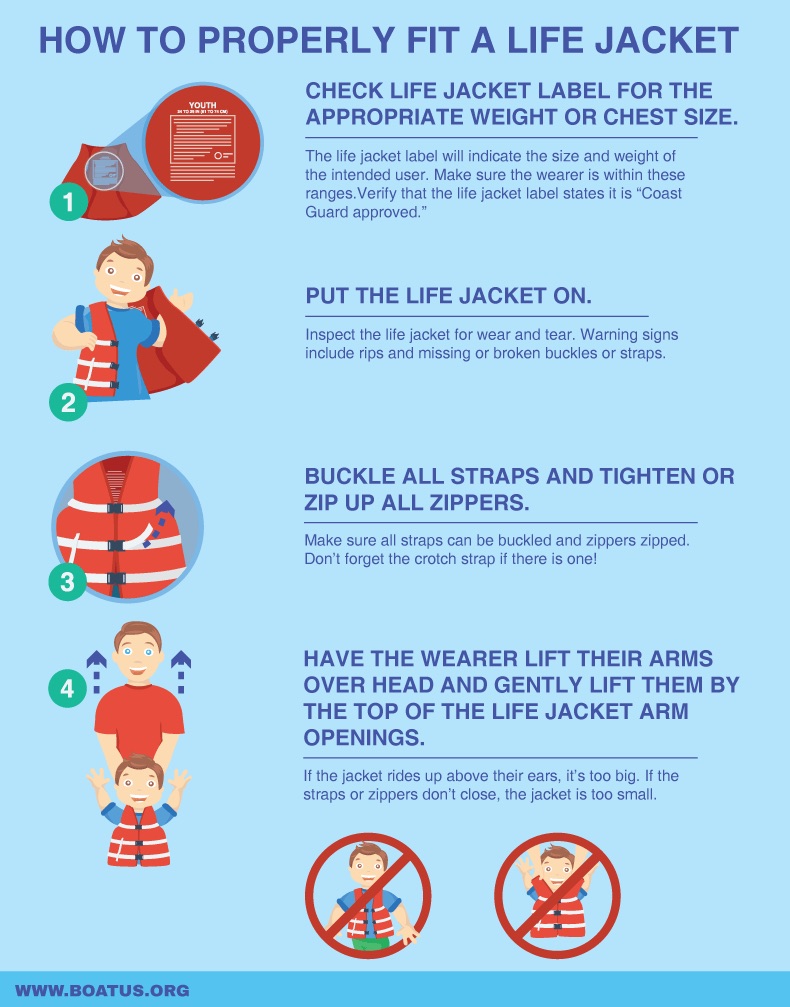
How to Fit a Life Jacket
The BoatUS Foundation is dedicated to putting more kids in properly fitting life jackets. The Life Jacket Loaner Program for Kids is just one of the many ways BoatUS keeps kids safe on the water.
State Requirements for Life Jackets
In states where no children’s life jacket law is in place, a U.S. Coast Guard interim rule requires children under 13 on moving boats to wear a U.S. Coast Guard approved life jacket that fits.
This rule does not change or supersede the existing law in states which have life jacket laws, it only applies to states that have no laws. Please see the list below for the latest laws in your state.
Please note that these laws provide boaters with the minimum age that a child is required to wear a life jacket. It is still a parent’s responsibility to decide if a child should wear a life jacket, even in situations where the law does not require it.
Find Your State’s PFD Requirements
What age must wear PFD: Under age 8.
Exceptions when PFD does not need to be worn: When in enclosed cabin.
Vessel Length: All lengths.
Approved PFD Styles: Type I, II, or III. USCG Approved, must fit properly and be in good condition.
When PFD Must be Worn: Wear at all times while aboard any vessel.
What age must wear PFD: Under age 13.
Vessel Length: All lengths.
When PFD Must be Worn: When in an open boat, on an open deck or waterskiing. The operator of a boat on water of the state may not transport a person under 13 years of age on the deck of a boat or in an open boat unless the person is wearing a United States Coast Guard approved Type I, Type II, or Type III personal flotation device. A Type V personal flotation device may be worn in lieu of a personal flotation device required in this subsection if the Type V personal flotation device is in serviceable condition and (1) if the approval label on the Type V personal flotation device indicates that the device is approved for the activity in which the boat is being used, or that the device is approved as a substitute for a personal flotation device of the type required on the boat; and (2) for a device that contains a reference to an owner’s manual, if the Type V personal flotation device is used in accordance with the requirements in the owner’s manual.
Exceptions when PFD does not need to be worn: When child is not in an open boat, on an open deck, or waterskiing.
Approved PFD Styles: Type I, II, or III, or Type V if approved and recommended for activity. USCG Approved, must fit properly and be in good condition.
What age must wear PFD: Age 12 and under.
Vessel Length: All lengths.
When PFD Must be Worn: Wear while underway on any vessel.
Exceptions when PFD does not need to be worn: When vessel is not underway.
Approved PFD Styles: Type I, II, or III. USCG Approved, must fit properly and be in good condition.
What age must wear PFD: 12 and under.
Vessel Length: All lengths.
When PFD Must be Worn: Wear at all times.
Exceptions when PFD does not need to be worn: When in enclosed area of a houseboat or cruiser, or within the area enclosed by railings on a party barge, cruise or houseboat and the vessel is not underway.
Approved PFD Styles: USCG Approved, must fit properly and be in good condition.
What age must wear PFD: 12 years of age or younger.
Vessel Length: All lengths.
When PFD Must be Worn: On a moving recreational vessel of any length.
Exceptions when PFD does not need to be worn: If the child is in an enclosed cabin, or on a sailboat if restrained by a harness tethered to the vessel.
Approved PFD Styles: Type I, II, III or V. USCG-approved, in serviceable condition, and of a type and size appropriate for the conditions and the activity.
What age must wear PFD: Children 12 years of age and under.
Vessel Length: All lengths
When PFD Must be Worn: While aboard recreational vessels underway.
Exceptions when PFD does not need to be worn: If child is below deck or in an enclosed cabin.
Approved PFD Styles: USCG approved Type I, II, or III PFD.
What age must wear PFD: 12 and under.
Vessel Length: All lengths.
When PFD Must be Worn: When on board a recreational vessel that is underway.
Exceptions when PFD does not need to be worn: When below deck or in an enclosed cabin.
Approved PFD Styles: USCG Approved, must fit properly and be in good condition.
What age must wear PFD: Age 12 and under.
Vessel Length: All lengths.
When PFD Must be Worn: While on board any vessel.
Exceptions when PFD does not need to be worn: Below deck, in an enclosed cabin, or when the boat is moored or at anchor.
Approved PFD Styles: Type I, II, III, or V.
What age must wear PFD: Under age 6.
Vessel Length: Less than 26 feet.
When PFD Must be Worn: Must be worn while vessel is underway.
Exceptions when PFD does not need to be worn: None.
Approved PFD Styles: Type I, II, or III.
What age must wear PFD: Under age 13.
Vessel Length: All lengths.
When PFD Must be Worn: When aboard a moving vessel.
Exceptions when PFD does not need to be worn: When in fully enclosed cabin.
Approved PFD Styles: USCG Approved, must fit properly and be in good condition.
What age must wear PFD: Age 12 and under.
Vessel Length: All lengths.
When PFD Must be Worn: When a vessel is underway or when the vessel is moored or anchored in a non-designated offshore mooring area.
Exceptions when PFD does not need to be worn: If child is below deck or in an enclosed cabin.
Approved PFD Styles: USCG Approved, must fit properly and be in good condition.
What age must wear PFD: 14 years of age and younger.
Vessel Length: 19 feet or less.
When PFD Must be Worn: While boat is underway.
Exceptions when PFD does not need to be worn: None.
Approved PFD Styles: USCG Approved, must fit properly and be in good condition.
What age must wear PFD: Under age 13.
Vessel Length: Less than 26 feet
When PFD Must be Worn: Must be worn while vessel is underway.
Exceptions when PFD does not need to be worn: Below deck in an enclosed cabin.
Approved PFD Styles: Properly fitting U.S. Coast Guard approved PFD.
What age must wear PFD: When boating on Waters of Concurrent Jurisdiction, children under the age of 13 must wear a PFD.
Vessel Length: All lengths.
When PFD Must be Worn: When on board any vessel on Waters of Concurrent Jurisdiction.
Exceptions when PFD does not need to be worn: Below deck, in an enclosed cabin, or when the watercraft is docked or at anchor.
Approved PFD Styles: USCG Approved, must fit properly and be in good condition.
What age must wear PFD: Children under 13 years of age.
Vessel Length: All lengths.
When PFD Must be Worn: On all recreational boats while underway on Iowa waterways.
Exceptions when PFD does not need to be worn: If child is below deck or in an enclosed cabin.
Approved PFD Styles: USCG Approved, must fit properly and be in good condition.
What age must wear PFD: Age 12 and under.
Vessel Length: All lengths.
When PFD Must be Worn: Must be worn while on board or while being towed. Must be worn on recreational vessels by children under 14 in waters under Coast Guard jurisdiction.
Exceptions when PFD does not need to be worn: None.
Approved PFD Styles: Type I, II, or III.
What age must wear PFD: Under age 12.
Vessel Length: All lengths.
When PFD Must be Worn: At all times while underway in an open vessel or on an open deck of a vessel.
Exceptions when PFD does not need to be worn: None.
Approved PFD Styles: USCG Approved, must fit properly and be in good condition.
What age must wear PFD: Age 16 and under.
Vessel Length: Less than 26 feet.
When PFD Must be Worn: Must be worn while vessel is underway.
Exceptions when PFD does not need to be worn: None.
Approved PFD Styles: Type I, II, or III. USCG Approved, must fit properly and be in good condition.
What age must wear PFD: Age 10 and under.
Vessel Length: All lengths.
When PFD Must be Worn: Wear at all times.
Exceptions when PFD does not need to be worn: None.
Approved PFD Styles: Type I, II, or III.
What age must wear PFD: Children under the age of 13; A child under the age of 4 must wear a PFD that features additional safety precautions, as appropriate for an infant, toddler, or young child, so as to: 1) Hold the child securely within the PFD, including a strap that is secured between the child’s legs to fasten together the front and the back of the PFD; 2) Maintain the buoyancy of the child, including an inflatable headrest or high collar; and 3)Ensure the ready accessibility of the child from the vessel, including a web handle.
Vessel Length: Under 21 feet in length.
When PFD Must be Worn: While underway on a recreational vessel.
Exceptions when PFD does not need to be worn: When a vessel is moored, anchored, or when a child is below deck or in an enclosed cabin.
Approved PFD Styles: U.S. Coast Guard approved PFD.
What age must wear PFD: Under age 12.
Vessel Length: All lengths.
When PFD Must be Worn: Must be worn while vessel is underway.
Exceptions when PFD does not need to be worn: When child is below deck.
Approved PFD Styles: Type I, II, III, or V.
What age must wear PFD: Under age 6.
Vessel Length: All lengths.
When PFD Must be Worn: When riding in the open deck area of a boat. Everyone riding or being towed by a PWC.
Exceptions when PFD does not need to be worn: When child is below deck.
Approved PFD Styles: Type I or II.
What age must wear PFD: Less than 10 years old.
Vessel Length: All lengths
When PFD Must be Worn: While aboard recreational vessels underway.
Exceptions when PFD does not need to be worn: 1. Children who are below the top deck or in an enclosed cabin; 2. Children aboard passenger vessels being operated by a licensed captain; 3. Children engaged in swimming or diving activities from an anchored boat.
Approved PFD Styles: USCG Approved, must fit properly and be in good condition.
What age must wear PFD: Age 12 and under.
Vessel Length: Less than 26 feet.
When PFD Must be Worn: While in the open portion of a vessel on Mississippi waters.
Exceptions when PFD does not need to be worn: None.
Approved PFD Styles: Type I, II, or III.
What age must wear PFD: Under age 7.
Vessel Length: All lengths.
When PFD Must be Worn: At all times while aboard any watercraft.
Exceptions when PFD does not need to be worn: When in the cabin area of a houseboat or cruiser.
Approved PFD Styles: Type I, II, III or V PFD.
What age must wear PFD: Under age 12; Sailboard operators under 15 years of age must wear a PFD at all times.
Vessel Length: Less than 26 feet.
When PFD Must be Worn: Must be worn while vessel is underway; If two or more persons are occupying a sailboard, each person must wear a PFD.
Exceptions when PFD does not need to be worn: None.
Approved PFD Styles: USCG approved, must fit properly and be in good condition.
What age must wear PFD: Under age 13.
Vessel Length: All lengths.
When PFD Must be Worn: Wear at all times.
Exceptions when PFD does not need to be worn: When hunting waterfowl in an anchored boat.
Approved PFD Styles: Type I, II, or III. USCG Approved, must fit properly and be in good condition.
What age must wear PFD: Under age 13.
Vessel Length: All lengths.
When PFD Must be Worn: While on board any vessel.
Exceptions when PFD does not need to be worn: When in an enclosed cabin or below decks.
Approved PFD Styles: USCG Approved, must fit properly and be in good condition.
What age must wear PFD: Age 12 and under.
Vessel Length: All lengths.
When PFD Must be Worn: While under way on a vessel at all times.
Exceptions when PFD does not need to be worn: When aboard boats, vessels, and ships with continuous side rails enclosing the perimeter, 3 feet or more in height, and enclosed between the deck and top railing, that would reasonably prevent passage of a small child.
Approved PFD Styles: USCG Approved, must fit properly and be in good condition.
What age must wear PFD: Age 12 and under.
Vessel Length: All lengths.
When PFD Must be Worn: Whenever a recreational vessel is underway.
Exceptions when PFD does not need to be worn: If the child is in a fully enclosed cabin that is a permanent, non-removable part of the recreational or commercial vessel that is designed to carry passengers, then the child is not required to wear a PFD.
Approved PFD Styles: Type I, II, III or V. USCG Approved, must fit properly and be in good condition.
What age must wear PFD: Children under 13 years of age.
Vessel Length: All lengths.
When PFD Must be Worn: When any vessel is underway.
Exceptions when PFD does not need to be worn: If child is below deck or in an enclosed cabin.
Approved PFD Styles: USCG Approved, must fit properly and be in good condition.
What age must wear PFD: Under age 12.
Vessel Length: Whenever on any vessel 65 feet in length or under.
When PFD Must be Worn: Must be worn while vessel is underway.
Exceptions when PFD does not need to be worn: When in a fully enclosed cabin.
Approved PFD Styles: Type I, II, III, or V. Properly fitting and secured U.S. Coast Guard approved PFD.
What age must wear PFD: Children under the age of 13.
Vessel Length: All lengths.
When PFD Must be Worn: When underway on a recreational vessel.
Exceptions when PFD does not need to be worn: If child is below deck or in an enclosed cabin.
Approved PFD Styles: Type I, II, or III USCG Approved, must fit properly and be in good condition.
What age must wear PFD: Children 10 years of age and younger.
Vessel Length: Any vessel less than 27 feet in length.
When PFD Must be Worn: While vessel is underway.
Exceptions when PFD does not need to be worn: None.
Approved PFD Styles: Type I, II, or III PFD.
What age must wear PFD: Under age 10.
Vessel Length: Less than 18 feet.
When PFD Must be Worn: While on board vessel.
Exceptions when PFD does not need to be worn: None.
Approved PFD Styles: Coast Guard approved PFD.
What age must wear PFD: Children under the age of 13.
Vessel Length: Less than 26 feet.
When PFD Must be Worn: Must be worn while vessel is underway.
Exceptions when PFD does not need to be worn: None.
Approved PFD Styles: USCG Approved, must fit properly and be in good condition.
What age must wear PFD: Age 12 and under.
Vessel Length: All lengths.
When PFD Must be Worn: At all times while on an open deck or cockpit of vessels that are underway or being towed.
Exceptions when PFD does not need to be worn: None.
Approved PFD Styles: USCG Approved, must fit properly and be in good condition.
What age must wear PFD: Age 12 and under.
Vessel Length: 20 feet or less including kayaks and canoes.
When PFD Must be Worn: Must be worn while vessel is underway.
Exceptions when PFD does not need to be worn: None.
Approved PFD Styles: Coast Guard approved PFD.
What age must wear PFD: Under 13 years old.
Vessel Length: Less than 65 feet.
When PFD Must be Worn: Must be worn while vessel is underway.
Exceptions when PFD does not need to be worn: When below deck or in a closed cabin.
Approved PFD Styles: USCG Approved, must fit properly and be in good condition.
What age must wear PFD: Under age 7.
Vessel Length: All lengths.
When PFD Must be Worn: On any vessel operating at greater than slow-no-wake speed.
Exceptions when PFD does not need to be worn: If child is below deck or in an enclosed cabin.
Approved PFD Styles: USCG Approved, must fit properly and be in good condition.
What age must wear PFD: Under age 7.
Vessel Length: All lengths.
When PFD Must be Worn: On any vessel operating at greater than slow-no-wake speed.
Exceptions when PFD does not need to be worn: If child is below deck or in an enclosed cabin.
Approved PFD Styles: USCG Approved, must fit properly and be in good condition.
What age must wear PFD: Children 12 years of age and under.
Vessel Length: All lengths
When PFD Must be Worn: While on the open deck of a recreational boat when the boat is underway.
Exceptions when PFD does not need to be worn: Except when anchored, moored, or aground.
Approved PFD Styles: U.S. Coast Guard approved Type I, II, III or V
What age must wear PFD: Under age 13.
Vessel Length: Less than 26 feet in length.
When PFD Must be Worn: While vessel is underway.
Exceptions when PFD does not need to be worn: Unless anchored, moored, or aground.
Approved PFD Styles: USCG Approved, must fit properly and be in good condition.
What age must wear PFD: Age 12 and under.
Vessel Length: All lengths.
When PFD Must be Worn: At all times.
Exceptions when PFD does not need to be worn: If the child is in an enclosed cabin of a boat that is 19 feet in length or greater.
Approved PFD Styles: USCG Approved, must fit properly and be in good condition.
What age must wear PFD: Under the age of 12. All persons under 16 years of age must wear a U.S. Coast Guard approved Type I, II or III PFD at all times while on a sailboard.
Vessel Length: All lengths.
When PFD Must be Worn: At all times while underway on the open deck of any vessel.
Exceptions when PFD does not need to be worn: None.
Approved PFD Styles: Type I, II or III PFD.
What age must wear PFD: No state law, boaters must abide by Federal Regulation, which requires that all children under 13 wear a PFD, while on federal waterways in this state. To determine if the waterway where you boat is a federal waterway, contact your state boating agency.
Vessel Length: All lengths.
When PFD Must be Worn: In support of the ongoing efforts of the states and Coast Guard to improve boating safety, the Coast Guard is requiring that all children under 13 years of age wear Coast Guard approved life jackets, while aboard recreational vessels underway.
Exceptions when PFD does not need to be worn: If child is below deck or in an enclosed cabin.
Approved PFD Styles: USCG Approved, must fit properly and be in good condition.
What age must wear PFD: 12 years of age and younger.
Vessel Length: Less than 19 feet.
When PFD Must be Worn: While underway.
Exceptions when PFD does not need to be worn: When below deck or in a fully enclosed cabin or when on a USCG inspected passenger-carrying vessel operating on the navigable waters of the United States.
Approved PFD Styles: USCG Approved, must fit properly and be in good condition.
What age must wear PFD: Age 12 and under.
Vessel Length: All lengths.
When PFD Must be Worn: Must be worn while vessel is underway.
Exceptions when PFD does not need to be worn: When child is below deck or in an enclosed cabin.
Approved PFD Styles: USCG Approved, must fit properly and be in good condition.
What age must wear PFD: No state law, boaters must abide by Federal Regulation, which requires that all children under 13 wear a PFD, while on federal waterways in this state. To determine if the waterway where you boat is a federal waterway, contact your state boating agency.
Vessel Length: All lengths.
When PFD Must be Worn: In support of the ongoing efforts of the states and Coast Guard to improve boating safety, the Coast Guard is requiring that all children under 13 years of age wear Coast Guard approved life jackets, while aboard recreational vessels underway.
Exceptions when PFD does not need to be worn: If child is in a cabin or below deck.
Approved PFD Styles: USCG Approved, must fit properly and be in good condition.
What age must wear PFD: Children under 13 years old.
Vessel Length: All lengths.
When PFD Must be Worn: While aboard recreational vessels underway.
Exceptions when PFD does not need to be worn: If child is below deck or in an enclosed cabin.
Approved PFD Styles: USCG Approved, must fit properly and be in good condition.
What age must wear PFD: No state law, boaters must abide by Federal Regulation, which requires that all children under 13 wear a PFD, while on federal waterways in this state. To determine if the waterway where you boat is a federal waterway, contact your state boating agency.
Vessel Length: All lengths.
Exceptions when PFD does not need to be worn: If child is below deck or in an enclosed cabin.
When PFD Must be Worn: In support of the ongoing efforts of the states and Coast Guard to improve boating safety, the Coast Guard is requiring that all children under 13 years of age wear Coast Guard approved life jackets, while aboard recreational vessels underway.
Approved PFD Styles: USCG Approved, must fit properly and be in good condition.
What age must wear PFD: Under the age of 13.
Exceptions when PFD does not need to be worn: Below deck or in an enclosed cabin.
Vessel Length: All lengths.
Approved PFD Styles: USCG Approved, must fit properly and be in good condition.
When PFD Must be Worn: When on board a recreational vessel underway.
What age must wear PFD: No state law, boaters must abide by Federal Regulation, which requires that all children under 13 wear a PFD, while on federal waterways in this state. To determine if the waterway where you boat is a federal waterway, contact your state boating agency.
Vessel Length: All lengths.
Exceptions when PFD does not need to be worn: If child is below deck or in an enclosed cabin.
When PFD Must be Worn: In support of the ongoing efforts of the states and Coast Guard to improve boating safety, the Coast Guard is requiring that all children under 13 years of age wear Coast Guard approved life jackets, while aboard recreational vessels underway.
Approved PFD Styles: USCG Approved, must fit properly and be in good condition.
What age must wear PFD: No state law, boaters must abide by Federal Regulation, which requires that all children 13 and under wear a PFD.
Vessel Length: All lengths.
Exceptions when PFD does not need to be worn: None.
When PFD Must be Worn: Must be worn while vessel is underway.
Approved PFD Styles: USCG Approved, must fit properly and be in good condition.
What age must wear PFD: 12 and under.
Exceptions when PFD does not need to be worn: None.
Vessel Length: All lengths.
Approved PFD Styles: Type I, II, or III.
When PFD Must be Worn: While vessel is moving.
What age must wear PFD: No state law, boaters must abide by Federal Regulation, which requires that all children 12 and under wear a PFD.
Vessel Length: All lengths.
Exceptions when PFD does not need to be worn: Not required unless boat is moving, or for children below decks, or in an enclosed cabin.
When PFD Must be Worn: Must be worn while vessel is underway.
Approved PFD Styles: USCG Approved, must fit properly and be in good condition.