
The Environment
Study Guide
What to Know About The Environment & Boating
From laws regulating garbage disposal and discharge to preventing the spread of invasive species, learn how to be environmentally responsible while out on the water. You’ll also find information on Marine Sanitation Devices and how to properly dispose of hazardous waste such as bottom paints, varnishes and oil.
Aquatic Nuisance Species
Alien Species
Chances are, no matter where you are in the country, you’ve heard of a local problem with a non-native plant or animal species that has been introduced into your local environment. Who hasn’t heard of at least one of the following: zebra mussels–like the one pictured on the right, carp, kudzu, snakehead fish, European green crab, or lampreys.
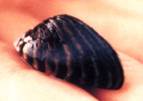
These alien species can wreak havoc on the natural balance of our waterways. While zebra mussels may appear to be cleaning up the Great Lakes (the water is much clearer than in years past) there are monumental negative implications of these mussels being there. And like many species that are not native, they are easily transported to new areas, and highly adaptable to new climates.
As boaters, we have an important role to play in NOT transporting species from one body of water to another. Experts predict that many aquatic nuisance species (ANS) will spread because of actions taken by un-informed people, and by trailered boats going from one lake to another, or from a lake to a river.
Almost every area of the country has specific nuisance species concerns that can be found on the internet. Visit the ANS Task Force for the latest information on various alien species.
Minimize the Risk
Here are some basic ideas that every boater needs to know in order to minimize the risk of being the carrier of ANS to a new waterway:
- If you are moving your boat from one water body to another, you are a potential carrier of plants and animals to the next waterway. Heads-up!
- Both big boats and small boats can be the carrier of ANS.
- Many ANS (like zebra mussels) can be transported in water, on equipment, the trailer, or on the boat. In their juvenile stage, you will not even be able to see them.
- If you have visible growth on the side of your boat you should double check that these are not ANS – contact your state Sea Grant or US Fish and Wildlife Agent if you have any doubts. Moving ANS from one state to another is not only really stupid, it’s against the law.
- If you are boating in an area where ANS are known to live, you should be especially careful about cleaning your boat off before taking it to a new waterway.
At any waterbody, if you have a small trailered boat, and have just pulled the boat out of the water but are still at the ramp, here are some things to check.
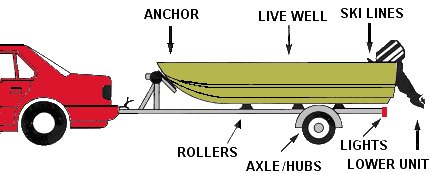
- Pull all plants or plant fragments off. Check the rollers to make sure there aren’t any plants between the boat and the roller or the pads. Make sure your engine doesn’t have any plants in the propeller.
- Empty all water from the boat, the live well, the bilge, and the bait bucket.
- Dump all unused bait at the fishing site, or give it to someone else who might be fishing.
- Wash off your boat, your ski lines, your gear, your engine, and scrub with a disposable rag. Leave the rag in the garbage can at the ramp.
- The overall idea with this cleaning process is to leave all plants and animals at the ramp, instead of moving any of them to another area of water or taking them home accidentally.
ONE FINAL NOTE:
Plants, fish, insects and animals from home aquariums should not be disposed of in lakes or anywhere in the natural environment. Many of these species are NOT native, and can destroy our local waterways.
Environmental Laws & Regulations
Garbage in the Water is Ugly and Dangerous
Garbage can also create entanglement, ingestion, and aesthetic problems for animals and boaters. Plastics in particular last for decades in the environment.
In the Gulf of Mexico, birds have been seen feeding cigarette butts to their young. In Marina Del Rey, cool water intakes for inboard boats have sucked up plastic bags, causing engines to overheat. In the Great Lakes, old rope and monofilament fishing line have wrapped around propellers, causing other engine problems. The problem is everywhere, but we all have a role to play in cleaning up our local boating waters.
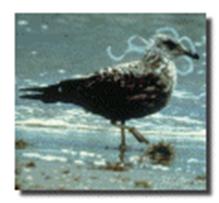
The bird in this photo has its head stuck in a plastic six-pack container.
The Law
Under federal law, it is illegal to toss ANY garbage from a boat while you are anywhere in lakes, rivers, bays, sounds, and offshore in the ocean less than 3 miles. Yes, this means you can’t throw a banana peel or your half-eaten sandwich overboard.
Violations may result in civil penalties up to $25,000, a fine of up to $50,000 and/or a prison sentence of up to 5 years! (State anti-littering laws may also apply on your boating waters.) The further offshore you go in the ocean, the more things you can legally dispose of from your boat. But you must always keep plastic items onboard for later disposal ashore.
Remember that while on inland and coastal waters where most of us do our boating, no garbage should go overboard. The only exception to this rule is fish waste, which under federal law, you can still put back into the water.
Please note that this law only covers garbage, and does not cover sewage (black water) or sink or shower water (grey water). These will be discussed under the sewage section below.
Garbage Disposal Regulations for U.S. Waterways
| Boat Position | Illegal to Dump |
|---|---|
| Lakes, Rivers, Bays, Sounds, and 0-3 miles from shore | Plastic, rags, glass, food, metal, crockery, dunnage, lining & packaging, materials that float |
| 3-12 Miles | Plastic, rags*, glass,* food*, metal*, crockery*, dunnage, lining & packaging, materials that float |
| 12-25 Miles | Plastic, dunnage, lining & packing, materials that float |
| 25 miles or more | Plastic |
| Dunnage– This refers to packing materials normally associated with commercial shipping such as packing foam or pallets | |
| Plastics–This includes such things as chip or garbage bags, plastic bottles, fishing line, and cigarette butts | |
| * Unless ground smaller than one inch | |
Specific Requirements
There are additional requirements based on how long your boat is. If you have a boat 26’ or longer, you must have a written garbage placard and an oil discharge placard “prominently posted” to remind you and your crew what can be thrown overboard and what can’t. The placards must be permanently attached, be made of durable material, and must be at least 4X9 inches in size. Great Lakes boaters must display a garbage placard specifically designed for the Great lakes.
If your boat is 40’ or longer, you must also have a written waste management plan, stating how you deal with the collected waste onboard, who handles it, and where it is disposed. This can be as short as one paragraph. We recommend that you keep your plan in your onboard ships papers. Click here for a sample waste management plan.
Human Waste Disposal
Marine Sanitation Devices (MSDs)
Anyone that spends a day on a boat with a head has the dubious pleasure of using the “onboard facilities.” Whether you are on a 16’ outboard or a 40’ ketch, the “call of nature” is a regular part of our boating experience. So what’s the big deal about using the water as a big bathroom?
The primary environmental concern with your sewage is not the urine (which is basically sterile) , but the feces. Human feces contains bacteria, pathogens, and nutrients. The idea behind federal regulations concerning sewage on boats is to keep untreated sewage out of our inland and coastal waters, so we don’t have to swim in it or drink it. Read on for the regulatory details.
Sanitation Regulations
In most inland and coastal waters, boats with installed toilets are required to have a sanitation system on board in order to control pollution. Standards have been set by the Environmental Protection Agency, and regulations have been Issued by the Coast Guard, covering the certification and use of Marine Sanitation Devices. Sanitation systems consist of an installed head (toilet), a waste-treating device (MSD), and/or a holding tank.
As with most Coast Guard Certified equipment, there are different classifications to cover most every marine application.
| Type/Cost | Inland Lakes and No Discharge Areas* | Rivers, Bays, Sounds, Etc. | Coastal and offshore areas (3 miles or more) |
|---|---|---|---|
| Installed toilet w/USCG Certified Type I MSD Cost: $1200+ | Not Legal. Type I + II MSD’s treat the waste and discharge it overboard. | Legal Option. Reduces bacteria, but not nutrients, in waste before discharging overboard. | Good option for boats < 65′. Not dependent on finding onshore pumpout stations. Treats waste before discharging overboard. |
| Installed toilet w/USCG Certified Type II MSD Cost: $4000+ | Good option for larger boats. Not dependent on onshore pumpout stations. Treats waste more effectively than Type I and discharges is overboard. | ||
| Installed toilet with a USCG Certified Type I or II MSD and a Type III holding tank Cost: $1400-4200 | Offers the most flexibility for use anywhere. Requires more space & more equipment. While in No Discharge Areas or inland, can treat waste and keep in holding tank for onshore pumpout. In coastal areas, can use pumpout if onshore facilities are available or discharge treated waste overboard. While offshore, can treat waste and discharge overboard. | ||
| Installed toilet w/Type III MSD. Cost: $500+ | Good option. Keeps waste out of water. Relies on having adequate onshore pumpout facilities. | Not practical for offshore without “Y” valve as a way to divert waste from holding tank. | |
| Installed toilet w/Type III MSD and “Y” valve Cost: $500+ | Good option. Keeps waste out of water. Relies on having adequate onshore pumpout facilities. While offshore, “Y” valve can be open to legally discharge directly overboard (3 miles or more offshore–oceans only). While not offshore, “Y” valve must be closed. | ||
| Portable toilet Cost: $70+ | Good option. Keeps waste out of water. Can use available onshore dump stations or dump in onshore toilet. | Need more capacity to be a practical option. | |
| *States with lakes capable of interstate navigation may allow the use of Type I or II’s. | |||
Pumpout Services
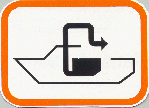
This national symbol is used to show boaters where onshore pumpout services are located. You’ll need to know this symbol if you use a portable toilet or Type III MSD (holding tank) on your boat.
Federal law says that untreated sewage (even if it’s been dosed with a deodorant product) can NOT be discharged in inland or coastal waters. This means the sewage from a portable toilet or a Type III holding tank can not be discharged unless you are in the ocean more than 3 miles offshore.
Federal law also states that if you have a holding tank with a “Y” valve allowing direct overboard discharge of untreated waste, it must be secured in the closed position while operating in all inland and coastal waters. Using a non-releasable wire tie, padlock, or removing the valve handle is considered adequate securing of the device.
Operating in a federally designated “No Discharge Area” further restricts what sewage you can discharge overboard. In these areas, there is no treated sewage discharge allowed from boats. That means if you have a Type I or II MSD, you are not allowed to discharge it while in those waters. There is a trend towards more local waters being designated as No Discharge Areas, so if you rely on using your Type I or II MSD, check a cruising guide before venturing into new waters.
Grey Water
Grey water is the water discharging from your sink and shower, while black water is the sewage/water discharging from a toilet. In the United States, there are no federal requirements for the containment of grey water. However, in Canada, and in some inland lakes, there may be additional restrictions. Please check your local cruising guide or with your local state boating agency for more details.
| Equipment on Boat | Legal? | Restrictions | |
|---|---|---|---|
| Installed toilet without MSD | No | None | |
| Installed toilet with macerator | No | USCG regulations require that all installed toilets have an attached MSD. Macerator does not count. | |
| Installed toilet with Type I MSD* | Yes (But not ok in No Discharge Areas) | Ok on boats < 65′. Discharge is < 1000 per 100 milliliters of fecal coliform bacteria with no visibly identifiable floating solids. | |
| Installed toilet with Type II MSD** | Yes (But not ok in No Discharge Areas) | Ok on any size boat. found on larger boats because of electricity and space requirements. Discharge is < 200 per 100 milliliters of fecal coliform bacteria with < 150 milligrams of suspended solids per liter. | |
| Installed toilet with Type III MSD** | Yes | Keeps waste out of water by using a holding tank. Discharge at onshore pumpout facility or via “Y” valve while more than 3 miles offshore in the ocean. | |
| Portable toilet | Legal on any boat.* | Does not fall under USCG regulations of MSDs. | |
| No installed toilet | Yes | Remember No Discharge Area rules. | |
| Note: Some states have additional restrictions. | |||
| For example, in Florida, houseboats may only have a Type III MSD or a permanent sewer line to shore. Check on your state’s laws. | |||
| ** Must be USCG certified | |||
| * Not legal in the province of Ontario | |||
Disposal of Toxic Substances
Hazardous Waste
Most of us come into contact daily with hazardous substances, whether or not we recognize it. One of the easiest ways to figure out what products need special handling, use, and disposal is to read the back label on the product packaging.
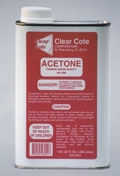
If the label includes strong warning statements about personal health, you can suspect that the product can also have significant environmental implications if improperly disposed (as well as significant personal health implications if improperly used).
Some boat products that may be hazardous are solvents, varnishes, cleaners, bottom paints, as well as gasoline, diesel, oil, and antifreeze.
Most hazardous materials laws relate to the proper disposal of large amounts of product – which won’t apply to the individual boater using a quart here or a gallon there.
Local recycling and proper disposal options vary widely depending on where you live.
One of the most frustrating parts of being a consumer of hazardous substances is the fact that the labels often state “dispose of according to local and state laws.” This doesn’t help the average person much, since we often can’t find those laws. Given that situation, some advice we have is listed below.
Hazmat Tips
- Start reading labels!
- Before you buy a new product, read the label and figure out if you really need to use that strong a product.
- Buy only the amount you’ll need or share with a friend.
- Follow directions for use and safely store where the product container can’t capsize!
- Try alternative products or methods of cleaning.
- Schedule major maintenance work on land away from the water’s edge (maybe during winter storage?).
- Find your local “Household Hazardous Waste” collection days where you can safely dispose of this stuff. Check with your local public works department or check out earth911.org to find possibilities in your town.
- Put some fuel booster product in outboard tanks in the fall to avoid having stale fuel in the spring. This may be even more important to remember if you are running one of the newer engines, which is not burning as much fuel.
- Wherever possible, use less toxic propylene glycol antifreeze instead of ethylene glycol.
When launching your boat in the spring, see if you can capture the chemical instead of letting it spew into the marina’s waters. Your marina may be able to reuse or recycle it for you.
Fuel and Oil Discharge
Under federal law (the Oil Pollution Act of 1990 and the Clean Water Act) it is illegal to discharge any petroleum product into the water. By law, any oil or fuel spill that leaves a sheen on the water must be reported to the U.S. Coast Guard at 1-800-424-8802.
You are responsible for any environmental damage caused by your fuel spill. So…preventing spills will be beneficial for you and the boating environment.
It is also against the law to use detergent or other chemicals on a spill to disperse the oil or sheen. These products can cause the petroleum to sink into the water, causing more harm to marine animals and bottom sediments.
If you have spilled a petroleum product, immediately stop the source of the leak, use oil absorbent pads or booms, and notify your marina. Call the U.S. Coast Guard. Your marina may also know a state agency that needs to be contacted. If the spill is of any substantial size, we also recommend you call your insurance company.
Fines for Discharging Hazardous Materials
Civil Penalties
Up to $25,000 per day, per violation. 33 U.S.C. 1319(d).
Injunctive relief. 33 U.S.C. 1319(b).
Criminal Charges
Negligent Violations: $2,500 to $25,000 fine or imprisonment for one year, or both. 33 U.S.C. 1319(c)(1).
Knowing Violations: $5,000 to $50,000 fine or imprisonment for not more than three years, or both. 33 U.S.C. 1319(c)(2).
Knowing Endangerment: Up to $250,000 fine or imprisonment for up to 15 years, or both. 33 U.S.C. 1319(c)(3).
Visit our page on Preserving Clean Water to learn more!
Ten Tips for Environmentally Friendly Boat Maintenance
Boaters enjoy the best of our waterways – the peace of being on the water, the ability to interact with nature, and the beauty of the open spaces. Whether you are in a personal watercraft, a row boat, or a large motorboat, each of us has a vested interest in the health of these waterways and natural resources. It’s this vested interest that drives many boaters and marina operators to ask what they can do to help the environment. The BoatU.S. Foundation for Boating Safety and Clean Water works to help these groups understand specific actions they can take to protect the environment while having a great time on the water. Here are some ideas.
- Reuse and recycle. Recycle spent antifreeze, fuel, oil, oil filters, and batteries. Use less toxic propylene glycol antifreeze whenever possible, but check before mixing it with other antifreeze for recycling.
- Put a sturdy trash container on your boat. If it’s in an open area, make sure it has a locking lid to prevent light items from blowing away.
- Tune up your engine. A tuned engine improves fuel economy and burns fuel more efficiently, causing fewer emissions from entering the air and water.
- Clean your bottom. Keeping your hull clean and free of barnacles, grass and other marine growth will help reduce fuel consumption, and help increase your boats’ performance. Use a hard (not ablative) anti-fouling paint if you plan on scrubbing the boat bottom while in the water.
- Recycle at your marina. If you do not currently have recycling at your marina, let the manager know that you and other boaters would support the separate collection of recyclables, particularly aluminum cans.
- Fix your prop. Damaged props greatly reduce the efficiency of your engine. Having a prop that is clean and in good condition will increase your performance, and help reduce fuel consumption.
- Clean your bilge. Having a clean bilge will help you spot fuel/oil leaks, and help you avoid discharging petroleum into the water. A clean bilge is also much easier on your nose!
- Wash your boat often. Try to wash your deck off regularly with fresh water and a scrub brush to reduce the amount of strong chemical cleaners needed throughout the boating season. If your boat is hauled for the winter, use that time to do any significant cleaning or repairs, to reduce the potential for pollutants to enter the water.
- Refuel carefully. Do not top off fuel tanks, because it usually leads to spillage.
- Clean naturally. By using natural cleaners such as vinegar and baking soda, or biodegradable cleaners and detergents, you will help reduce the amount of solvents and chemicals going into the water.
Environmental Tips
Ten Ways to More Environmentally Friendly Boating
Boaters have a vested interest in clean water, which is able to support diverse fish and wildlife. One by one our collective actions add up. Here are some ideas about how you can help the waters while boating.
- Stash your trash. Never throw anything into the water that didn’t come out of it. Keep trash, even food waste, onboard and bring it back to recycle or throw away on shore.
- Fish for the future. Learn proper catch and release techniques and use them after you’ve caught what you need.
- Respect marine wildlife. Don’t feed or harass dolphins and other mammals. Reduce speed and give a wide berth to whales and manatees.
- Watch your wake. Large wakes can unnecessarily accelerate shoreline erosion. Throttle back in narrow waterways. Use moorings rather than anchoring in environmentally delicate areas such as coral reef. When snorkeling or diving, never touch any live coral.
- Comply with sewage standards. Install a Coast Guard- approved marine sanitation device on your boat and use it. Consult up-to-date cruising guides for the locations of pump- out facilities. If you can’t find one in your area, organize boat owners to convince your local marina to install one.
- Establish a boat rule that no trash goes overboard – even cigarette butts. While orienting guests aboard your boat, let them know about this rule and the reasons behind it.
- Use moorings rather than anchoring in environmentally delicate areas like coral reefs.
- Less is more. Reduce the amount of packaging and plastic you take aboard. Pack food in Tupperware, use bulk containers of chips, soda, etc.
- Know the water. Avoid shallow waters, reefs, and sandbars. You can not only avoid the cost of a tow, potential fine, and the damage done to your boat, but you can also help protect fragile marine plants and animals.
- Get involved. You can make an even greater impact by donating money and/or your time to environmental action groups, from national organizations such as the BoatU.S. Foundation as well as regional and local groups. Be a watchdog. If you’re out on the water and see oil or chemical spills or other pollution, call the Coast Guard’s National Response Center hotline (800-424-8802).
For further reading on these topics and other boating information, The BoatU.S. Foundation recommends any of the following:
- Chapman’s Piloting by: Elbert S. Maloney
- Chapman’s Hands-On Powerboating CD ROM
- The Annapolis Book of Seamanship by: John Rousmaniere
- US Power Squadron Booklets (Knots, Sailing, GPS, Radar, etc.)
- US Coast Guard Auxiliary’s Skipper’s Safe Boating Course