
Carbon Monoxide
Safety First
What you need to know about carbon monoxide before your next outing
Carbon monoxide (CO) is a colorless, odorless, and tasteless gas that is essentially undetectable by human senses. It is produced when an engine that uses a carbon-based fuel like gasoline is running.
Use the tabs below to explore all Boating Safety content related to carbon monoxide.
What You Can’t See, Can Harm You
The Basics of What you Need to Know
Carbon monoxide is a component of exhaust gases – if you can smell exhaust then CO is present. Carbon monoxide is also produced when propane, charcoal, or oil burns to power onboard appliances such as a stove, grill, hot water heater or generator. The most common source is the gasoline-powered engine which is found on the majority of recreational motor boats. For this reason, it is important to know the sources of CO, the symptoms of CO exposure, and what to do if you suspect someone has been exposed to this deadly gas for any period of time.
- You cannot see, smell or taste CO
- The most common source of CO is a running engine or generator
- Install and maintain a marine grade CO detector
- CO can make you sick in seconds and high concentrations of CO can kill
- CO symptoms are similar to and often confused with seasickness or alcohol intoxication
- Avoid closed-off, poorly ventilated areas of a boat when its engine is running
- Never ride or hang on a swim platform where gases accumulate when the engine is running
- If CO is suspected, open all windows, hatches, and ports to ventilate
- Move a person to fresh air if CO poisoning is suspected and seek medical attention
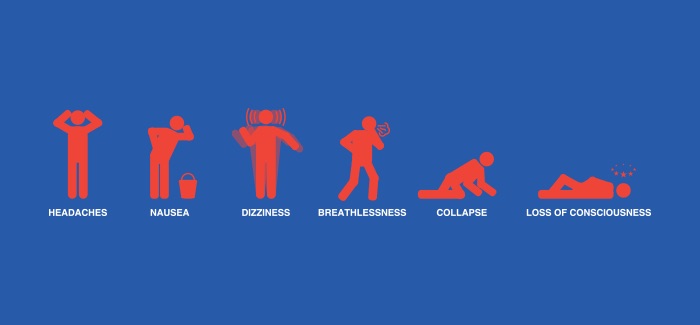
Dangerous Gases
Carbon monoxide enters the bloodstream though the lungs by breathing in this dangerous gas. Exposure in a well ventilated environment is generally not a problem. Brief exposure in a more confined environment can cause sickness and prolonged exposure to higher concentrations can kill you. Since symptoms of carbon monoxide mimic seasickness or alcohol intoxication it is sometimes overlooked as nothing serious and those affected never receive the medical attention they need.
Tip: Maintain fresh air circulation throughout the boat at all times and maintain your vessel to assure peak engine performance. An improperly tuned engine is more likely to produce elevated levels of CO.
To avoid CO you should know the areas of where CO can accumulate such as inadequately ventilated canvas enclosures and engine compartments. If you are tied to a dock be certain exhaust ports aren’t blocked which can force exhaust back into the boat and if you are rafted to another boat be certain exhaust from one boat doesn’t enter the other. Another way for exhaust to enter a boat is when a moving boat creates the station wagon effect where exhaust finds its way back aboard because of circular airflow known as back drafting.
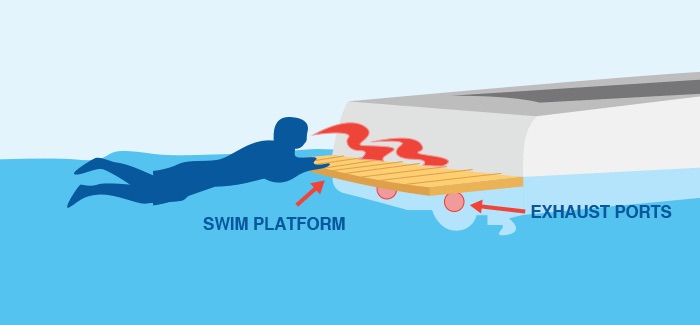
What You Can’t See, Can Harm You
Trip Checklist for Carbon Monoxide
- Make sure you know of all exhaust outlet locations and confirm they are not obstructed
- Confirm that water flows from the exhaust outlet when motors or generators are running
- Educate all passengers about the symptoms of CO poisoning and where CO may accumulate
- Test the operation of each CO detector for proper functioning by pressing the test button
- Open hatches or canvas enclosures if CO accumulation is suspected
- When rafted to another boat, ensure that both boats are able to ventilate their exhaust away from themselves and each other
- Avoid swim platforms, or swimming, around or near a boat when the engine is running
- Periodically examine the exhaust fixtures on your boat to be certain of proper performance
- Always maintain your boat’s engine and exhaust system to reduce the risk of CO buildup