
Fire Extinguishers
SAfety First
What you need to know about fire extinguishers before your next outing
Everything you need to know about fire extinguishers on your boat — from current requirements and maintenance tips to choosing the right type and knowing how to use one.
Use the tabs below to explore all Boating Safety content related to Fire Extinguishers.
Fire Extinguisher Requirements
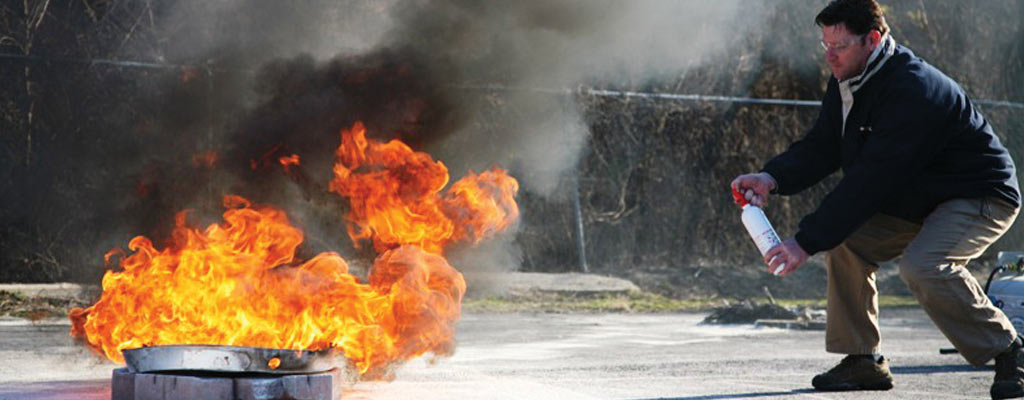
2022 Regulations – Fire extinguishers must be replaced 12 years after manufacture
The new fire extinguisher regulations that went into effect on April 20, 2022, may seem a little confusing, but here they are below.
Vessel Length and Fire Extinguisher Type Table
Goes into effect April 20, 2022
| Vessel Length | No Fixed System | With approved Fixed Systems |
| Less than 26′ | One 5-B or One 10-B | 0 |
| 26′ to less than 40′ | Two 5-B or Two 10-B or One 20-B | One 5-B or One-10-B |
| 40′ to 65′ | Three 5-B or Three 10-B or One 20-B and One 5-B or One 10-B | Two 5-B or Two 10-B or One 20-B |
If you own a boat that is model year 2018 or newer, you may need to replace your fire extinguishers.
- In addition to meeting the carriage requirements for the correct number of extinguishers for the size of your boat, they must be labeled as 5-B, 10-B or 20-B, extinguishers labeled with B-I or B-II only are no longer acceptable.
- Extinguishers must not be more than 12 years old according to the date of manufacture stamped on the bottle
- You only have to get new ones if they are no longer serviceable. Good serviceable conditions are as follows:
– If the extinguisher has a pressure gauge reading or indicator it must be in the operable range or position
– The lock pin is firmly in place
– The discharge nozzle is clean and free of obstruction
– The extinguisher does not show visible signs of significant corrosion or damage.
If you own a boat that is 2017 model year or older (between 1953-2017):
- You may keep your extinguishers labeled B-I and B-II as long as they are still serviceable, but
- If there is a date stamped on the bottle, extinguishers must not be more than 12 years old according to that date.
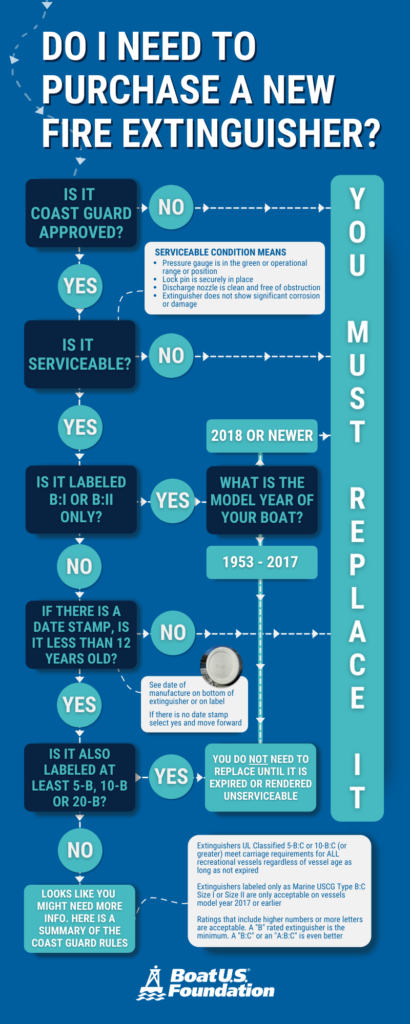
Still need guidance? Follow our flow chart.
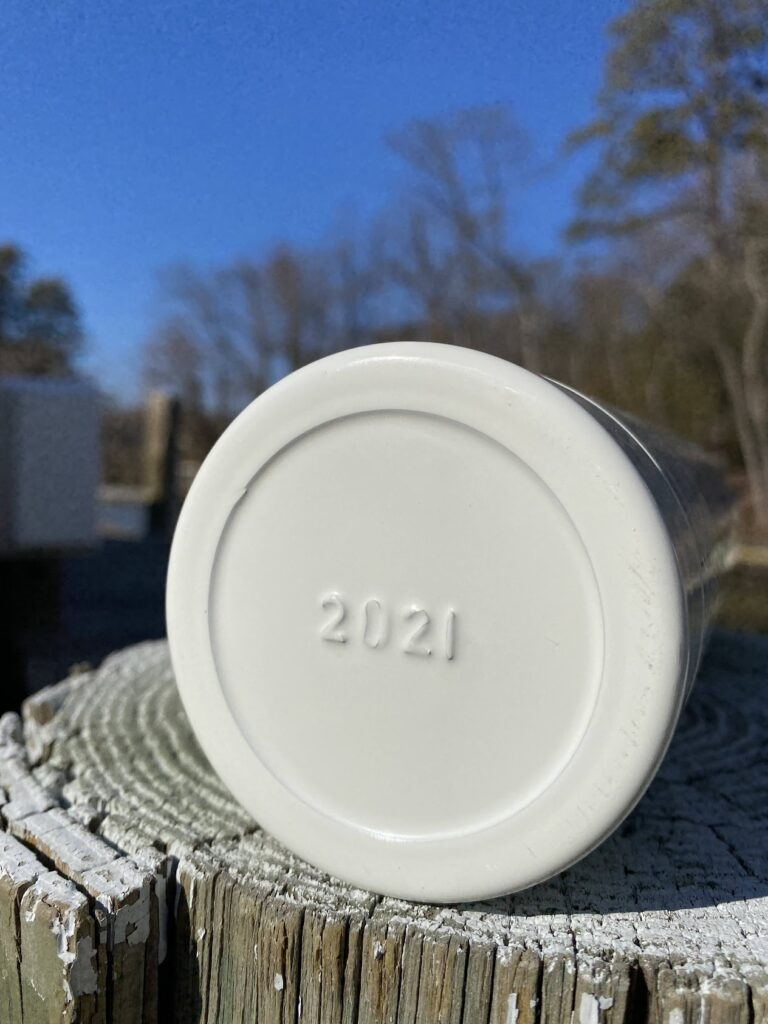
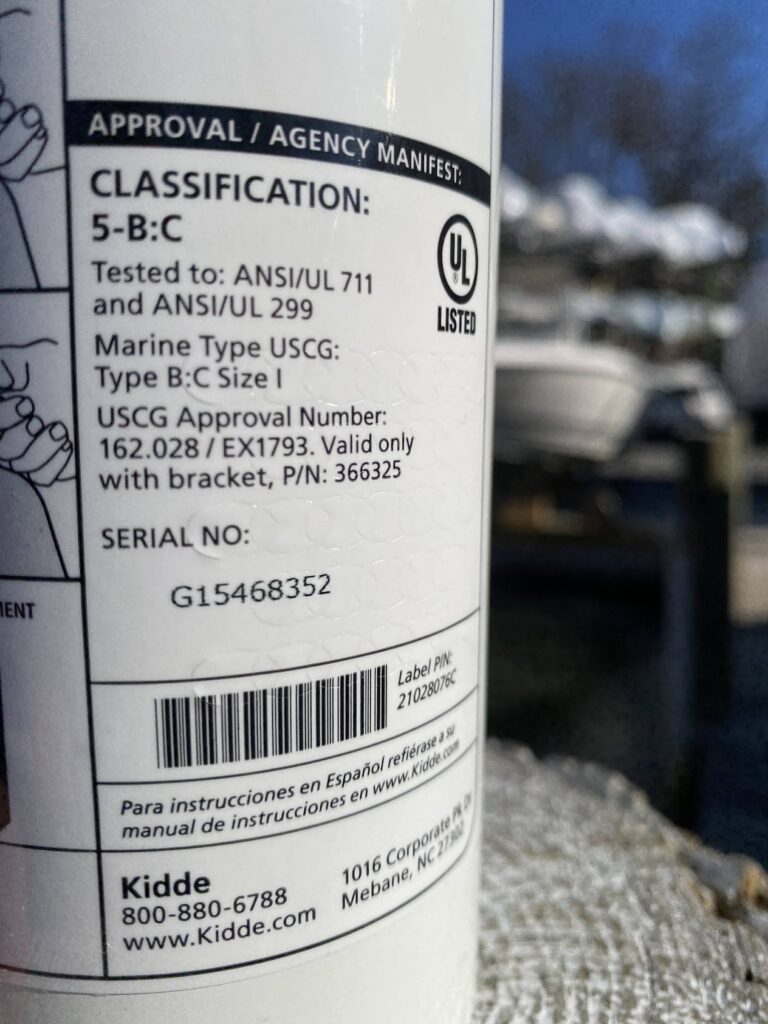
These images depict what you should be seeing when you check your fire extinguisher: a date that is within the last 12 years and a classification of at least 5B. Remember, a fire extinguisher with more letters and numbers is OK too. The minimum size and classification is 5B.
FAQs PDF
Still Have Questions?
Check out the frequently asked questions (FAQs) guide that gets to the bottom of some of your burning questions.
Which Fire Extinguisher is Right for Me?
A tri-class dry chemical extinguisher will meet most boaters’ needs. If you have concerns about damage to your electronics or your engine compartment lacks a fixed well.
As fire extinguishers are required on most boats, you most likely have one aboard. But chances are, you’ve never needed to use one, and might not know the proper technique for using one.
Take the time to read the directions on your fire extinguisher – you might be surprised about what it can and can’t do. For more information on fire extinguishers, check out the Gear Tests & Safety Guide that we did in 2009 testing different extinguishers on different fires as well as testing volunteers on how quickly they could figure out how to use one.
Our recommendation is to have a tri-class (1A:10BC) fire extinguisher on board your boat. We also suggest you have more than the Coast Guard requires.
Parts & Contents of a Fire Extinguisher
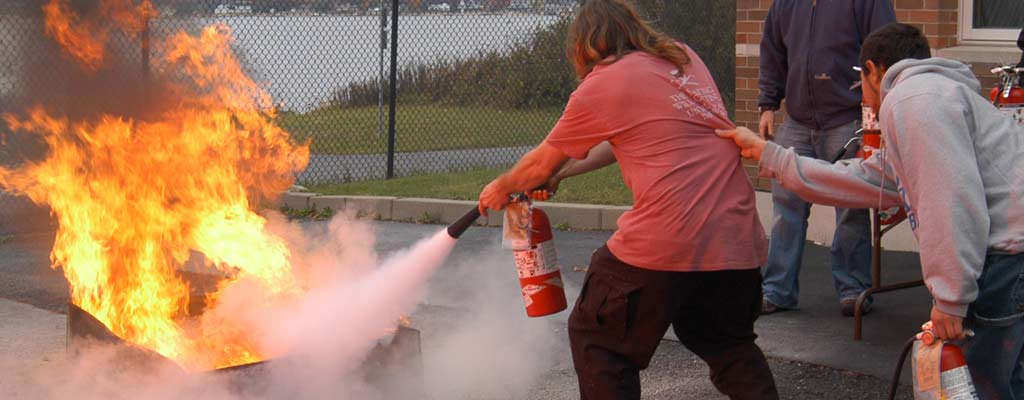
Firing Mechanism
All extinguishers have pins or pull tabs which must to be removed to activate the unit. Often, a plastic tie is included to prevent accidental discharge. Some of our testers had difficulty removing the pin because it was held in by a thin sacrificial plastic tie.
We found most extinguishers had two levers that are squeezed together to activate. This is in contrast to the smaller 5-BC units designed for personal watercraft, which use a more simplified firing mechanism. Kidde uses a plunger mechanism and First Alert uses a trigger to activate their unit. Both are designed so that the firing mechanism does not extend past the width of the cylinder.

Gauges
There is a gauge on most extinguishers to measure the pressure of its contents. A fire gauges extinguisher can be “overcharged” meaning the contents are under too much pressure, “discharged” meaning that there is not enough pressure to work correctly or “in the green” which means that the unit is properly charged.
The standard round gauge was found on all but the personal watercraft units. Over time, or after it has been used, a fire extinguisher will loose pressure and will cease to work properly.
Most of our test extinguishers were not rechargeable. A rechargeable extinguisher can be taken to a service station for maintenance. If it is not rechargeable then it should be discarded when the gauge reads “discharged” or it has been in service for 12 years from manufacture.
Partial Discharge
Fire extinguishers are designed to rapidly release fire retardant onto their target. The firing mechanism pierces a gas cylinder exerting additional pressure in the cylinder propelling the retardant out of the open nozzle. During our test we found that a partially discharged dry chemical extinguisher was inoperable after mere seconds. Due to this fact, if you have a flare-up after several minutes, a partially discharged unit might not work. It is important to replace or service the extinguisher as soon as possible.
Extinguisher Contents
Dry Chemical Extinguisher
The economically priced, handheld dry chemical fire extinguishers are the most common type found aboard recreational boats. The retardant functions by coating the material on fire and removing the oxygen from the flame similar to throwing a fire blanket on a fire. An accurate aim at the base of the fire directs the retardant at the source. Sometimes our testers found that by aiming at the top or middle of the fire, they could not put out the fire completely, and frequently required an additional extinguisher to finish the job. Clean up of dry chemical extinguishers can be messy and it is corrosive to electronic components and wiring.
Halon Replacement Extinguishers
Unlike dry chemical extinguishers, the Halotron extinguisher displaces oxygen from the fire. This gaseous fire suppressant allows for easy sight of the fire and does not harm engine or electronic components. Halon replacement extinguishers are ideal for separated, enclosed spaces such as an engine compartment for use through a Fire-Port. All portable halon replacement units are safe to breathe but fixed systems typically are not. Drawbacks for these fire extinguishers are the higher price and bulkier size.
How to Use Fire Extinguishers
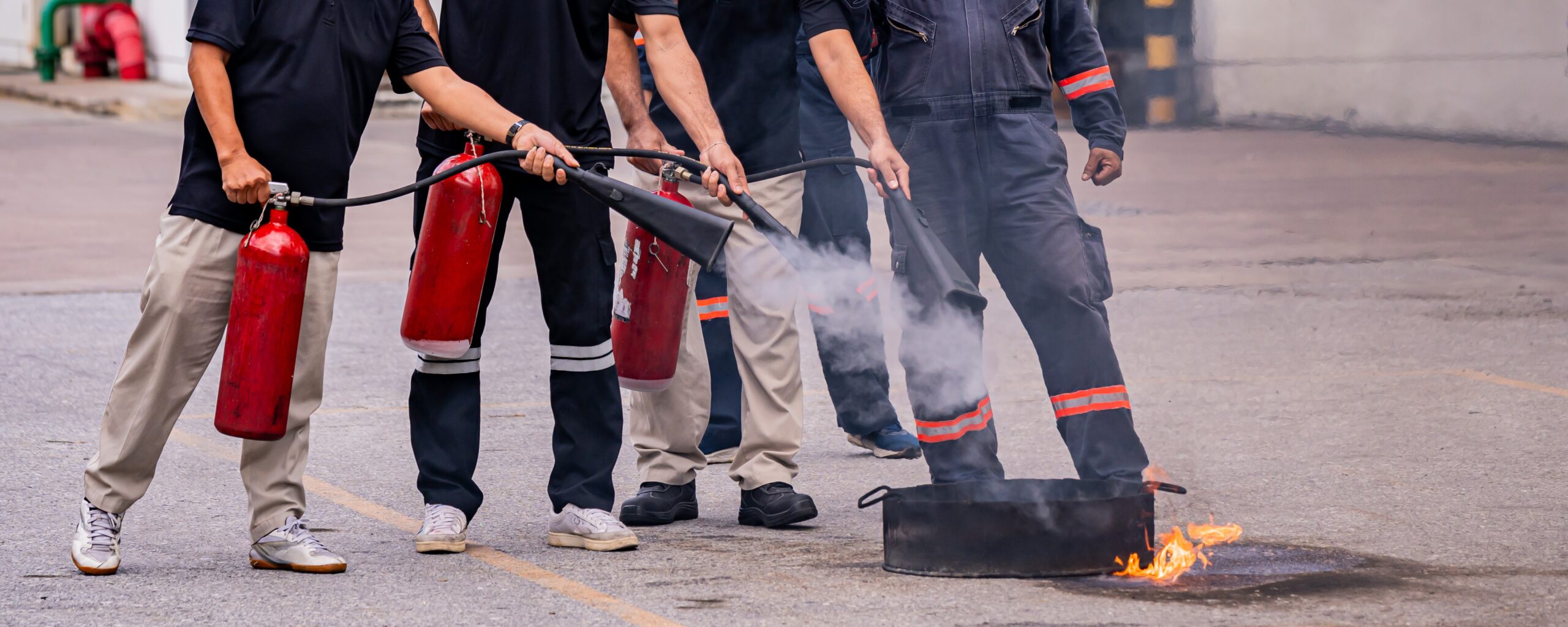
Know how to use a fire extinguisher before you are in a situation where you have to use it
Fire extinguishers are labeled according to the type of fire on which they may be used. Fires involving wood or cloth, flammable liquids, electrical current or a combination of those will each react differently to extinguishers. Using the wrong type of extinguisher on a particular type of fire could be dangerous and make matters even worse. In the heat of the moment reading the directions on the extinguisher is an after-thought. Check out our Gear Test & Safety Guide on Fire Extinguishers for more information.
Remember the P-A-S-S word!
- Pull the pin at the top of the cylinder
- Aim the nozzle at the base of the fire
- Squeeze or press the handle
- Sweep the contents from side to side at the base of the fire until it goes out
Mounting and Storage
The time it takes to find a fire extinguisher in a cluttered locker could mean the mounting difference between saving your boat or having to jump overboard. A properly mounted fire extinguisher should be at every exit and near the engine compartment. This keeps your back to your escape route and an extinguisher ready near the likely sources of fire aboard. In the galley, an extinguisher should be mounted so you do not have to reach over the stove.
On open motorboats, fire extinguishers should be mounted in an easily accessible location. A non-marine-rated fire extinguisher could have parts that corrode or do not secure it firmly to a moving boat. Be sure to purchase a US Coast Guard-approved marine-rated fire extinguisher which has a noncorrosive metal or plastic bracket that can secure it firmly to a vertical surface.