Cold Water Boating
Safety First
What you need to know about boating in cold water before your next outing
Boating in cold weather can be exhilarating, but it also puts you at risk of falling into dangerously cold waters. Even boating in warm weather can be dangerous if the water is much colder than the air. Use the tabs below to explore all Boating Safety content related to cold water boating.
Explore the content on this page and the tabs below to understand boating in colder water.
Be Prepared for Cold Water
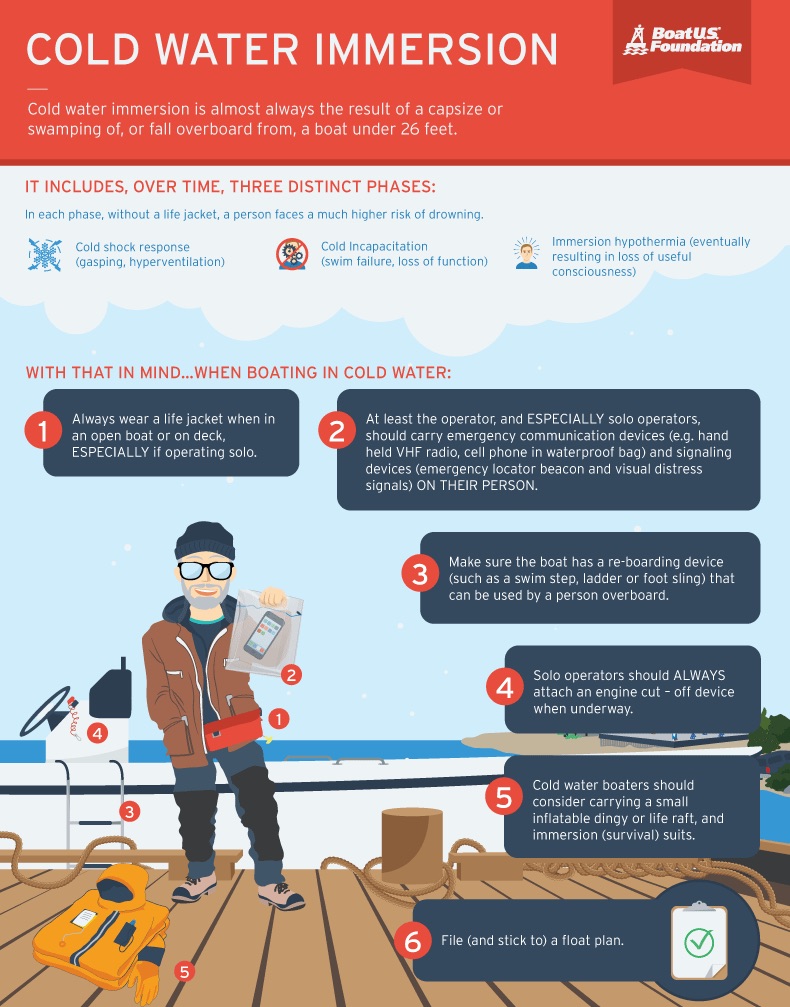
As a general rule, if the air and water temperature added together equal less than 100 degrees Fahrenheit you should take the following steps:
- Wear a properly fitted life jacket. There are even special life jackets that have extra insulation to double as an additional warm layer. This could save your life!
- Dress for the water temperature not the air temperature. Having lots of layers on, including a hat will help you survive if you do end up in the water. The first layer should be a synthetic fabric which will keep cool water away from your skin. Cotton keeps cool water close to the skin and should be avoided as the first layer.
- Bring extra clothes in a dry bag and keep them on the boat just in case someone in your party gets wet. Energy bars and a thermos of a warm beverage is also a welcomed accessory.
Gasp! The Four Stages of Cold Water Immersion
What you should know about cold water immersion
Falling into cold water is more than just an inconvenience, it’s downright dangerous.
For example, your body may react to the cold water or sustained immersion in cold water, in uncontrollable ways. Experts have described what happens to the body when immersed in cold water and have summarized the features and characteristics into four distinct stages. Failure to recognize this, can lead to hypothermia, a serious condition which is the abnormal lowering of internal body temperature that should be treated only by medical personnel or specially trained individuals.
- Cold Shock – Falling into cold water provokes an immediate gasp reflex. If your head is under water, you’d inhale water instead of air and it is unlikely you’ll resurface if you’re not wearing a life jacket. Initial shock can cause panic, hyperventilation, and increase heart rate leading to a heart-attack. This stage lasts 3-5 minutes and at this point you should concentrate on staying afloat with your head above water.
- Swimming Failure – In just 3 -30 minutes, the body will experience swimming failure. Due to loss of muscle coordination, swimming becomes a struggle and the body tends to go more vertical in the water making any forward movement increasingly difficult. That’s why it is not recommended to swim for help, but remain with the boat or something else that floats while keeping your head above water while awaiting rescue.
- Hypothermia – True hypothermia sets in after about 30 minutes. Most victims never make it to this stage since 75% of individuals succumb and die in the earlier stages of cold water immersion. At this stage, regardless of your body type, size, insulation of clothing, acclimatization and other factors, your body’s core temperature gets dangerously low. Your survival chances are greatly lessened at this stage. Victims are usually rendered unconscious in this stage.
- Post Rescue Collapse – A rescued victim must be handled very carefully. When a person is removed from cold water, the body will react to the surrounding air and the body position. Blood pressure often drops, inhaled water can damage the lungs, and heart problems can develop as cold blood from the extremities is released into the body core. Proper medical attention is essential to re-warm the body safely.
While Waiting for Help to Arrive
Heat Escape Lessening Posture – H.E.L.P.
Individual Technique
If you find yourself in the water, button up your clothing, cinch your life jacket down nice and snug, keep your head out of the water as much as possible and if you’re wearing a hat pull it down tight. Kick off any heavy shoes or boots, but know that some boots like waders can be turned upside down to create an air pocket making the boots good emergency flotation.
Group Technique
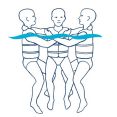
Huddle with others if there are several people in the water. To do this face inward, link arms over each other’s shoulders or under each other’s arms and get together close and tight. This will allow you to share as much heat as possible. If there are children or seniors have them move to the middle of the huddle.
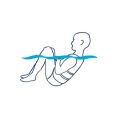
This position aims to protect some of the areas of your body most prone to heat loss – the head, neck, sides of the chest cavity and the groin area. If you are wearing a life jacket, this position can be very effective. To reach this position, you should bring your knees up as close as possible to your chest and grasp your hands together over your chest. If this is too difficult, or too unstable, cross your calves, bend your knees and pull your legs close to your body. Cross your arms and tuck your hands flat under your armpits.