
Boating Equipment
Study Guide
What to Know About Boating Equipment
Here’s where you’ll find topics ranging from life jacket types and requirements to lists of the equipment boats are required to carry aboard. Fighting fires and using visual distress signals are also covered in this section. You can also read up on the different kinds of radios you might have aboard and how they work as well as other methods you might use to communicate while out at sea.
Personal Flotation Devices (PFDs)
Life Jackets
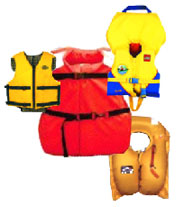
There are five types of traditonal foam flotation devices. Each is designed for different boating activites and water conditions and has its own maximum buoyancy, performance level, and limitations. You should choose your life jacket based on your boating activities and conditions, as recommended below. Buy a life jacket that you will wear.
Try to buy a brightly colored jacked, such as orange or yellow, so that you will be visible to rescuers. Take it out of the plastic, try it on, and learn how to adjust it for a snug fit. Then, test it in the water, make sure your life jacket supports you and keeps your mouth and head clear of the water with no effort on your part. Then, try pulling it on once you’re in the water…it’s not as easy as it seems.
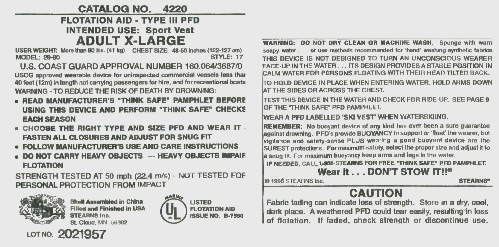
Manufacturers include valuable information about each PFD on the product label, and in an attached brochure. The label will give you information about what uses the jacket was intended for, along with information about the size of person it will fit, care instructions, and how to wear or ‘don’ the jacket. Keep in mind that using the jacket outside of its listed restrictions and intended use is illegal, and can result in receiving a ticket–or more importantly, the loss of a loved one.
What you would find on a typical life jacket label
When Should You Wear a Life Jacket?
In general, the best time to wear your lifejacket is when you are near the water. Accidents happen…both on the dock, and on quiet, still waters. In fact, most boating fatalities occur when the boat is moving slowly or not at all. If you feel comfortable without a life jacket on during calm conditions, always keep your eye on weather and water conditions as they can deteriorate very rapidly. While you should always wear your PFD, it is particularly important to wear your PFD during the following times:
- Boating at night, or at times of reduced visibility – When it is hard to see, it will take that much longer to find you if you fall overboard.
- In congested waterways – Many boats and turbulent water might make it difficult to see you in the water. Wearing a PFD will get you higher up, and the jacket colors should make you easier to see.
- When you are by yourself – If you boat alone, there’s generally no one around that can help immediately.
- If you boat in rough weather – Difficult sea conditions make for difficult rescues.
- If you boat in hazardous waters – Hydraulics near dams, or in places with strong currents/cold water–even if it’s sunny and warm–can make it difficult to rescue you quickly.
Even if you avoid these situations, if you are on an unfamiliar boat, or in unfamiliar waters, you should strongly consider wearing your life jacket. By law, recreational vessels must carry a properly fitted, serviceable PFD for every person on board. Jackets must also be of the correct size for the person wearing it, and you must have life jackets READILY AVAILABLE for use. That means they shouldn’t be buried in a locker under a pile of gear, or still in their packaging. Have them out, and ready for use. Better yet, wear them from the start!
What is Buoyancy and Why is it Important?
Buoyancy is the force, expressed in pounds, required to keep you afloat with your head and chin above the water. Since everyone’s buoyancy requirements are different based on size, weight, sex, age, percent body fat, and general physical condition you should test your life jacket in the water to make sure it will offer you maximum performance when your life depends on it.
TYPE I – Inherently Buoyant
Recommended Uses
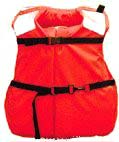
- When cruising, racing and fishing offshore, or in stormy conditions.
- Minimum buoyancy: 22 lbs. (11 lbs. for child size).
- Best for open, rough or remote water where rescue may be slow to arrive. Will turn MOST unconscious wearers face-up in water.
- Offers the best protection, but is somewhat bulky and uncomfortable. Does the best job of retaining body heat, as it has additional foam and fabric, and keeps your head higher above water.
TYPE I – Inflatable
Recommended Uses
- Minimum buoyancy: 34 lbs.
- Recommended Uses: offshore cruising, racing, fishing.
- Will turn unconscious wearer face-up.
- Advantages: two inflation mechanisms, both manual and automatic; very comfortable to wear.
- Disadvantages: requires periodic maintenance; not suitable for whitewater, for use with personal watercraft, or while skiing. So expensive that there currently aren’t any Type I inflatable PFD’s available to the general public.
TYPE II – Near-Shore Inherently Buoyant
Recommended Uses
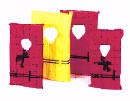
- When cruising, racing and fishing offshore, or when boating alone, or in stormy conditions.
- Minimum buoyancy: 15.5 lbs.
- Good for protected, inland water near shore, where chances of immediate rescue is good. Not suitable for extended survival in rough water. Will turn SOME unconscious wearers face-up in water. Poor performer in rough water, often requires you to tread water in order to keep your head above water.
- More comfortable but less buoyant than Type I. Provides far less floatation than a Type I.
Type II – Inflatable
Recommended Uses
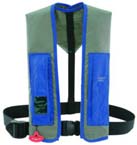
- Minimum buoyancy: 34 lbs.
- Recommended Uses: inland cruising, dinghy sailing and racing.
- Not guaranteed to turn unconscious wearer face-up.
- Advantages: very comfortable, more buoyant than Type II Inherently Buoyant jackets.
- Disadvantages: High price , may be manual or automatic.
TYPE III – Flotation Aid Inherently Buoyant
Recommended Uses
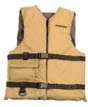
- Supervised activities, such as sailing regattas, dinghy races, water skiing, fishing, canoeing, kayaking and during personal watercraft operation.
- Minimum buoyancy: 15.5 lbs.
- Good for protected, inland water near shore, where chance of immediate rescue is good.
- Not suitable for extended survival in rough water. Not designed to turn unconscious people face up in water.
- Most comfortable to wear than a Type I or a Type II, but provides far less floatation than a Type I.
Type III – Inflatable
Recommended Uses
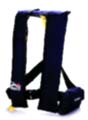
- Minimum buoyancy: 22.5 lbs.
- Recommended Uses: supervised activities such as sailing regattas, dinghy races, canoeing.
- Not guaranteed to turn unconscious wearer face-up.
- Advantages: more comfortable than a Type III Inherently Buoyant jacket.
- Disadvantages: one manual inflation mechanism only.
TYPE IV – Throwable Device Inherently Buoyant
Recommended Uses
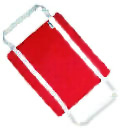
- Throw to overboard victim or to supplement the buoyancy of a person overboard. It is not to be worn.
- Minimum buoyancy: 16.5 lbs. for ring buoy or 18 lbs. for boat cushion.
- Can be a cushion, ring or horseshoe mounted on deck.
- For calm, inland water with heavy boat traffic, where help is always nearby. Not for unconscious persons, non-swimmers or children. NEVER to be used as a seat cushion! This degrades the foam and reduces the amount of floatation that is provided.
- More comfortable than a Type I or a Type II, but provides less floatation than a Type I.
Note
Type IV devices must be IMMEDIATELY AVAILABLE for use. You must have one at arm’s length to throw over the side in an emergency. Having one in a locker under the driver’s seat isn’t considered “immediately available.”
TYPE V – Special Use Device
Recommended Uses
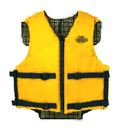
- Restricted to the special use for which each is designed, for example: sailboard harness, decksuit, commercial white water vest or float coats.
- Minimum Buoyancy: 15.5 to 22 lbs.
- Good for protected, inland water near shore, where chance of immediate rescue is good.
- Not suitable for extended survival in rough water. Not designed to turn unconscious people face up in water.
- More comfortable to wear than a Type I or a Type II, but provides far less floatation than a Type I.
Type V – Automatic Inflation Models
Recommended Uses
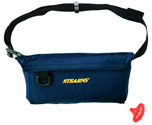
- Minimum buoyancy: 22.5 to 34 lbs., depending on style.
- Restricted to the one use for which it is designed, ex., sailboard harness, belt pack, deck suit, float coat.
- Must be worn to meet federal requirements.
- Not guaranteed to turn unconscious wearer face-up.
- Some models feature a combination of CO2 inflation and built-in foam and provide 15.5 to 22 lbs. of buoyancy.
Type V: Hybrids
Recommended Uses
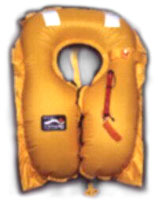
- Recommended for boating activities where rescue is nearby and must be worn when underway.
- Minimum buoyancy: Have 7.5 lbs. of built-in foam buoyancy and can be inflated to 22 lbs.
- More comfortable to wear than Type I or Type II, but are inadequate for unconscious overboard victims.
Inflation Mechanism
When activated, a CO2 cartridge is pierced, releasing gas to inflate the device. Water-activated models inflate automatically when submerged in water. Manual units are activated by yanking a pull-tab. Both types of inflatables feature blow-tubes to provide a back-up method of inflation. It is important to follow the manufacturer’s instructions for checking and maintaining your inflation mechanism.
Maintenance
Inflatable life jackets require more frequent maintenance than inherently buoyant life jackets.
- Check the status of the inflator to be certain cartridge is properly installed.
- Check for leaks every two months; inflate life jacket orally and leave it overnight to check for leaks.
- Immediately replace any spent CO2 cartridges with new ones.
- Frequent users of inflatables should check them often, especially if used around sharp equipment like fishing gear.
Inflatables are NOT recommended for individuals who cannot swim (unless worn inflated) and are not for use where water impact is expected, like water skiing or riding a jet ski.
Life Jackets and Kids
A life jacket is no substitute for adult supervision of children in and around the water. Children float differently than adults. Because their body weight is distributed differently, children are more likely to float face down in the water. Children’s life vests should have a crotch strap and a neck collar for the most protection.
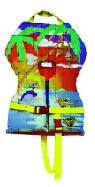
Youth PFD Wearing Requirements
As of January 1, 2006 there are 48 states and territories that mandate that children wear life jackets while on a boat under certain circumstances. As of December 2002, if you boat in one of the states without a children’s PFD regulation, you are required to have all children under 13 wear a PFD while under way, unless they are below deck or in an enclosed cabin while boating on federal waterways.
This list does not include requirements for PFD usage while riding on a PWC or on a towed device such as skis or an inflatable tube.
Care and Storage of your Life Jackets
- Stow life jackets in an accessible place. Life jackets that are stored far from where everyone sits, or under gear are virtually worthless in an emergency. The USCG requires that wearable life jackets be READILY ACCESSIBLE AT ALL TIMES. Also, on boats over 16 feet, at least one Type IV throw-able device must be IMMEDIATELY AVAILABLE.
- All kids should wear a properly fitted and correctly sized, bright, life jacket. Adults, for that matter, should set the example for children by wearing a life jacket.
- Families should mark each life jacket with the person’s name and store them facing up.
- Teach your children how to put on their life jackets. Make a game or race of putting a life jacket on. It’s the best way for children–and adults, to learn how to don a life jacket quickly. To make it more difficult, try putting them on in the water–it is far harder than you might think!
How to Care for Your Life Jackets
Do:
- Check your life jackets at the beginning of each boating season.
- Check that all hardware and straps are in good shape, are firmly attached, and are in working order.
- Check for leaks, mildew, lumpy or hardened buoyancy material, and oil saturation in the fabric.
- Make sure that there are no rips or tears in the fabric.
- Make sure that the label stating USCG approval is attached, and that it is readable.
Don’t:
- Don’t use a life vest or throwable flotation cushion as a kneeling pad or boat fender.
- Don’t use harsh detergents or gasoline to clean it.
- Don’t remove any labels, straps or buckles.
- Don’t sew ANYTHING onto the life jacket!
Storage:
- Store in an area with good ventilation.
- If wet, allow it to dry thoroughly in open air before storing.
- Drying it in a dryer, in front of a radiator, or other source of direct heat will destroy its buoyancy.
The amount of buoyancy (and life-saving value) your life jacket provides will decrease over time.
Treat your life jacket as if your life depends on it!
Required Equipment
PFDs, Flares Fire Extinguishers, Sound Devices and Lights
To legally operate your vessel, both the Coast Guard and the states require you to carry certain equipment aboard your boat. These requirements are generally based upon the length of your boat, but a recent trend has been to have requirements based upon the time of year that you operate your vessel, or how far from shore you might operate your vessel. For example, boats 16 feet in length and over must have the at least:
- One personal flotation device (in good condition) for each person on board, plus a throw-able cushion or ring is required. You must have the PFDs out of the plastic and in a READILY accessible location. The throw-able should be close by the steering station. For more information on PFD’s, click here.
- Three current-dated, hand-held, approved flares are minimum equipment to serve for day and night distress signals, both inshore and offshore. For more information on Visual Distress Signals, click here.
- The correct number of approved fire extinguishers, readily available for use is based on the size of your vessel. For more information on fire extinguishers, click here.
- A sound making device. For more information on sounds, click here.
- Working running lights. For more information on lights, click here.
Ventillation Systems
If you have enclosed areas on your boat, a ventilation system can do many things for you. If you have any gasoline powered engines aboard a ventilation system is a legal requirement. Good ventilation can do many things for you–help prevent mildew and bad odors, to saving your life by taking carbon monoxide and gasoline fumes out of the boat.
Ventilation systems must have two parts–an air inlet, and a separate air outlet. Both the inlet and the outlet must have ducts–which are tubes or hoses that extend down into the boat. Ducting for the exhaust must be located in the lower third of the hull–but above any bilge water. Ducting should be routed away from any heat sources, should not be “kinked”, and should be inspected regularly for cracks or debris. (Birds like to make nests in ducts.) Intakes are usually pointed forward, exhausts usually face aft.
Boats must have a ventilation system that is adequate for the size space the system is used for. Larger boats with larger compartments must have more ventilation–the figure is 15 square inches of opening for each cubic foot of compartment. For most boats that works out to having two inlets and exhausts, with each vent having ducting from 3 inch diameter hose for smaller boats to 5 inch hose for larger boats.
Natural Ventilation
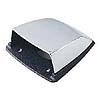
A natural, or passive, ventilation system consists of vents, cowls and other permanent openings in the boat that are designed to let air enter or exit using wind power or the boats’ motion to move the air.
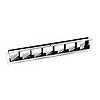
This type of system is rather ineffective at clearing fumes when the boat is not in motion, so it used primarily for living spaces and tank/bilge areas. It can be used in engine compartments, but only in conjunction with powered blowers.
Power Blowers / Vents
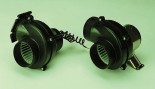
A bilge blower is important not only because it’s required, but because your life may depend on it. The USCG stipulates the use of a mechanical ventilation system for all non-open boats built after July 31, 1981 that run on gasoline.
Even if your boat is older, it still must conform to USCG minimum ventilation levels, and may require a bilge blower to satisfy those guidelines.
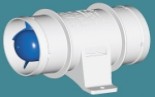
Bilge Blowers are specifically designed to clear gasoline fumes from closed compartments. They are ignition protected to prevent sparks, and are built to resist overheating and corrosion. The size blower you need is determined by the volume of your engine compartment. It is recommended that you use a blower at least 4 minutes before you ever start the engine, and especially after fueling.
Backfire Flame Arrestor
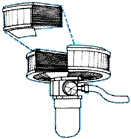
With some minor and technical exceptions, every inboard gasoline engine must be equipped with an acceptable means of backfire flame control-or “flame arrestor.” This safety device prevents an exhaust backfire from causing an explosion. It operates by absorbing heat.
Flame arrestors no longer require Coast Guard approval; the USCG now accepts flame arrestors complying with Underwriters Laboratories Standard 1111 or Society of Automotive Engineers J1928. When in use flame arrestors must be secured to the air intake of the carburetor with an airtight connection. Elements must be clean, and grids must be tight enough to prevent flames passing through. Cleaning with soap and water is the best way to maintain its effectiveness.
Equipment Chart
| U.S. COAST GUARD MINIMUM EQUIPMENT REQUIREMENTS | ||||
|---|---|---|---|---|
| Equipment | Boats less than 16 feet | 16 to 26 feet | 26 to 40 feet | 40 to 65 feet |
| Personal Flotation Devices | Recreational boats must carry Coast Guard approved Personal Flotation Devices, in good and serviceable condition, and of the appropriate size for the intended user. Wearable PFDs must be readily accessible, not stowed in bags, locked or closed compartments or have other gear stowed on top of them. Throwable devices must be immediately available for use. There must be one Type I, II, III, or V PFD for each person on board or being towed on water skis, etc., PLUS one Type IV throwable device. Throwable, Type IV PFDs may no longer be substituted for wearable types on boats less than 16 feet. State laws on mandatory PFD wear may vary. | |||
| Fire Extinguishers* | At least one B-1 type (see below) Coast Guard-approved hand portable fire extinguisher. Not required on outboard boats less than 26 feet long and not carrying passengers for hire if the construction of such motorboats will not permit the entrapment of explosive or flammable gases or vapors, and if fuel tanks are not permanently installed. | At least two B-1 type approved portable fire extinguishes; OR at least one B-2 type.. | At least three B-1 type approved portable fire extinguishers; OR at least one B-1 type PLUS one B-2 type. | |
| Visual Distress Signals | Must carry approved visual distress signals for nighttime use. | Must carry visual distress signals approved for daytime and nighttime use. For pyrotechnic devices (hand-held or aerial red flares, floating or hand-held orange smoke, and launches for aerial red meteors or parachute flares) a minimum of three required, in any combination that totals 3 for daytime and 3 for night use. Three day/night devices will suffice. Devices must be in serviceable condition, dates not expired and stowed accessibly. Exceptions are open sailboats less than 26 feet long and not equipped with propulsion machinery, and manually propelled boats; both required to carry only night signals. | ||
| Sound Device | Every vessel less that 39.4 feet (12 meters) long must carry an efficient sound-producing device. | Every vessel 39.4 (12 meters) long, but less than 65.6 feet (20 meters) must carry a bell and a whistle. | ||
| Ventilation (boats build after April 25, 1940) | At least two ventilator ducts fitted with cowls or their equivalent for the purpose of properly and efficiently ventilating the bilges of every closed engine and fuel tank compartment of boats constructed or decked over after April 25, 1940, using gasoline as fuel and other fuels having a flashpoint of 110° F or less. | |||
| Ventilation (boats build after August 1, 1980) | At least two ventilator ducts for the purpose of efficiently ventilating every closed compartment that contains a gasoline engine and every closed compartment containing a gasoline tank, except those having permanently installed tanks vented outside the boat and containing no unprotected electrical devices. Also, engine compartments containing a gasoline engine with a cranking motor must contain power-operated exhaust blowers controllable from the instrument panel. | |||
| Backfire Flame Arrestor | One approved device on each carburetor of all gasoline engines installed after April 25, 1940, except outboard motors. Device must be marked to show compliance with SAE J-1928 or UL 1111 Standards. | |||
| * When fixed fire-extinguishing system is installed in machinery spaces, it will replace one B-1 type portable fire extinguisher. | ||||
Coast Guard minimum equipment requirements vary with the size of the boat, type of propulsion, whether operated at night or in periods of reduced visibility, and, in some cases, the body of water on which it is used. For a more thorough discussion and complete details on how many and what types of equipment you must have aboard your boat, request a free copy of the pamphlet “Federal Requirements for Recreational Boats’ from the Coast Guard. For more information visit www.uscgboating.org, and many local marine retailers have printed copies available in store at no charge. Many state requirements go beyond Coast Guard requirements. Contact your state boating office for details.
Recommended Equipment
Coast Guard minimum requirements are just that, minimum. It is suggested you carry additional safety equipment, such as:
- Anchor with sufficient line/chain (at least five times water depth)
- Bailer (bucket)
- Oars or paddles
- First aid kit
- VHF radio
- Extra fuel & water
- Tool kit
- Sun protection
- Flashlight
Dealing with Fires
Using the Wrong Type of Extinguisher to Fight a Fire is Like Trying to Dig a Hole With a Rake
Fire Extinguishers
The Boat U.S. Foundation for Boating Safety tests of fire extinguishers confirmed that Coast Guard minimum requirements are exactly that: the absolute minimum. For fire extinguishers, they are barely adequate. (For USCG fire extinguisher requirements, see the chart at the bottom of this page.
Carrying only the required minimum is literally “playing with fire.” The tests, using a simulated galley fire, revealed that a 2.5-lb. extinguisher in the hands of an inexperienced user lacked the capacity to extinguish the fire-no surprise when you consider that the average discharge time for a 2.5-lb. canister is nine to ten seconds. The National Fire Protection Association (NFPA) has issued extinguisher recommendations that go beyond the Coast Guard’s minimum requirements. Not only the number, but the location of your extinguishers is critical-if you can’t get to an extinguisher when you need it, it’s worthless. You shouldn’t have to travel more than half the length of the boat to reach it.
If that’s not practical, an alternative is to step up to the next larger extinguisher size. Spend the few extra dollars for a tri-class (ABC) extinguisher instead of settling for the less expensive BC unit. Consider a BC unit for the engine room: it leaves less residue on electrical equipment and machinery, and it costs slightly less. What’s the worry?
You might not think you need to worry too much about fire on a boat. After all, you are literally surrounded by water. But fire is a very real threat, not only to your boat, but to you and your passengers. Today’s fiberglass/composite boats burn very quickly, and produce large volumes of toxic smoke that is equally as dangerous. Below are a few tips on fire safety from BoatUS Magazine, along with a few claims reports from BoatU.S. Insurance that highlight how quickly events can get out of hand. Knowing what to expect, and what to do are critical if you expect to effectively fight a fire. Each year you need to ensure that your fire extinguishers are in proper working order, and that everyone who boards the boat knows where they are.
Claim #9702081C
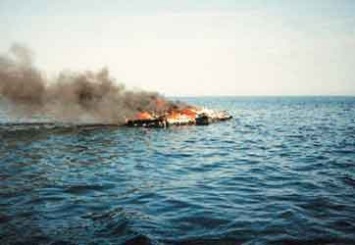
The owner and his two friends were nearing the last leg of a long trip from Yorktown, Virginia to Watkins Glen, New York aboard a 46′ sport fisherman that he’d bought barely three weeks before. They were making good time across Oneida Lake when one of the crew left the fly bridge to go below. He quickly reappeared on the fly bridge: “We’ve got a problem,” he informed the captain, ” smoke!” The captain immediately brought the engines to idle and one of the crew tried very briefly to extinguish the fire. Within a minute or two, he as overwhelmed by fumes and had to abandon the effort. After trying unsuccessfully to send out a Mayday on the VHF, the captain ran to the foredeck, set an anchor, and hailed a passing boat by waving a life jacket. Meanwhile, a volunteer fireman saw the smoke from shore and dispatched a fireboat. By the time the fire was brought under control, the boat was destroyed.
Later investigation determined that the electrical panel was the source of the fire. The captain’s urgent Mayday call conveys the danger of all fire outbreaks on boats. Unlike fires ashore, where there are usually several escape routes to safety, there are few places on a burning boat to hide from the heat and noxious fumes. Add to that the anxiety of standing above many gallons of explosive fuel and the choice to sink or swim (literally) becomes even more, well, problematic.
Time is critical with any fire, but when one occurs in the confined spaces of a boat it is imperative that every move made by the crew be the correct move.
BoatU.S. Marine Insurance claim files consistently confirm that a crew that reacts initially with confusion and indecision is likely to panic as the fire spreads.
Success and failure depends on understanding the fundamentals of fire classification, and providing the most efficient fire extinguishers in the locations where they are most likely be needed.
The Fundamentals
Learning Your ABCs of Fire Classification
Not all fires should be treated alike. The source and location of a fire will determine which extinguishing agent should be used for maximum effect. Many people learn at home, for example, that throwing water on a stove-top grease fire (Class B) will cause a violent spattering reaction and spread the burning grease elsewhere. Matching the agent to the fire begins with an understanding of how fires are classified:
- Class A fires consist of all combustible solid materials, such as paper, wood, cloth, rubber, and many plastics including the fiberglass reinforced plastic used for decks and hulls.
- Class B fires consist of all flammable liquids, including stove alcohol, grease, gasoline, diesel, kerosene, oil, oil based paint, teak oil, paint thinners, acetone, varnishes, and flammable gases or fumes.
- Class C fires consist of energized electrical equipment. Class C fires are identified for their potential to electrocute or shock personnel if conducting water-base extinguishing agents are applied. Turning off the electricity will change the status of a Class C fire to a Class A and/or B fire.
- Note that Class A, B, and C categories are not subdivided any further, so it may be easier to think of them as (A) solids, (B) liquids, and (C) electrical fires; there’s no need, for example, to waste time distinguishing between alcohol or kerosene when your stove’s on fire.
All fire extinguishers are rated according to the extinguishing agent’s effectiveness in controlling one or more classes of fire. For example, ABC-rated extinguishers, commonly called multi-purpose or tri-class extinguishers, are capable of fighting all three classes of fire. Numbers preceding the letters (on portable units only) indicate an agent’s relative effectiveness in extinguishing that particular class of fire. For instance, a 10 BC dry chemical extinguisher is twice as effective in putting out a fire as a 5 BC unit. Multi-purpose 1A-10 BC dry chemical extinguishers are becoming more popular as an alternative to the common 10 BC extinguishers because of the additional Class A rating, especially since the additional cost is minimal (less than $5).
In general, dry chemical extinguishers, which use a chemical powder to smoother the source of the fire, are the favored choice in the boat’s cabin. Not only is a dry chemical extinguisher more effective, it is easier for an inexperienced user to direct the discharge plume to the base of the flame from a safe distance.
Conversely, extinguishers with gaseous agents ( CO2, Halon, and Halon replacements FE-241 and FM-200), which react with the surrounding oxygen, aren’t as effective in a cabin because the gases are often dissipated before the fire is extinguished.
The ABC units have the drawback of often ruining equipment, but because the priority is on safety and the overall effectiveness of the extinguishing agent, the American Boat & Yacht Council (ABYC) recommends that ABC multi-purpose extinguishers be used in most instances on boats under 65′. The ABC extinguishers not only reduces any confusion about what to use and where (saving time), but also covers the possibility that, for example, any Class B fire that spreads from the stove to the curtains (Class A) can be fought with the same extinguisher.
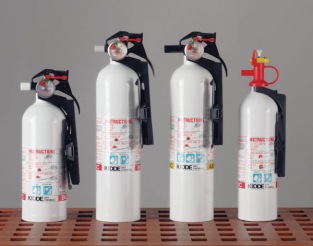
United States Coast Guard Minimum Equipment Requirements
Coast Guard minimum equipment requirements vary with the size of the boat, type of propulsion, whether operated at night or in periods of reduced visibility, and in some cases, the body of water on which it is used. Boats carrying passengers for hire have additional equipment requirements.
- All fire extinguishers must be Coast Guard Approved
- Fire extinguishers must be in serviceable condition
- All fire extinguishers must be READILY AVAILABLE for immediate use
- Boats less than 26 feet in length: At least one 2 pound hand-portable extinguisher (assuming no fixed-fire extinguishing system is installed). When an approved fire extinguishing system is installed in machinery spaces, no extinguisher is required. If construction of the boat does not permit the entrapment of explosive or flammable gases or vapors, no fire extinguisher is required. (Boat must be under 26 feet long and outboard powered)
- Boats 26 feet to less than 40 feet in length: At least two 2 pound portables, OR at least one 2.5 pound extinguisher. When an approved fire extinguisher is installed, one less 2-pound extinguisher is required
- Boats 40 feet to not more than 65 feet in length: At least three 2 pound portables, or at least one 2 pound and one 2.5 pound extinguisher. When an approved fixed-fire extinguisher is installed, one less 2 pounder is required
| MARINE FIRE EXTINGUISHER CLASSIFICATION | ||||
|---|---|---|---|---|
| Classes | Foam (Gals) | CO2 (Lbs.) | Dry Chem (Lbs.) | Halon |
| B-1 | 1.25 | 4 | 5 | 2.5 |
| B-2 | 2.5 | 15 | 10 | 10 |
For more details on how many and what types of equipment you must have aboard your boat, request a copy of the free brochure, “Federal Requirements for Recreational Boats”, from your BoatU.S. Marine Center, the BoatU.S. Foundation, or from the Coast Guard Consumer Hotline, 800-368-5647.
Fighting Fires
Fight a Fire Yourself If and Only If:
- It’s small and confined to the immediate area where it started. Generally, if you don’t get to it within two minutes, you’re too late.
- You have a way out and can fight with your back to the exit.
- Your extinguisher is rated for the class of fire at hand. (If you bought ABC units, you don’t have to worry about this.) Only Class A fires can be extinguished with water.
- You are confident that you can operate your extinguisher effectively: Aim the nozzle at the base of the fire. Hold the unit upright. Sweep from side to side at the base, or use a series of short blasts aimed at the base. Check for glowing or smoldering embers and repeat the procedure if “flashback” occurs.
- If you have the slightest doubt about whether you can contain the fire, don’t even try. Your first concern is the safety of the people aboard. Notify someone immediately of your situation and location before the fire burns through the battery cables or forces you off the boat.
Burning fiberglass is extremely hot and gives off noxious fumes. If fiberglass is burning, get off the boat immediately!
Portable Fire Extinguisher Maintenance:
- Inspect once a month, more often if exposed to weather.
- Have the unit weighed annually to verify it’s fully charged. Gauges fail often enough that they cannot always be relied on. Twice a year, remove unit from bracket, turn upside down and shake to loosen any dry chemical compacted at the bottom.
- Recharge or replace after any use. Recharges run $15-25. Inexpensive units can be replaced for about the same amount.
- Never check a unit by partially discharging it. Remaining pressure in canister can leak out over time.
- Have a full maintenance check annually by a qualified technician; see the Yellow Pages under “Fire Extinguishers.” A more economical method: weigh the unit your- self every year, and replace it every few years.
A Subtle, but Costly, Distinction
A 42′ powerboat was cruising offshore when a crew member reported a strange smell coming from the engine compartment. The owner grabbed a dry chemical extinguisher from the galley on his way to the enclosed compartment, opened the access door, and was immediately driven back by smoke. He tried to direct the stream of dry chemical inside the compartment, but he could not see beyond the smoke to locate the source of the fire. By then the fumes had also engulfed the main saloon and he was driven back. From the cockpit he saw flames coming out of the engine compartment’s starboard ventilation ducts, so he directed another dry chemical extinguisher into the duct openings; the fire died momentarily but quickly resumed and grew rapidly. It soon became apparent that the vessel would have to be abandoned. It burned to the waterline (claim 9708770C).
The same dry chemicals that are so effective in a boat’s cabin, aren’t much use when a fire breaks out in the engine compartment. The reason has to do with how the two types of fires are fought.
Accounts of engine fires typically began with a warning – a burning smell, a loss of engine power, or even smoke trailing after the boat. If someone then opened the engine hatch to check out the trouble, he or she was usually overwhelmed immediately by flames and smoke.
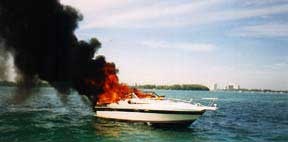
Fires need two things: fuel and oxygen. Opening an engine compartment hatch to look for a fire is like throwing gasoline on hot coals; it fans the fire with a rush of fresh oxygen.
The solution is to leave the hatch closed and fight the fire either with a fixed extinguisher in the engine compartment or with a portable extinguisher discharged through a fire port ” (a small opening into the engine compartment) on deck, which is why dry chemical extinguishers of any class are inappropriate. Blindly spraying a chemical extinguisher through a fire port does little or nothing to stop an engine fire because the chemical isn’t being directed toward the base of the flames. A gaseous extinguisher, on the other hand, extinguished the fire by effecting the oxygen supply. The same extinguisher that wasn’t effective in the wide-open spaces of a boat’s cabin will be much more effective in a cramped engine compartment.
For this reason, among others, the ABYC recommends that either a portable gaseous extinguisher be provided near (outside) the engine compartment or a fixed gaseous extinguishers be used inside the engine compartment. In the event of a fire, either option eliminates the need to open the hatch.
Fixed Systems in the Engine Room
Overall, the most efficient fire protection system is the safest. The majority of fires begin in the engine compartment for numerous reasons:
- Constant pounding and vibration loosens wiring terminals and causes chafe, engine exhausts fail, water pumps fail, fuel leaks–the list goes on.
- An automatic system, activated by a rise in temperature, can discharge and extinguish a fire long before any crew can detect a fire and react with a portable extinguisher, which is even more relevant if you sometimes cruise short handed.
- The automatic system kills the fire earlier and minimizes damage. And since Halon and its replacements will not damage internal engine parts, it is often possible, after locating and correcting the problem, to restart the engine(s) after a fire and return to port.
- Fire extinguishers are typically the last line of defense when a fire suddenly appears. The first line of defense is knowing how to prevent fires before they occur.
Restrictions on Halon
For many years, Halon was recognized as the most effective fire fighting agent available. It was quick to extinguish all classes of fires and was particularly safe and effective for use near expensive electronic equipment because it left no residual damage. And, it was safe for both occupied and unoccupied spaces. It was then determined that Halon posed a significant threat to the environment by contributing to the depletion of the ozone layer, and as of January 1, 1994, no new Halon could be made in the U.S. However, recycled or previously made Halon is still available for purchase, so you don’t have to dispose of an old Halon unit. It only poses a danger to the ozone if it is used or develops a leak. As long as your unit is in good condition and not leaking, it’s safe to keep on board.
The Halon Alternatives-FE-241 and FM-200
With the phase-out of Halon 1301, the search for a replacement resulted in the development of a number of “clean” fire suppression agents. Both FE-241 and FM-200 have been shown to be effective, safe for people and equipment, and environmentally friendly. Although both agents do pose some threat to the environment, it is considered to be substantially less than that of Halon. Their characteristically rapid extinguishing performance is considered by most to mitigate the detrimental effects of fire. Both agents’ relatively short atmospheric lifetime (somewhere between 7-42 years) assure minimal direct contribution to global warming. When choosing which system is best for you, keep in mind that FM-200 is considered to be safe for use in occupied spaces, whereas, FE-241 is not as safe, but is significantly less expensive. Both require more agent by weight than Halon 1301 did, so your storage requirements for the extinguishers may increase. Both are Factory Mutual (FM) and USCG-approved.
Marine Communications
In this age of e-mail, fax machines, pagers, and cell phones, there is no shortage of ways to get your message across. But when you’re out on the water, what’s the best device to maintain your lifeline to shore?
Today’s boaters are faced with many choices for ship-to-ship and ship-to-shore communications. VHFs, cell phones, Family Radio Service radios, CB radios, Single Sidebands, and satellite communications are among the myriad of choices available.
Cell Phones
Having a Cell Phone on board allows you to keep in touch with land-based people and businesses easily. They are very convenient and should be used in tandem with a VHF.
Cell phones, although very convenient on land, are less reliable on the water. Most are not water resistant, and their range is relatively short. The maximum range to and from a cell antenna/station varies, but it is basically line-of-sight.
Range is further complicated by the fact that the majority of cell antenna/stations are placed with land-based use in mind, so the distance offshore that a vessel can remain in contact is frequently short.
Cell phones can also be expensive to operate, although there are many different packages available. Your communication power with a cell phone is limited on the water because the other ship you are trying to contact must also have a cell phone. In some areas, you can place a call to the local Coast Guard station by dialing *CG.
Family Radio Service Radios
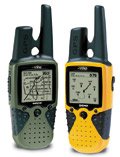
Family Radio Service Radios are intended for personal, non-commercial use like CB radios. They are very handy because they can be used on land for communication without a license.
They are perfect for outdoor trips with friends and family where you need to stay in contact.
And they also help with communications while still on the boat. You can talk to each other from bow to stern, from below to above deck, and more! The range is typically 1-2 miles and is line-of-sight like VHFs and cell phones. They have limited battery power and no emergency channel. They operate in the 460 mHz UHF band between VHF radios and cell phones and transmit at 0.5 watts.
Because these units have become so popular, you may want to pre-arrange what channel you will be using and test it out-very often one or more channels will be overloaded, especially in crowded areas.
Citizen Band (CB) Radios
Citizen Band Radios is intended to afford the general public economical access to two-way radio communication. CB is allocated 40 specific frequencies between 26.965 and 27.405 mHz, commonly referred to as channels 1-40.
Any channel may be used with either single or double sideband amplitude modulation except Channel 9, which is reserved for emergency communications. CB stations are limited to 4-watt carrier waves output power on DSB AM, and 12-watts PEP on SSB AM. The usual reliable range of CB is five miles.
There are several pitfalls to having a CB radio on the water: Making contact may be difficult, since not all boats have CB radios. Channel noise and station traffic are sometimes heavy, and the Coast Guard doesn’t monitor the emergency channel.
Single Sidebands
Single Sidebands operate in the medium frequency (MF) and/or high-frequency (HF) bands for reliable direct-voice communications over distances exceeding 25 miles (depending on antenna heights).
SSBs are commonly available with an output power from 50-150 watts. An SSB’s range is affected by the strength of the radiated signal, among other things. The maximum reliable range in the 2-3mHz (MF) band during the day is 50-150 miles. Transmission in HF band can reach thousands of miles.
Unlike VHF radios, SSBs require a large ground plane in order to radiate its signal which except on metal hulls, needs to be installed in the form of a large copper mesh panel (sometimes built onto the fiberglass hull). With SSBs, antenna selection and installation is also more complicated. SSBs generally require a much longer antenna than VHFs, and different antenna tuning for different bands.
Satellite Communications
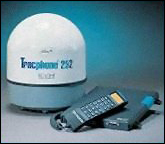
Satellite Communications such as Iridium is the first example of a worldwide voice communication system which can be accessed using a small hand-held telephone.
The 66 Iridium satellites have the ability to forward voice phone calls from one another and then relay the conversations to ground stations.
Magellan’s GSC 100 Personal Satellite Communicator is for those who need worldwide e-mail capabilities. Using 36 ORBCOMM satellites, the constellation allows real-time data communications with low per message costs and low hardware costs.
Our recommendation for reliable on-the-water communications, we recommend using either hand-held or fixed-mount VHF radios. When you’re stuck in a jam-whether from engine failure or a fierce storm approaching, a VHF radio can be your lifeline to the world.
In Coast Guard jurisdictions, VHFs are monitored 24 hours a day, seven days a week. For extra assurance, the USCG and most TowBoatU.S. and Vessel Assist towers can locate your boat by tracking your VHF signal. VHFs are handy in an emergency, but they have other uses: telephone calls to shore, obtaining supplies and services such as marina reservations, and boat operations like drawbridge openings and communicating with commercial and other recreational vessels.
The Federal Communications Commission (FCC) regulates marine radio traffic and dictates that all other uses are secondary to safety, so chatting is frowned upon by the FCC and forbidden on Channel 16 and 9.
VHF Radios
Very High Frequency (VHF) Radios Very High Frequency (VHF) radios have been around for many years and remain the primary means of communication for vessels throughout the United States. The main uses of a VHF radio are:
- Distress calling and safety
- Ship to shore communications
- Navigation (vessels to bridges, etc.)
- Marine operator to place calls to shore
- NOAA Weather Broadcasts
They come equipped with a choice of transmitter power: one (1) watt for very close communication (approximately one mile or less) or twenty five (25) watts for extended communication (up to approximately twenty five miles). All of this is done usually with the push of a button.
If you need to communicate over a greater distance consider installing a Single Side Band (SSB) radio – which has the capability to transmit over hundreds of miles.
If you are not sure whether you might have the need for Single Side Band radio please feel free to contact your local BOAT/U.S. or West Marine Center where you may discuss the pros and cons.
VHF radios come in many shapes, sizes and colors to meet anyone’s needs today. Prices start at about $150.00 for a basic model and can go as high as $1500.00 for the full – featured units. The main factor governing prices of the VHF radios are the features available.
When choosing a VHF radio you should first make a list of the features you feel you want and need.
DSC Capability
Digital Selective Calling, or DSC, is the equivalent of a “mayday button” on a VHF or SSB. When activated, it automatically broadcasts an encoded distress call that will be picked up by all nearby vessels equipped with DSC. If the radio is interfaced with a Loran or GPS, it will also automatically broadcast the distressed vessel’s position.
All fixed-mount radios now include it as a feature, so when the USCG Rescue 21 System becomes fully operational, your VHF will be able to take advantage of this latest feature. To use DSC, you must obtain a MMSI (Maritime Mobile Service Identity) number.
You may do so free of charge here. Keep in mind that the U.S. Coast Guard is not yet responding to DSC transmissions nationally.
Licensing
As of October 26, 1996, most recreational boaters are no longer required to obtain an individual Ship Station License from the Federal Communications Commission (FCC). However, boaters still need a VHF Ship Station License in the following categories:
- Those traveling to or broadcasting in a foreign port (including Canada, Bahamas, Caribbean)
- Those with boats 65 feet or longer
- Navigation (vessels to bridges, etc.)
- Those using single sideband radios or Inmarsat equipment
- Commercial vessels
Those traveling to or broadcasting in a foreign port must also obtain a Restricted Radiotelephone Operator’s Permit (RP). However, if you (1) merely plan to sail in domestic or international waters without docking in any foreign ports and without communicating with foreign coast stations, and (2) your radio operates only on VHF frequencies, you do not need an RP.
Forms can be obtained from your nearest FCC field office or from the FCC Wireless Communications Division (se below). Call the Gettysburg office to locate your nearest field office, or call the FCC Form Distribution Center at 800-418-FORM (3676).
For More information on FCC rules and regulations, and to download license applications, click on the button to visit the FCC Marine Radio Fact Sheet.
VHF Radio Channels
Most VHF radios on the market today have in excess of twenty twenty-five usable channels. Aside from the U.S. channels there are also International and Canadian channels, all of which come standard with many of the newer units on the market.
The most important channels on your VHF radio are 13, 16, 19, 22, and 70. Channel 13 is used by commercial shipping to communicate their actions and confirm passage. Channel 16 (156.8 MHz) VHF-FM is designated by the FCC (Federal Communications Commission) as the national distress, safety and calling frequency.
All vessels must monitor this channel while underway. Calls to other vessels are normally initiated on Channel 16 except for recreation vessels which may use (voluntarily) Channel 09 VHF-FM. The FCC has designated Channel 09 as a recreational calling channel in order to eliminate congestion on Channel 16 VHF-FM.
However, it is important to take note that the United States Coast Guard does not monitor Channel 09 VHF-FM for distress calls. Any vessel in distress should use Channel 16 VHF-FM (which the Coast Guard does monitor). Channel 22 is the most common working channel for USCG in the event of an emergency.
The following list of channels are those available in the United States for VHF Radio communications. Always remember to check locally for channels authorized for use in your area as well as any local restrictions.
Try to remember that your VHF is not a private telephone. It’s more like an old-fashioned party line. Everyone can hear your conversation. Keep the conversation short and to the point as there will be others waiting to use the channel. Also, do not allow children play with the VHF radio.

Channel 16 – Distress calling and safety, ship-to-ship and ship-to-coast. Users must switch to a “working” channel after making initial contact (except in emergencies). All vessels must monitor Channel 16 when not using the VHF radio for other purposes.

Channel 09 – Secondary calling channel (a new FCC Rule has designated Channel 9 to be the preferred channel for calling). The purpose of this change is to free Channel 16 for distress calls.

Channel 06 – Ship-to-ship safety messages, and communication with search and rescue and Coast Guard vessels and aircraft.

Channel 13 and Channel 67 – These are navigational channels. Channel 13 (all vessels) is for one watt of transmission power only. Channel 67 (Commercial Only) is for one-watt transmission power only. These radio channels are also known as the “bridge-to-bridge” channels. These channels are used for listening to ship movements in tight waterways, locks, etc.

Channel 22 – Used to speak with Coast Guard after initial contact on Channel 16.

Channel 68, Channel 69, Channel 71 and Channel 72 – Used solely for communications between vessels.

Channel 01, Channels 07 through 11, Channel 18, Channel 19, Channel 63, Channel 67, Channel 79 and Channel 80 – Commercial working channels and are reserved for commercial vessels only. Also note that Channel 63 has no listen.

Channels 24 through 28 and Channels 84 through 88 – Are reserved for Marine Operator communications for the purpose of sending or receiving ship-to-shore phone calls.

Channel 70 – Digital Selective Calling. Those few vessels with DSC radios should use this channel for distress and calling channel instead of 16.

Channel W1 through Channel W10 – These channels are reserved for weather transmissions. For the most part only Channels W1 through W4 are receiving weather broadcasts from NOAA. These are receive-only channels.
ALL OTHERS – Virtually every radio manufactured today has every available channel. If your radio has channels that you do not see on this list do not use them. These extra channels are reserved for government, commercial, or vessel use only.
VHF Radio Antennas
Antennas
After you decide which VHF radio is best for you, your next step is to pick out an antenna. The VHF antenna is a very important part of your VHF Radio System. VHF antennae come in many lengths and types so, before buying a VHF antenna contact an expert and determine which style best fits your needs. If you buy the wrong antenna you will not get the performance your VHF radio is capable of producing. VHF and DSC equipment are made up of three distinct parts – each part is equally important. These pieces are:
- The Transceiver
- The Coaxial Cable with its connectors carrying the signal to or from the antenna
- The antenna itself. Even today the cables, connectors and antennae often do not get the attention they demand
Yet, their individual functionality has a notable effect on the performance of the system as a whole. The wrong antenna or a damaged or poor quality coax cable can drain the transmission power therein wasting the money spent for a good installation. At every frequency, besides being free from obstacles, the antenna has to meet precise electrical and electronic requirements.
When choosing an antenna it is advisable to discuss with your dealer all the problems connected with the installation, use of the equipment and the type of transceiver needed.
This will allow you further understand and tackle many problems before they arise. In case this sort of advice is not available to you, the information provided below should be helpful in the selection of the proper antenna.
Gain
The “gain” is singularly the most important specification of the antenna. It is indicated in dB (Decibels) which briefly means this: the higher dB numbers, the greater the range. On the other hand, a high gain will decrease the antenna radiation patterns.
This means that low gain antennae are less influenced by the rolling and pitching of a boat. With increased gain, the pitching movement of the boat may cause a temporary signal reduction.
These are the reasons why on the faster planing boats it is recommended that a high gain antenna be used. Conversely, on sailboats, with a masthead installation and with the mast subject to swaying, it is recommended that the 3 dB gain antenna be used.
Height
In general, the higher the antenna, the better the range of your radio. VHFs transmit via “line-of-site” radio waves–therefore the higher the antenna, the farther your signal will reach over the horizon.
You may be able to talk to the local Coast Guard station that may be over twenty miles away (because they have a very tall radio tower) but not your friend who is only a few miles away as their antenna is only a few feet above the water. Having an antenna with the right gain, and located as high as practicable, will give you the optimal operating conditions for using your VHF radio.
VHF Radio Communications
How to Use your VHF Radio
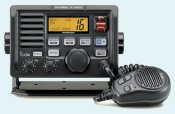
To use your VHF, turn it on and pick a channel, set the squelch to the point where you don’t hear any white noise, and begin talking. Things to remember when you are on the radio:
- To use your VHF, turn it on and pick a channel, set the squelch to the point where you don’t hear any white noise, and begin talking. Things to remember when you are on the radio.
- Don’t tie up channel 16 or channel 9. If you are talking with someone, switch to a working channel so you are not keeping others from using channel 16 or 9. In some instances, the Coast Guard may even order you to switch channels if you are abusing these channels.
- A VHF radio is not a telephone. When you use your VHF, everyone tuned to that station in the area can hear you! Watch your language, and try to keep your conversations short and to the point so that others may use the channel.
Using a VHF radio is one of the easier things to do on a boat, but their are things you need to do to operate a VHF properly. Most VHF radios have some or all of the following:
- Volume Knob – Adjusts volume
- “Squelch” Knob” – Adjusting the squelch is similar to tuning your radio–it will make the signal sound much more clear
- Channel Knob or Up/Down Buttons – This lets you change the channel you are using
- Channel Display Screen – This tells you what channel you are on, and also any other feature that you may be using
- Weather Button – This is a direct way to get to your local weather channels
- Scan Button – This will automatically change your radio channel to one that is currently being used by other boaters. You may also be able to “Priority scan” which will allow you to program specific channels that you frequently use.
- 16/9 Button – Automatically takes you to either channel 16 or 9
- 1/25 or Hi/Lo Button – This allows you to raise or lower the power with which you broadcast your signal. For boats close to you, use low power. For boats farther away, use high
- INT/USA – Allows you to change channel type if you leave the United States for other countries such as Canada
- Transmit Button – This is usually on the mike. Simply push it down, and your radio will transmit a signal
VHF Emergency Procedures
How to Use your VHF Radio in an Emergency
In emergency situations, there are certain procedures to follow to ensure prompt response to your need for help. There are three phrases that you might hear on a VHF radio, and they all relate to safety.
MAYDAY – is the distress signal, and requires the most urgent response. This signal is only to be used when a person, or boat is threatened by grave or imminent danger, and requires assistance.
PAN-PAN – this signal is used to signal urgent information, such as when someone has fallen overboard, or a boat is drifting into the shore or a busy shipping channel.
SECURITE – Is the safety signal. This is used to transmit information about the safety of navigation. For instance, if a large commercial vessel is coming through a narrow channel, this signal would be used. Can also be used to transmit weather information, such as when a powerful storm system is approaching.
There is a “procedure” for sending out a distress call, but all you really need to know is to turn your VHF to Channel 16 and high power, key the mike, and say one of the three phrases three times, along with position and situation information.
Here’s a hypothetical mayday from the fishing boat Tambourine:
“Mayday, Mayday, Mayday. This is the Tambourine. Our position is 24:33′ north and 74:56′ west and we are sinking.”
Try to speak slowly and clearly, and repeat this information three times. The essential information is Mayday, your position, and your emergency. If you have time, describe your boat and how many are aboard:
“Mayday, Mayday, Mayday. This is the Tambourine. Our position is 24:33′ north and 74:56′ west and we are sinking.”
Mention if Someone is Injured
If you don’t get an immediate response keep periodically sending out a Mayday broadcast as long as the radio will function, taking care to give your position with every transmission. If time permits, scan through the other channels and interrupt any radio traffic you hear with your Mayday broadcast. If you don’t hear traffic, try transmitting on Coast Guard Channel 22A.
If your emergency isn’t immediately life threatening, say Pan-Pan instead of Mayday. This is the urgency call-Pan-Pan, Pan-Pan, Pan-Pan (pronounced pahn). Make it just like a distress call, except state exactly what assistance you want. For example, maybe you have a controllable leak, and you just want help standing by in case it gets worse.
Visual Distress Signals
The Regulations
This information is directed primarily to recreational boaters, but the requirements discussed also apply to operators of vessels engaged in the carrying of six or fewer passengers. The Visual Distress Signal requirements for most commercial vessels are in Title 46 of the Code of Federal Regulations. The requirement to carry visual distress signals became effective on January 1, 1981. This regulation requires all boats when used on coastal waters, which includes the Great Lakes, the territorial seas and those waters directly connected to the Great Lakes and the territorial seas, up to a point where the waters are less than two miles wide, and boats owned in the United States when operating on the high seas to be equipped with visual distress signals.
The only exceptions are during daytime (sunrise to sunset) for:
- Recreational boats less than 16 feet in length
- Boats participating in organized events such as races, regattas or marine parades
- Open sailboats not equipped with propulsion machinery and less than 26 feet in length
- Manually propelled boats
These boats only need to carry night signals when used on these waters at night.
Types of Visual Distress Signals
A wide variety of signaling devices, both pyrotechnic and non-pyrotechnic, can be carried to meet the requirements of the regulation.
- Recreational boats less than 16′ operating in coastal waters need only carry night signaling devices when operated at night. All other boats must carry both night and day signaling devices.
- Any combination can be carried as long as they add up to three signals for day use and three signals for night use. Three day/ night signaling devices meet both requirements.
Note: If pyrotechnic devices are selected, a minimum of three must be carried. Pyrotechnic devices come with an expiration date, which is 42 months from the date of manufacture. To meet carriage requirements, you must have at least three un-expired flares aboard. You may carry expired flares as back up, but they will not count towards the legal requirement.
The following details a combination of devices which can be carried in order to meet the requirements:
- Three hand-held red flares (day and night). Flares must be under 42 months of age.
- One electric distress light (night only).
- One hand-held red flare and two parachute flares (day and night). One hand-held orange smoke signal, two floating orange smoke signals (day) and one electric distress light (night only). Flares must be under 42 months of age.
Pyrotechnic Visual Distress Signaling Devices
Must be Coast Guard approved, in serviceable condition and stowed to be readily accessible. If they are marked with a date showing the serviceable life, this date must not have passed. Launchers produced before Jan. 1, 1981, intended for use with approved signals are not required to be Coast Guard Approved.
USCG Approved Pyrotechnic Visual Distress Signals and Associated Devices include:
- Pyrotechnic red flares, hand held or aerial
- Pyrotechnic orange smoke, hand held or floating
- Launchers for aerial red meteors or parachute flares
The purpose of the regulation is to assure that boaters have a way of attracting attention and securing assistance should the need arise. Properly used visual distress signals will also help reduce the time it takes to locate a boat in difficulty when a search is underway. This will reduce the possibility of a minor emergency becoming a tragedy.
Non-pyrotechnic Visual Distress Signaling Devices
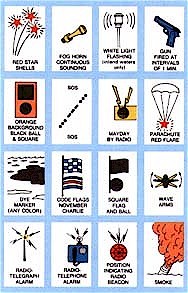
Must carry the manufacturer’s certification that they meet Coast Guard requirements. They must be in serviceable condition and stowed to be readily accessible. This group includes:
- Orange distress flag
- Electric distress light
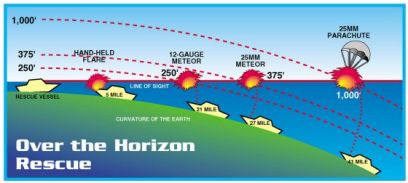
No single signaling device is ideal under all conditions and for all purposes. Consideration should therefore be given to carrying several types. For example, an aerial flare can be seen over a long distance on a clear night, but for closer work, a hand-held flare may be more useful.
SOS Distress Light
The SOS Distress Light is an LED Visual Distress Signal Device that meets U.S. Coast Guard requirements to completely replace traditional pyrotechnic flares. Unlike traditional flares, this electronic flare never expires, which solves the challenge of flare disposal. The LED light flashes up to 60 hours, unlike traditional flares that last minutes or less. It flashes only the SOS sequence, per USCG requirements, and is visible up to 10 nautical miles.
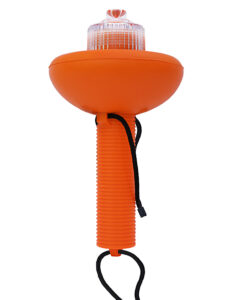
Day Use Only
Hand Held Orange Smoke Distress Signals
Hand held distress signals are very common. Make sure to hold the flare with a glove, and make sure to keep the smoke down-wind of your boat.
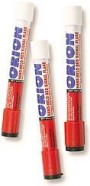
Floating Orange Smoke Distress Signals
These come in two varieties, one lasting approximately 5 minutes, one lasting 15 minutes.
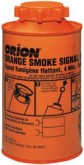
Orange Distress Signal Flag for Boats
The distress flag must be at least 3 x 3 feet with a black square and ball on an orange background. It is accepted as a day signal only and is especially effective in bright sunlight. The flag is most distinctive when waved on something such as a paddle or a boat hook or flown from a mast.
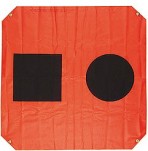
Sea-marker Dye
This is useful when air search has been initiated. Comes in several colors, and should be used when chances of being spotted are high.

Signal Mirror
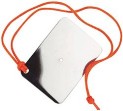
Although not recognized by USCG as a carriage requirement, a well-handled signal mirror can be very effective in calling attention to oneself. It is low in cost and has an unlimited shelf life.
Night Use Only
Electric Distress Light for Boats
The electric distress light is accepted for night use only and must automatically flash the international SOS distress signal, which is three short flashes, three long flashes, and three short flashes. Flashed four to six times each minute, this is an unmistakable distress signal, well known to most boaters. The device can be checked any time for serviceability if shielded from view.
NOTE: An ordinary flashlight is not acceptable since it must be manually flashed and does not normally produce enough candle power. The Regulation States: “No person in-a boat shall display a visual distress signal on water to which this subpart applies under any circumstances except a situation where assistance is needed because of immediate or potential danger to the persons aboard.”
Day and Night Use
- Hand Held Flare Distress Signal
- Parachute Red Flare Distress Signals – (25 mm or larger) These signals require use in combination with a suitable launching device.
- Hand Held Rocket-Propelled Parachute Red Flare Distress Signals
- Distress Signal for Boats, Red Aerial
- Pyrotechnic Flare – These devices may be either meteor or parachute assisted type. Some of these signals may require use in combination with a suitable launching device.
Warning:
In some states the pistol launcher for meteors and parachute flares may be considered a firearm. Therefore, check with your state authorities before acquiring such launcher.
Visual Distress Signals: When and How to Use Them
Visual distress signals are part of your boat’s safety equipment. Check them before you leave harbor. Their intended purpose is to summon help should the need arise. Visual distress signals can only be effective when someone is in a position to see them. Therefore, when employing pyrotechnic devices, do so only when you see or hear a boat or airplane or you are reasonably sure that someone on shore is in position to see your signal and take action. Good judgment is an essential part of successful use of visual distress signals.
All distress signaling devices have both advantages and disadvantages. The most popular, because of cost, are probably the smaller pyrotechnic devices. Pyrotechnics make excellent distress signals, universally recognized as such, but they have the drawback that they can be used only once. Additionally, there is a potential for both injury and property damage if not properly handled.
Pyrotechnics devices have a very hot flame, and the ash and slag can cause burns and ignite material that burns easily. Projected devices, such as pistol launched and hand-held parachute flares and meteors, have many of the same characteristics of a firearm and must be handled with the same caution and respect.
The hand-held and the floating orange smoke signaling devices are excellent (if not the best) day signals, especially on clear days. Both signals are most effective with light to moderate winds because higher winds tend to keep the smoke close to the water and disperse it which makes it hard to see.
Red hand-held flares can be used by day, but are most effective at night or in restricted visibility such as fog or haze. Only Coast Guard or SOLAS flares are acceptable for use on recreational boats. When selecting such flares look for the Coast Guard approval number and date of manufacture. Make sure that the device does not carry the marking: “Not approved for use on recreational boats,” and that no more than 3 years have passed since manufacture.
If you See a Visual Distress Signal in the Distance
The unwritten law of the sea requires that a mariner come to the aid of a mariner in distress. Therefore, should you see a distress signal, immediate and positive action should be taken. Notify the nearest Coast Guard station or State authority by radio. Channel 9 on CB and Channel 16 on VHF marine radio (156.8 MHz) are recognized distress channels. If you can assist the stricken vessel without endangering yourself, you should. The Federal Boat Safety Act of 1971 contains a “Good Samaritan” clause stating: “Any person ….who gratuitously and in good faith renders assistance at the scene of a vessel collision, accident, or other casualty without objection of any person assisted, shall not be held liable for any act or omission in providing or arranging salvage, towage, medical treatment, or other assistance where the assisting person acts as an ordinary, reasonably prudent man or woman would have acted under the same or similar circumstances.”
Flags
Flags serve a variety of purposes in the marine environment. There is no legislation governing the flying of any flag on numbered, undocumented or licensed vessels. However, there is a proper etiquette involved when displaying flags.
Recreational boaters may fly flags to display boating affiliations. For example, many yacht clubs provide triangular shaped burgees to members. And, members of the U.S. Power Squadrons and U.S. Coast Guard Auxiliary fly flags to identify themselves. Boaters also fly flags to identify their home state or nationality.
Flags are also used for specific boating activities and navigational purposes. For example, boats with scuba divers must fly a “diver down” flag when divers are in the water. There are two types of diver down flags and both are appropriate to display. They are a red flag with a white diagonal stripe and a rigid replica of an “alfa” flag.
Another example is the flags used by committee members and participants of events sponsored by the US Sailing, the governing body of sailboat racing.
Flags are also used to signal your need for help. When in distress, a boat should fly an orange flag with a black square and black ball. A man overboard flag, consisting of the letter “O”, can be fixed to a staff which is in turn fixed to a life ring.
 Alfa Diver down |  Bravo Dangerous cargo |  Charlie Yes |
 Delta Keep clear |  Echo Altering to starboard |  Foxtrot Disabled |
 Golf Want a pilot |  Hotel Pilot on board |  India Altering to port |
 Juliette Keep clear |  Kilo Desire to communicate |  Lima Stop immediately |
 Mike I am stopped |  November No |  Oscar Man overboard |
 Papa About to sail |  Quebec Request clearance into port (int’l) |  Romeo Preparing to replenish (at sea) |
 Sierra Engines going astern |  Tango Keep clear of me |  Uniform You are running into danger |
 Victor I require assistance |  Whiskey Need medical assistance |  X-Ray Watch for my signals |
 Yankee Dragging anchor |  Zulu Require tug |