
Life Jacket Tests
Boaters can go to a store or on-line and see not only a wide array of life jacket styles, but also a wide array of performance options and related government approvals. Read the original article from 1998 and the updated test from 2011 below.
Foundation Findings #50 — May 2011
With recent actions by both the Army Corps of Engineers and the US Coast Guard exploring mandatory life jacket wear, we wanted to examine the range of life jackets currently available and evaluate their performance and comfort. The Foundation last looked into life jackets back in 2003 with our test of inflatable life jackets. Since then inflatables have come a long way, but we have also seen diversification in the life jacket market with new designs targeting different types of boating and water activities.
Boaters can go to a store or on-line and see not only a wide array of life jacket styles, but also a wide array of performance options and related government approvals. This test aims to help you navigate the differences in performance, and also the differences in approvals-whether the approval is from the USCG, the ISO-or none at all.
Testing Procedures
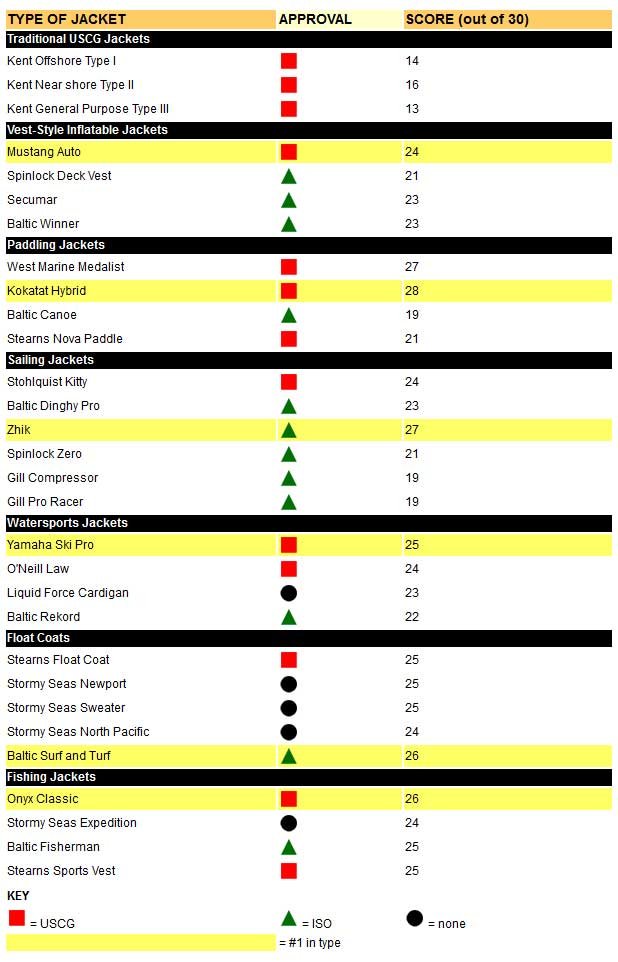
Foundation staff gathered over 30 life jackets and grouped them into six categories for evaluation: inflatables, paddlesports, dinghy sailing, watersports, fishing, and clothing-style. A standard Coast Guard-approved Type I, Type II and Type III jacket were used as a control. Some jackets were inherently buoyant with typical foam flotation and some inflated with CO2 cylinders. Some were approved by the US Coast Guard and some had ISO designation and carried the CE (Conformite Europeene) stamp of approval. We also evaluated some buoyancy aids that had no official approval.
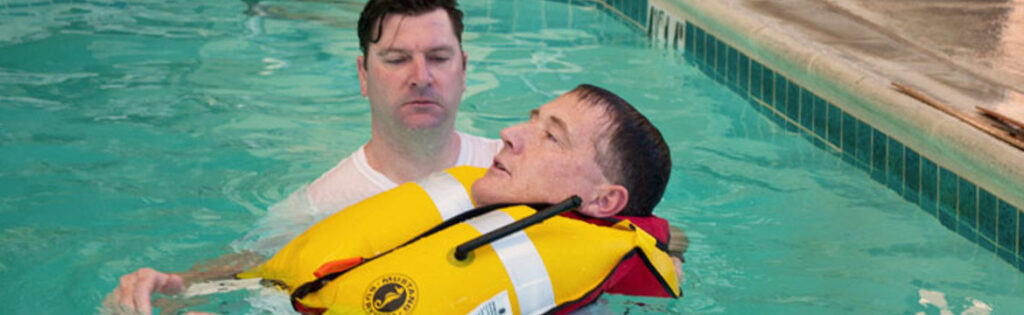
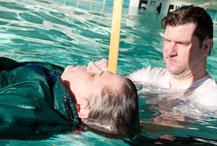
Tests were performed in an indoor swimming pool to provide the controlled setting necessary for data collection and recording in winter weather. The Foundation’s approach to testing began with fitting a life jacket on a tester while out of the water. Most jackets were simple to fit, but some, especially those with internal harnesses and crotch straps, required us to tinker a bit to obtain a proper fit. Then we had testers do a series of sits and squats, twists and broad arm movements to gauge the overall comfort level.
We then asked the volunteers to jump into the pool and evaluate the jacket on fit and maneuverability. We also measured the freeboard (how high the tester floated) and the face angle to determine the positioning of the head in a static state. Our observations and measurements allowed us to make comparisons between jackets in the same category, and allowed us to draw broader conclusions across a range of jackets, such as between European and US designs and our control jackets.
Control Jackets
When many people hear the term life jacket, the first thing that comes to mind is a bright orange Type II jacket. They’re easily recognizable, and they’re on most people’s boats, but they are rarely worn except in an emergency. The U.S. Coast Guard Type I, Type II and Type III vests meet strict performance requirements (see flotation standards below). The Type I life jacket is intended for offshore use, and will turn an unconscious person face up. The Type II life jacket has similar performance but has less floatation and may not always turn an unconscious person face up. And finally, the Type III life jacket will not turn an unconscious person face up, but is less bulky and is intended for use where a quick rescue is likely.
Control Jackets Type I and Type II
The Kent Offshore Type I life jacket ($44.99) and the Kent Nearshore Type II life jacket ($8.99) scored low on comfort among our testers. While the Type I was the only inherently buoyant jacket in our study that consistently turned our testers face up, its bulk made it challenging to swim and heavy after getting out of the water. The Type II jacket, while an inexpensive way to meet the Coast Guard requirements for carrying a life jacket aboard, was not comfortable enough to be worn for extended periods of time.
Control Jackets: Type III
The standard Type III life jacket is popular with the active boaters and tends to be worn more often than the bulkier Type I and Type II jackets. The Kent General Purpose Type III ($21.99) was easier to fit properly that the Type I and II jackets, although one of our testers, a non-boater, initially put the jacket on inside out and another tester misaligned the buckles. The life jacket we tested was an adult universal size, so while adjustable, it was far from a perfect fit on most testers. The Coast Guard Type III is the only life jacket in this control category that our testers would consider wearing routinely while boating.
Inflatable Life Jackets
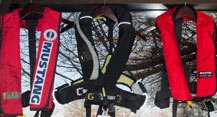
Inflatable life jackets come in two basic styles, suspender-style and belt packs. The suspender-style fits over your shoulders and clips in the front and the belt pack, which is worn like a fanny pack around your waist, but is positioned in the front. Some inflatable life jackets have an auto-inflate feature that activates when submersed in water.
All inflatable life jackets have a manual-inflate pull cord mechanism and an oral inflation tube. We tested three suspender-style inflatable life jackets; however there are many others on the market.
Spinlock Deck Vest
The most complex of the inflatables, the 150N Spinlock Deck Vest ($399.99) features an integral sailing harness and leg straps. It also has a line cutter to free you from entanglement, a spray hood to prevent the ingestion of water, and a strobe light to be spotted from a distance. Because of all the extra features, including the auto-inflate mechanism, the jacket was heavier and considerably harder to don and to adjust than the others.
Baltic Winner
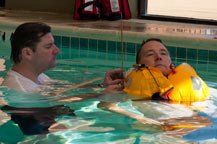
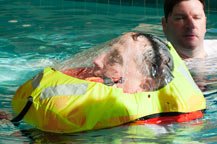
A more basic version of the European-rated jacket was the 150N Baltic Winner ($89.99). The substantially lower price is partially a result of the manual inflation (an auto-inflate version is available) and simple design relative to that of the DeckVest. The Winner has a crotch strap that proved beneficial in keeping the jacket from riding up. The Winner relies on a zipper that separates upon inflation, and in theory, makes the unit easier to repack. However, testers discovered that the zipper sometimes came apart when it wasn’t supposed to.
Mustang Auto Deluxe
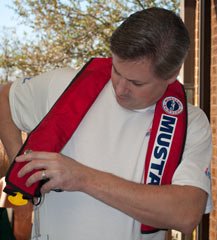
The Mustang Auto Deluxe ($247.50) is the mid-priced jacket in this category, and was a “Staff Pick” because of its all around simplicity for an inflatable life jacket and the ability to repack easily, in part because of the Velcro closure. The in-water performance was similar to the other two inflatables, but testers noted this jacket was initially tight around the neck after inflation and they had to let some air out through the oral inflation tube to improve comfort. The Mustang was the only US Coast Guard-approved life jacket tested in this category, although there are several other manufacturers that make Coast Guard-approved inflatable life jackets.
Before making a purchase in this category, you should consider what type of boating you do. Testers felt the DeckVest was the best choice if you venture offshore for days at a time. It floated our tester high and provided a great sense of security, especially if waiting for a rescue. If nearshore boating is more your style and you’ll be taking the jacket on and off, a simpler jacket with fewer accessories might be a better choice. Once deployed, all of the inflatable life jackets were difficult to swim in, but all turned our testers face up, as designed – adding peace of mind, especially if you are rendered unconscious.
Staff Pick
Paddlesport Jackets
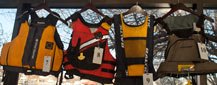
Paddlers expect a lot from their gear and active performance characteristics rank high on their list of requirements. Paddlesport jackets are designed with large arm openings to allow for a great range of motion for paddle strokes. Since paddlers spend the majority of their time seated, paddlesports jackets also tend to have short torsos so they don’t bunch up in the neck and shoulder region.
West Marine Medalist and Baltic Canoe
Inherently buoyant jackets like the West Marine Medalist ($69.99) tend to be somewhat thicker in the front, back and sides. The CE rated Baltic Canoe ($42.65) was longer in the torso, but had did not have any flotation on the sides. When seated, testers felt it rode up into the neck region, despite having a crotch strap. The Medalist was favored over the Canoe since it had a more secure fit. It also was relatively easy to swim in if you capsized and had to swim back to your craft.
Sterns Nova Inflatable
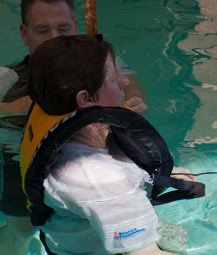
The remaining two paddlesport jackets tested had CO2 canisters to provide the required Coast Guard buoyancy. The Sterns Nova inflatable ($99.99) with its many adjustment straps fit snuggly on the torso and was a comfortable paddling jacket. When inflated, the bladder is the size of a small throw pillow protruding from the front of the jacket. A strap is included so that it can be placed around the back of the neck to hold the inflated bladder in place. With the inflated bladder in the front, testers found it difficult to swim, and its rating is lower as a result.
Kokotat Hybrid Inflatable
The Kokotat Hybrid inflatable was the most expensive in this class at $199.99. Multiple testers found that it fit great and had some initial inherent buoyancy built into the jacket (7lbs). Its 16g canister when punctured provided additional flotation bringing the total buoyancy up to 22 lbs. This jacket was comfortable to wear un-inflated and was very easy to repack after inflation. Swimming in it was a little challenging due to the bulk in the front when inflated, but overall the Kokotat was an all around solid performer with a great fit. It also had a convenient pocket for accessories like a water trail map and whistle, which made this a clear “Staff Pick” in this category.
Dinghy Sailing Jackets
In competitive sailing, especially small-boat dinghy regattas, participants are usually required to wear some sort of personal flotation or buoyancy aid. Since sailors often move around the boat, bend at the waist, change sides quickly, and dash below to retrieve sails, a non-bulky life jacket is vital. Buckles can potentially tangle or snag on rigging so a simple jacket with clean lines is important. The European 50N buoyancy aid is common overseas and favored by the small boat crowd in the US. We evaluated five European sailing jackets and compared them to a readily available US Coast Guard-approved jacket.
The first thing testers noted, was how snugly the dinghy sailing jackets fit. Some were challenging to put on, but once adjusted, they felt like a second skin. Swimming in these jackets was easy due to the reduced bulk compared to a US. Coast Guard-approved Type III jacket. While the chance of going for a swim when dinghy sailing is high, mobility is often key for self-rescuing. In the event assistance is needed, response time is short during organized regattas. Testers in this category appreciated the slightly less flotation in favor of a smaller, but snug fitting life jacket.
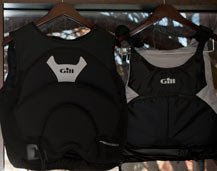
Baltic Dinghy Pro, Spinlock Zero, Gill Compressor and Pro Racer
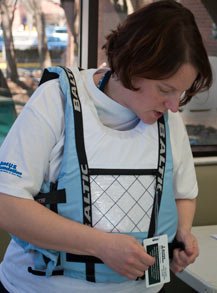
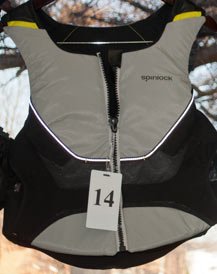
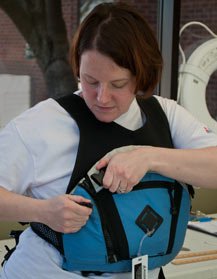
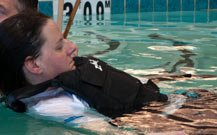
The Baltic Dinghy Pro ($67.27) and the Spinlock Zero ($125.00) were the easiest to put on but were the least snug initially. With some additional adjustment, the Zero fit better, but testers stated these two jackets bunched up behind the neck when seated, which dinghy sailors do a lot. Both of the Gill models (photo inset from left – Compressor, $140.00 and Pro Racer, $80.00) were harder to pull on over the head, but were comfortably snug once adjusted. A test of the Zhik buoyancy aid takes place in a swimming pool.Testers favored the Pro Racer over the Compressor since it stayed in place better when in the water and testers felt the range of motion was also better in the Pro Racer.
Zhik
The Zhik buoyancy aid ($119.00) was the staff favorite in the dinghy sailing category because of its overall fit and comfort. It was easy to put on and fit well without riding up when in the water. The Zhik was also the least bulky of the jackets and was easy to swim in, making it the “Staff Pick” of this category. This is perhaps because it had more room in the shoulders than some of the other jackets.
Stohlquist Kitty
A close runner up to the Zhik was the US Coast Guard-approved Stohlquist Kitty ($99.99), available at West Marine. It rated well due to its overall comfort. It had multiple adjustments, which allowed for a snug fit, yet it offered a wide range of motion. The neoprene in the shoulders provided comfort and stretch, and the jacket didn’t ride up in the back or neck region. Although this was a women’s model, a comparable men’s variety from Stohlquist is available.
Watersports Life Jackets
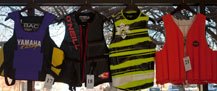
Watersports participants typically play hard and fall harder. Because of this, they demand a life jacket that moves with their body, protects them upon impact with the water, and offers some degree of flotation. In the United States, the typical life jacket for this type of activity is a Coast Guard-approved Type III life jacket. The Coast Guard label on the inside of the jacket will typically specify if a life jacket is intended for this activity.
As the popularity of watersports has grown, manufacturers have responded with specialty jackets suited for aggressive riders. While some of these jackets are Coast Guard-approved, many lack the required flotation for Coast Guard-approval. Retailers of non Coast Guard-approved (non-CGA) jackets are careful to specify that these jackets are only permissible for use on a private body of water or for use by riders at sanctioned competitions. Outside of those two exceptions, non-CGA jacket will not meet the wear or carriage requirements in the United States.
Liquid Force Cardigan
An extreme example of a non-CGA jacket is the Liquid Force Cardigan ($109.00) competition vest. Our testers noted that it was essentially a wetsuit top, though in fairness, it is marketed as such and makes no promise of flotation whatsoever. It is designed without straps, buckles or zippers, and has just enough padding to take the sting out of an unexpected spill. Our testers could not recommend this vest for any activity where flotation is desired or required.
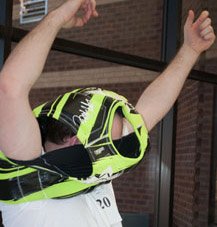
O’Neil Outlaw Comp and Law
The O’Neill Outlaw Comp ($130.00) is also not Coast Guard-approved, but it offers substantially more flotation than the Cardigan. At first glance, you might even guess it is Coast Guard-approved. That is, until you compare it side by side to the O’Neill Law ($130.00). The Law is essentially the same design, with thicker panels to provide the flotation needed to secure Coast Guard approval. Both jackets fit well, but testers favored the Outlaw over the Law because it was less bulky and hot.
Ski Pro Impact Vest
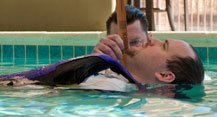
The first thing that struck us about the Coast Guard-approved Ski Pro Impact Vest ($49.99), was the label on the outside that stated “Impact Tested to 100mph.” To make such a claim, the vest must use oversized components and extra stitching to prevent the jacket from disintegrating upon impact with the water.
Although speeding at 100 mph is highly unlikely for most recreational boaters, 50 mph+ isn’t out of the question. The Ski Pro was the “Staff Pick” in this category because it had a snug yet comfortable fit. Testers did comment that the jacket gets hot after awhile, but you could wear this jacket for hours provided you were getting wet periodically.
Baltic Rekord
We included the European marketed Baltic Rekord ($122.63) 50N device in this category even though it is not designed for aggressive watersports performance. It looks somewhat similar to a US Coast Guard-approved Type III but is more suitable for lounging around the boat due to the fact it lacks buckles. Even though the Rekord had a drawstring to cinch the bottom of the jacket, without buckles, it rode up easily when in the water. Swimming in this jacket was challenging, and the metal zipper concerned us when we realized it could hit your teeth, if your head snapped forward.
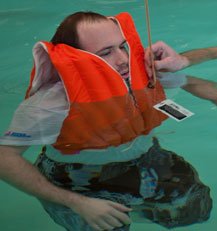
Clothing Style Life Jackets
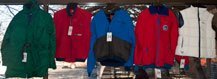
We often hear complaints that life jackets are too hot to wear for an extended period of time. However, the life jackets in this category were designed to provide warmth, which was certainly of great benefit, especially for those who boat in colder weather.
Stearns Float Coat
The Stearns Float Coat ($165.00) is every bit of a coat by definition. It has a full length front zipper, comfortable quilted interior and large fleece-lined pockets. To any casual observer, it looks like your typical waist length winter jacket, but sewn inside is enough flotation to be approved as a Type III life jacket, offering a full 15.5 lbs of buoyancy. It was a favorite of the men testers since it was so simple to wear. It wasn’t tight or restrictive. However, the loose fit was somewhat problematic when attempting to swim in the jacket.
Stormy Seas Newport, North Pacific and Alaskan Sweater
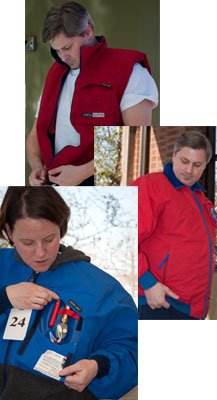
The Stormy Seas line of jackets, created by an Alaskan fisherman, was designed specifically for recreational and working waterman. Each design in the Stormy Seas line is a functional piece of clothing, designed to be warm and wearble with an inflatable bladder sewn in to provide buoyancy when manually deployed. Despite not being Coast Guard-approved, these jackets all have 35lbs of buoyancy, the most of any of the jackets we tested, but testers found they needed to top off the jackets using the manual inflation tube.
The Stormy Seas Newport ($149) is a vest style life jacket that is very comfortable out of the water. It was stylish and hard to differentiate from a typical fleece-lined nylon vest. It had no substantial adjustments so it is not restrictive and inflates easily with a pull of a lanyard. However, when fully inflated the zipper tended to come down which made testers nervous that they would eventually slip out of the vest.
None of the Stormy Seas jackets were auto-inflatable or Coast Guard-approved. All were difficult to swim in while wearing. However, in colder water it is best to conserve energy and draw your legs and arms to your core, and await rescue.
Baltic Surf & Turf
A final product in this category, and a hands-down “Staff Pick”, was the Baltic Surf & Turf ($112.13). The Surf & Turf is a refreshing new design that looked like a down vest and was almost as feather-light. This jacket was easily the most stylish in our line-up and was envied by all, especially the ladies. You could wear it around town as a late fall or early spring jacket and its comfort range could be extended with proper layering. Its in-water performance was good too. Because this 50N rated device provided the least amount of flotation of any in this category it was not very bulky and swimming short distances was relatively easy. An optional crotch strap kept the jacket low and in place. The Surf and Turf was a “Staff Pick” due to its comfort on land and in the water, and its fashionable styling.
Staff Pick

Fishing Style Jackets
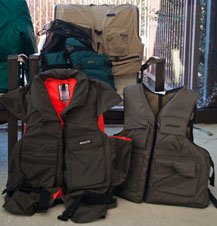
Coast Guard statistics show that anglers are particularly vulnerable as they often boat alone and in cold weather. A few lifejackets sit side by side.For this reason, the BoatUS Foundation has worked closely with the angling community on boating safety for over a decade. Among the excuses given by anglers for not wearing a life jacket is they get in the way of casting a rod. Manufacturers of life jackets have attempted to address these concerns by repositioning flotation in these active wear life jackets and making them more multi-functional.
Stormy Seas Expedition
The Stormy Seas Expedition ($149) looks like a typical fly fishing vest. It has many pockets and was the thinnest and lightest jacket in this category. It also offered the greatest range of hip and waist motion. It was the only fishing vest to use a small CO cylinder to inflate an internal bladder. Like all of the inflatable life jackets we tested, it was challenging to swim in effectively, however, it can always be deflated slightly if necessary and re-inflated with the oral inflation tube.
Baltic Fisherman, Stearns Sport Vest, and Onyx Classic Fishing Vest
The Baltic Fisherman ($90.07), Stearns Sport Vest ($35.71) and Onyx Classic Fishing Vest ($49.99) are all constructed with inherently buoyant material. Each vest features adjustable belts, large armholes and pockets for small gear. The Baltic was longer in the waist than the others and was noticeably heavier than the others when exiting the water. The Stearns and the Onyx had large drain holes or mesh to help alleviate this issue.
The favorite in this group and our “Staff Pick” was the Onyx, available at West Marine. It edged out the Stearns slightly because the straps prevented the vest from riding up or shifting. The back of the vest also has some flotation that was designed to ride up slightly to keep the neck and head positioned up when treading water, which made our testers feel more secure. The price of the Onyx was also reasonable, especially when you consider it is a fishing vest and life jacket in one.
Staff Pick
Final Thoughts
Of the 30 jackets evaluated by the Foundation, all but one would most likely help keep you afloat when worn and adjusted properly. The one exception in the watersports category, the Liquid Cardigan, was so thin that we couldn’t recommend it. It was not Coast Guard-approved.
Overall many of the ISO-approved jackets, available primarily on the European market, performed like similarly styled USCG-approved jackets. In fact, two of our six “staff Picks” were not USCG-approved, but ISO-approved jackets. These jackets do not currently meet the USCG carriage requirements, and can be difficult to find in the US. Upon closer inspection one type of the ISO approved jackets, the level 50 approved buoyancy aids, did offer less flotation, but rated consistently higher in overall comfort.
Comfort can be costly. All of our “Staff Picks” in each category cost more than the basic Type II or Type III USCG-approved jackets. The highest price jackets were not always the top performers, but it does seem that the most comfortable jackets, the ones that are more likely to be worn, require an investment. Our least expensive “Staff Picks” were in the watersports and fishing categories and at $49.99 are still more than twice the price of the basic universal fit Type III USCG jacket tested.
Considering your boating activity is essential in choosing the best jacket for you. Many of the inflatable life jackets offered unmatched flotation, but proved to be too cumbersome should you need to perform a self rescue or swim any distance. Many of the buoyancy aids and less bulky jackets allowed testers greater comfort when dry and increased mobility in the water, but lacked the freeboard see with USCG-approved jackets.
Below are some tip for selecting the best jacket for you learned from our tests. When possible, we used several testers to evaluate each jacket for a variety of sizes and body types. Your experience may be different from our testers. The bottom line is to select a life jacket that you will wear and that is a good fit.
Tips for selecting the right jacket for you:
- Select a jacket based on your intended activity. Check out the label on the jacket or marketing material to see if it appropriate for your intended use.
- Purchase a jacket that is sized for you, not a “universal” fit. Make your life jacket a piece of personal safety gear, and not intended general use.
- The more adjustments, the better they tend to fit. However, the more adjustments there are, the harder they are to get into. Also, extra buckles and straps can snag.
- A comfortable fit is paramount. If it’s not comfortable, you won’t wear it. If boating in hot weather, consider an inflatable life jacket. If boating in the cold, consider a float coat.
- Consider a crotch strap. Even though it sounds uncomfortable, every life jacket with a crotch strap performed well – it keeps the life jacket from riding up in the water.
- You don’t have to look like a geek. There are a ton of new designs that border on ‘safety chic’, especially those offered by European designers.
- Know the laws regarding use and approval of life jackets. In the United States, there must be a properly sized life jacket for each person aboard a recreational vessel. Depending on age, type of jacket you have, time of year, where you boat, and what type of boating, you may be required to wear a Coast Guard-approved life jacket.
Foundation Findings #30 – May 1998
After more than a decade on boating’s most-wanted list, U.S. Coast Guard approved manual inflatable life jackets are now available and coming on the market in earnest.
This means that recreational boaters can now meet federal life jacket carriage requirements with reliable, comfortable and “wearable” equipment that could have a significant impact in reducing boating fatalities.
Coast Guard statistics show that over 75% of all boating fatalities result from a person falling overboard and drowning. BoatUS has been pushing for federal approval and widespread production of moderately-priced inflatable life jackets because the Association is concerned that many boaters who would not wear bulky life jackets will choose to wear these lightweight and compact devices.
Since most boaters will not be able to try out an inflatable before they make a selection, the BoatUS Foundation decided to conduct in-the-water tests on an array of the readily available devices. What follows is their report on what these devices are really like in actual use.
New / Old Technology
Unlike the familiar inherently buoyant Coast Guard-approved vest or yoke-style life jackets, inflatables use a carbon dioxide (CO2) cylinder to blow up an air bladder with the tug of a lanyard. The bladder, which in most devices encircles the neck, is cinched to the torso with straps and keeps the user’s head and mouth above water once inflated.
Although inflatable life jackets have been widely used on military and commercial aircraft for over 50 years, and have been common on recreational vessels in Europe for a couple of decades, the Coast Guard stamp of approval only came in September, 1996.
This isn’t to say that life jackets that inflate with a CO2 cylinder weren’t on the market in the U.S. They were. A number of companies have been producing inflatable life jackets for some time and foredeck crews on ocean racing yachts have used inflatables for years. But they were not Coast Guard approved and could not count toward federal carriage requirements.
Taking the Test
This Foundation Findings test was limited to manually-activated life jackets which inflate by pulling a lanyard. Since life jackets that inflate automatically upon immersion are not yet Coast Guard approved, we did not include them in our test.
We compared seven inflatables from four manufacturers in both calm and rough water conditions. All seven were Coast Guard Type III life jackets.
Inherently buoyant Type III’s, the familiar vest-style life jackets intended for supervised activities where help is near at hand, must provide a minimum of 15.5 pounds of buoyancy. Inflatable Type IIIs, however, must have at least 22.5 pounds of buoyancy and all our test models exceeded that standard.
For our calm water testing we used a hotel swimming pool. And for the rough water tests, we used the wave pool at Walt Disney World’s Typhoon Lagoon in Orlando, Fl, hosted by Wayne Mitchell, Disney’s senior safety administrator and a member of the National Safe Boating Council.
We knew going in that all of the life jackets met Coast Guard certification standards. They should inflate on demand, float the average adult with the head out of the water and turn most people face-up.
While we did measure performance characteristics like inflation time,we were most concerned with some of the more subtle characteristics of approved manual inflatables.
Are they easy to put on and adjust? Are they comfortable to wear in normal boating activity? How do they feel when worn inflated in the water? And, very important, we wanted to find out how easy it is to rearm each model after discharge and repack it to its ready state.
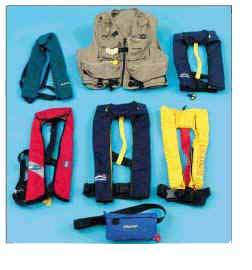
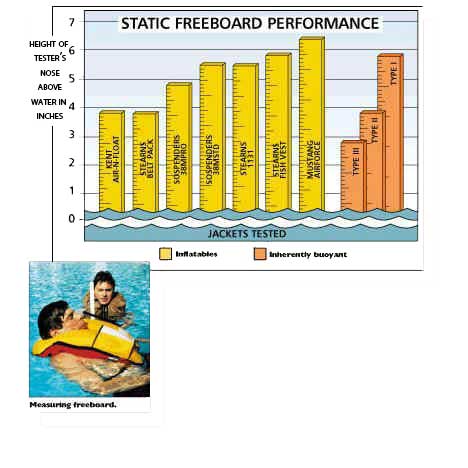
For testing, we selected two models of SOSpenders, a Stearns Model 1131, a Kent Air-N-Float and the Mustang AirForce. To that we added a fishing vest-style inflatable and a belt pack unit, both by Stearns. And for comparison, we brought along three conventional Coast Guard approved inherently buoyant life jackets in Types I, II, and III.
Performance Factors
An inflatable life jacket properly adjusted and fully activated is tough to beat when it comes to keeping you afloat and safe. All the inflatable achieved fully deployed status within the five seconds called for in the Coast Guard standards.
In the calm water test, we used a 220 pound male, a boater who is familiar with inflatables and a good swimmer. (Inflatables are not recommended for non-swimmers and are not approved for children and people who weigh less than 90 pounds.)
We measured the freeboard between the water and the subject’s nose (see graph) the face angle, the angle at which the device held the subject’s head relative to the surface of the water.
In addition, we measured turning moment, the time required for each unit to turn our test subject from face-down in the water to a face-up position with mouth and nose clear of the water.
With the exception of inflation rate, we compared these performance factors against the inherently buoyant life jackets. The bulky but dependable Type I offshore life jacket has always offered the most protection and it became the bellwether for our comparisons.
In the turning moment test, the inflatables as a group performed better than the inherently buoyant life jackets with an average time of 4.5 seconds. (The Coast Guard standard is 6.5 seconds for 80% of users) By comparison, the inherently buoyant Type I turned our test subject over in 6 seconds.
In the face angle test, the inflatables floated our subject from 55 degrees to 35 degrees as measured from the water’s surface behind the head. There is no Coast Guard face angle standard for Type III inflatables but with the Type I inherently buoyant life jacket our subjects’ face angle measured 40 degrees.
For good measure, we added a jump test with arms overhead and each device in the ready position. All stayed on our subject as originally adjusted and each deployed as expected when the subject triggered the devices from a few feet below the surface.
Rough Water Tests
For rough water testing at the wave pool, we used three certified life guards from the Disney World staff, Andy Powell, Elaine Benson, and Rusty Tillman. (They were particularly interested in our tests since all three are also patrol boat operators on Disney World’s Bay Lake and Seven Seas Lagoon.)
It was here that we got the most insight into the “user friendliness” of inflatables as all three subjects, completely unfamiliar with the device, experienced some difficulty donning the jackets on shore for the first time.
In seas up to four feet, all inflatables proved more than adequate to keep the test subjects’ heads above even cresting waves. Everyone was able to maintain a heads-up position with little difficulty.
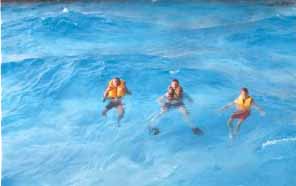
Our three test subjects reported feeling as safe wearing any of the inflatables in the waves as they did wearing the bulkier Type I inherently buoyant life jacket.
In fact, the type III inherently buoyant vest-style life jacket proved the real eye-opener for our test crew who had to work hard treading water to keep their faces clear of the waves when using this device. When another test was conducted simulating an unconscious victim, those wearing the Type III inherently buoyant devices repeatedly sank well beneath the surface as the waves rolled over them.
The big surprise in the big waves was the belt pack. Quite naturally, our testers found this to be the most comfortable to wear in its ready position on land. Once activated and adjusted in the water, they all loved it.
Donning the belt pack is a two-step process. The pouch is strapped around the waist and a yank on the inflation lanyard deploys the bladder. The wearer, treading water, slips the inflated bladder over the head and adjusts the fit with a strap to the waist belt. While it may sound complicated, we found that it works surprisingly well.
Although we noted that wearers could place the bladder over the head backwards, with chest buckle and inflation tube against the body, each tester gave the belt pack high marks, It rated very comfortable in heavy seas when inflated, particularly since the waist belt tends to pull the bladder in to the body at a lower angle than the underarm straps of the conventional inflatables.
Rearm and Repack
Boaters who choose to rely on inflatables must be thoroughly familiar with rearming the CO2 inflator. Each device is rearmed the same basic way but you must follow the instruction with your unit carefully.
The seven models in our test used three different sized CO2 cartridges. We found that it is possible to arm an inflatable life jacket with the wrong cartridge which could result in only partial inflation.
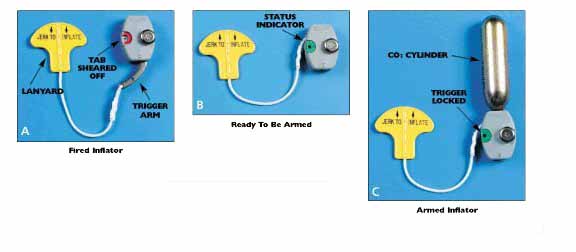
A small green status indicator tab shears off when the lanyard is pulled, revealing a red indicator that shows the unit has been deployed. We strongly recommend you remove the spent cylinder and dispose of it as soon as possible after use to avoid confusion later.
Before screwing in a new cylinder, the inflation trigger must be in the closed position. The green tab is inserted through the arm to show that it is closed. (These tabs are too small and fragile, we thought, for large or cold fingers at work in heavy seas or in the dark.)
After use, each vest-style inflatable repacks into its exterior fabric shell rather simply by following the instruction diagrams attached to the inside of the jacket. The belt pack must be folded carefully, accordion-fashion, into its pouch. We found we could miss-fold it such that the bladder became twisted upon deployment and therefore would not deploy properly.
For all models, hook-and-loop tabs hold the folded shell in the ready state and, if done properly, the inflation lanyard handle will dangle just enough to be grasped.
Conclusions
As we expected, all the inflatable life jackets in our test met or exceeded the Coast Guard minimum standards. In the more subjective area of “user friendliness”, we found all the inflatables easy to don and adjust, with a little practice, out of the water. But in the water, they are significantly harder to put on. In fact, our tester found it next to impossible to don the uninflated units while treading water, emphasizing that the point of using inflatables is to WEAR them on-board.
Once inflated, we found the models with wider back straps more comfortable. Indeed, the thin straps on the Stearns 1131 quickly made our testers very uncomfortable. (In an emergency situation, however, comfort may be the last thing on your mind.)
Should you choose to equip your boat with this type of gear, we strongly recommend doing CO2 inflation “dress rehearsals” in the water with each member of your crew so they know how to don, adjust and activate their life jacket. that way they will not only know what to expect, they will gain confidence in the device. Investing in a few extra CO2 rearming kits would be money well spent.
All our testers agreed. If they had to drift around in the water, waiting for rescue, they would want to be wearing the bulky but tried-and-true, inherently buoyant Type I life jacket – but few boaters would want to wear a Type I in their everyday activities on the water. And now, at last, Coast Guard approved inflatables offer the boater an excellent option, superior performance in the water with a high comfort quotient on deck or in the cockpit.
But remember, inflatable life jackets are not fool-proof. They require more attention than inherently buoyant devices and you must be thoroughly familiar with their use. However, if you are willing to make the effort, the added buoyancy plus the “wearability” factor make inflatable life jackets an attractive safety option that could help deflate boating accident statistics–and maybe even save your life.
Infaltables Need Attention
Like every other piece of equipment on your boat, inflatable life jackets require periodic inspection and maintenance. The manufacturers recommend inspection by performing a leak test. Blow up the life jacket through the oral inflation tube and let it sit for 16 hours. IF there is air loss, it should be repaired professionally or replaced. (doing repairs yourself is ILLEGAL, and makes the life jacket subject to seizure.)
Remember to keep your inflatables in top condition.
Keep safe. Use a re-arming kit available through West Marine or other boating supply store and inspect your lifesaving gear before leaving the dock.
If the life jacket passes the leak test, check the straps, buckles and seams, and check the inflator mechanism to be sure it is properly armed with the correct CO2 cylinder. Unscrew the cylinder and inspect it as well as the inflator for damage and corrosion. Be sure to store the life jacket completely dried in a dry, well-ventilated place (and that may not be a locker on your boat).
For our testers, locating the firing lanyard and the oral inflation tube proved a minor problem a few times, particularly with the fishing vest. But that just points up the need to acquaint yourself, your crew and your guests with the nuances of inflatables.
Finally, every time you go out, make it a habit to check the status indicators to be sure the unit is ready. Even better, unscrew the CO2 cylinder to be absolutely certain the seal has not been pierced.